
Nifty 50 FY27 EPS Outlook Improves After August Upgrades
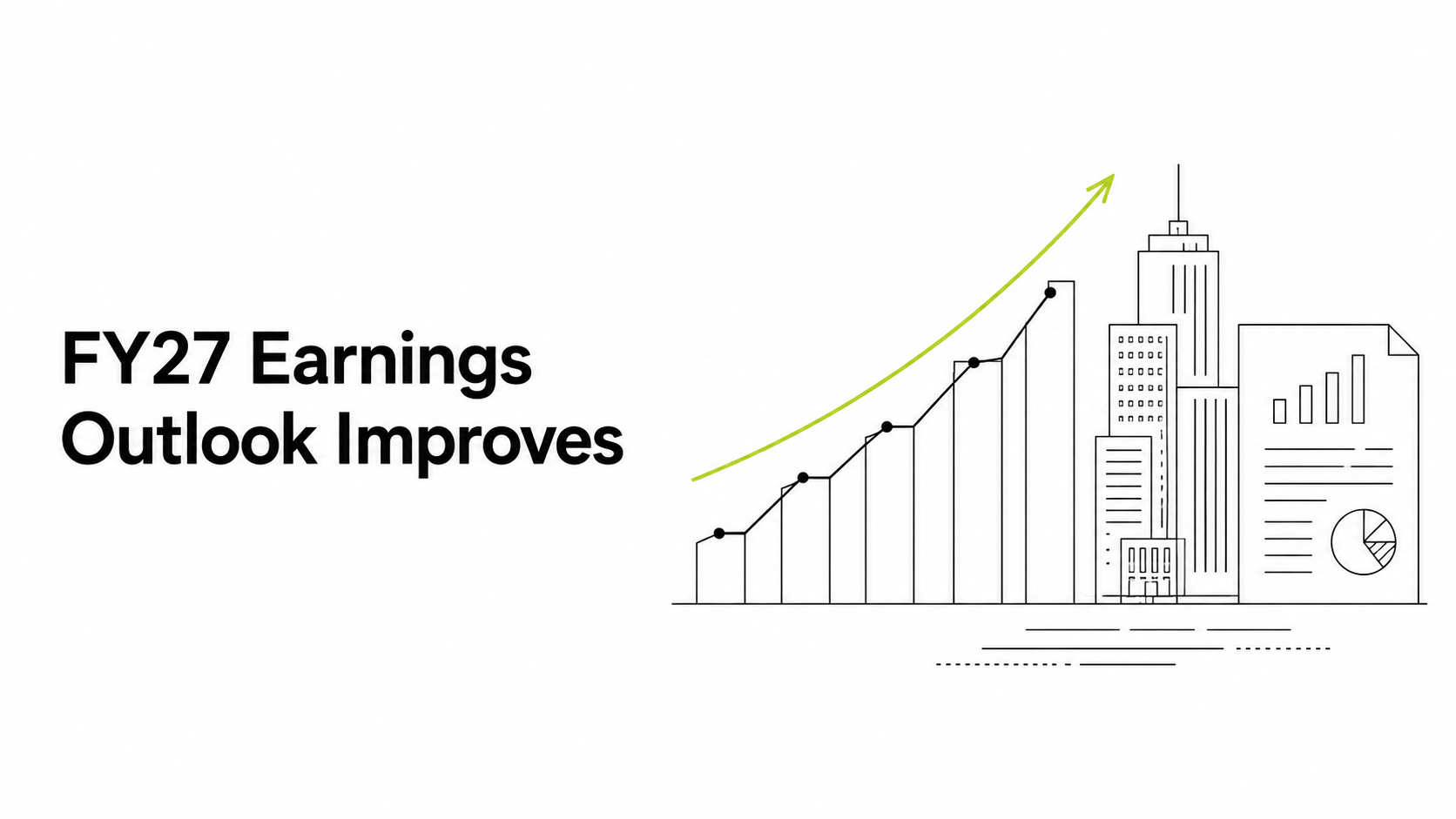
The earnings outlook for Nifty 50 companies showed signs of improvement in August 2026, with 23 of the 50 index constituents receiving upgrades to their FY27 earnings per share (EPS) estimates. Overall Nifty 50 FY27 EPS estimates increased 0.1% month-on-month, reversing part of the weakness seen in July.
The change is important for investors because earnings expectations play a major role in stock valuations. However, the latest numbers do not suggest that earnings concerns have disappeared. They indicate that the pace of downgrades may finally be moderating after a difficult period for corporate earnings estimates.
What Happened to Nifty 50 FY27 EPS Estimates in August?
According to JM Financial’s Nifty 50 analysis, 23 companies, representing 46% of the index, saw upgrades to their FY27 EPS estimates in August.
At the index level, FY27 EPS estimates increased 0.1% month-on-month. That compares with a 0.7% decline in July.
The improvement was also visible further out. FY28 EPS estimates increased 0.2% month-on-month in August after falling 0.5% in July.
These are small increases, but the direction matters.
Earnings estimates had been under pressure for several months. A shift from widespread cuts towards a more balanced mix of upgrades and downgrades could indicate that analysts are becoming more comfortable with the earnings outlook for selected sectors.
Which Sectors Led the FY27 EPS Upgrades?
The improvement was not evenly distributed across the Nifty 50.
Cement stood out as the strongest sector in terms of earnings revisions. FY27 EPS estimates for cement increased around 9% month-on-month.
Other sectors also recorded upgrades.
| Sector | FY27 EPS estimate change in August |
|---|---|
| Cement | +9.0% |
| NBFCs | +1.8% |
| Oil and gas | +0.5% |
| Metals and mining | +0.5% |
Both cement companies represented in the Nifty 50 received earnings upgrades. The same was true for the two oil and gas constituents.
The index’s telecom constituent also received an upgrade.
Infrastructure and ports had upgrades for two of their three companies, while three of the five automobile companies recorded higher FY27 EPS estimates.
“Start investing with confidence! Explore
0 demat account
and grow your wealth.”
Which Nifty 50 Stocks Received Major EPS Upgrades?
At the company level, some of the notable upward revisions were recorded by Grasim, Bajaj Finserv, Hindalco, State Bank of India and Titan.
The mix is worth noting because the upgrades were not limited to one part of the economy.
Companies exposed to financial services, commodities, consumer demand and industrial activity were represented among the major upgrades.
That provides a broader signal than an improvement driven by just one large company.
Still, investors should look at the reason behind an EPS upgrade before interpreting it as a bullish signal.
An earnings estimate can rise because of stronger volumes, better margins, higher commodity prices, lower costs or company-specific factors. The quality and sustainability of the upgrade matter as much as the headline percentage.
Are Nifty 50 Earnings Downgrades Over?
No. The August numbers point towards stabilisation, not the end of the downgrade cycle.
Seventeen Nifty 50 companies, or 34% of the index, still received FY27 EPS downgrades during the month.
Consumer companies experienced the sharpest sector-level cut, with FY27 EPS estimates falling 4.7% month-on-month. Automobiles recorded a 2.2% reduction at the sector level, even though three individual auto constituents received upgrades.
ITC, Tata Steel, Kotak Mahindra Bank, Maruti Suzuki and Adani Enterprises were among the companies recording notable FY27 EPS cuts.
Banks also showed mixed trends. Three of the five banking companies in the Nifty 50 received downward revisions.
This divergence shows why investors should avoid treating the Nifty 50 as one uniform earnings story.
The Longer-Term Earnings Picture Remains Challenging
August’s improvement needs to be viewed against the larger reset in earnings expectations.
Between August 2025 and August 2026, Nifty 50 FY27 EPS estimates were cut by 9.3%. FY28 estimates declined 7.5% over the same period.
Earlier in 2026, the downgrade cycle had been particularly visible. By May, nearly two-thirds of benchmark companies had experienced FY27 earnings downgrades, while infrastructure, cement, banking and utility companies were among the areas facing pressure.
August therefore represents an improvement from a weak base rather than a complete earnings recovery.
Why Do EPS Upgrades Matter to Investors?
EPS is one of the most widely followed measures of corporate profitability.
When analysts increase future EPS estimates, a stock’s valuation can become more attractive if its market price remains unchanged.
For example, suppose a company’s share price is ₹1,000 and expected EPS is ₹50. Its forward price-to-earnings ratio would be 20 times.
If expected EPS increases to ₹55 while the share price stays at ₹1,000, the forward valuation falls to roughly 18.2 times.
That does not automatically make the stock a good investment, but it illustrates why earnings revisions matter.
Earnings and valuations work together
Investors generally need to consider:
- Expected earnings growth
- Current stock valuation
- Sustainability of margins
- Revenue growth
- Balance-sheet strength
- Industry conditions
- Management execution
- Risks to future estimates
A company receiving an EPS upgrade can still be expensive if its stock price already reflects very optimistic assumptions.
Similarly, a company receiving a temporary downgrade could still offer value if the longer-term business outlook remains strong.
What Could Support Nifty Earnings From Here?
Several factors could influence the direction of FY27 and FY28 earnings estimates.
Domestic consumption is one important variable. A sustained improvement in consumer spending could support companies across automobiles, retail, financial services and discretionary consumption.
Infrastructure and industrial activity also matter, particularly for cement, capital goods, commercial vehicles and metals.
Commodity prices can have a mixed impact. Higher prices may benefit producers while increasing input costs for consumer and manufacturing companies.
Interest rates, credit growth, global demand and currency movements can also influence sector-level earnings.
This means the Nifty 50 earnings recovery is unlikely to move in a straight line.
What Should Investors Watch Next?
Rather than focusing only on the number of companies receiving upgrades, investors can monitor whether earnings revisions remain positive over several months.
Three signals are particularly useful.
First, watch whether the proportion of companies receiving upgrades continues to increase.
Second, look at whether upgrades broaden beyond a few sectors.
Third, compare earnings growth with valuations. Strong earnings growth is more meaningful when valuations leave room for disappointment.
The August data is encouraging because the downgrade cycle appears to have eased. It is still too early, however, to call it a decisive earnings turnaround.
FAQs
How many Nifty 50 companies received FY27 EPS upgrades in August?
Twenty-three Nifty 50 companies, representing 46% of the index, received upgrades to their FY27 EPS estimates in August 2026.
How much did Nifty 50 FY27 EPS estimates increase?
Overall FY27 EPS estimates increased 0.1% month-on-month in August after declining 0.7% in July.
Which sector received the biggest EPS upgrade?
Cement recorded the largest sector-level improvement, with FY27 EPS estimates increasing around 9% month-on-month.
Did all Nifty 50 sectors see earnings upgrades?
No. Consumer companies experienced a 4.7% decline in FY27 EPS estimates, while the automobile sector’s aggregate estimate fell 2.2%.
Does an EPS upgrade mean a stock price will rise?
Not necessarily. Stock prices depend on earnings, valuations, expectations, market sentiment and several other factors. An EPS upgrade is one input in the investment decision.
Is the Nifty 50 earnings downgrade cycle over?
The August data suggests the downgrade cycle is easing, but it is too early to conclude that it has ended. FY27 EPS estimates remained 9.3% below their August 2025 level.
Key Takeaways
- 23 of the 50 Nifty 50 companies received FY27 EPS upgrades in August.
- Nifty 50 FY27 EPS estimates increased 0.1% month-on-month.
- FY28 EPS estimates improved 0.2%.
- Cement led sector-level upgrades with a 9% increase.
- Consumer companies remained under earnings pressure.
- 17 Nifty 50 companies still received FY27 EPS downgrades.
- The August data points towards earnings stabilisation, but a sustained recovery needs confirmation from future revisions and corporate results.
Disclaimer
The stocks mentioned in this article are not recommendations. Please conduct your own research and due diligence before investing. Investment in securities market are subject to market risks, read all the related documents carefully before investing. Please read the Risk Disclosure documents carefully before investing in Equity Shares, Derivatives, Mutual fund, and/or other instruments traded on the Stock Exchanges. As investments are subject to market risks and price fluctuation risk, there is no assurance or guarantee that the investment objectives shall be achieved. Lemonn (Formerly known as NU Investors Technologies Pvt. Ltd) do not guarantee any assured returns on any investments. Past performance of securities/instruments is not indicative of their future performance.
Related Posts

Download Lemonn
Download my app for share market trading, ipo investment, trading account, and all your investment needs.



