
Commercial Vehicle Sales Gain Momentum in August 2026
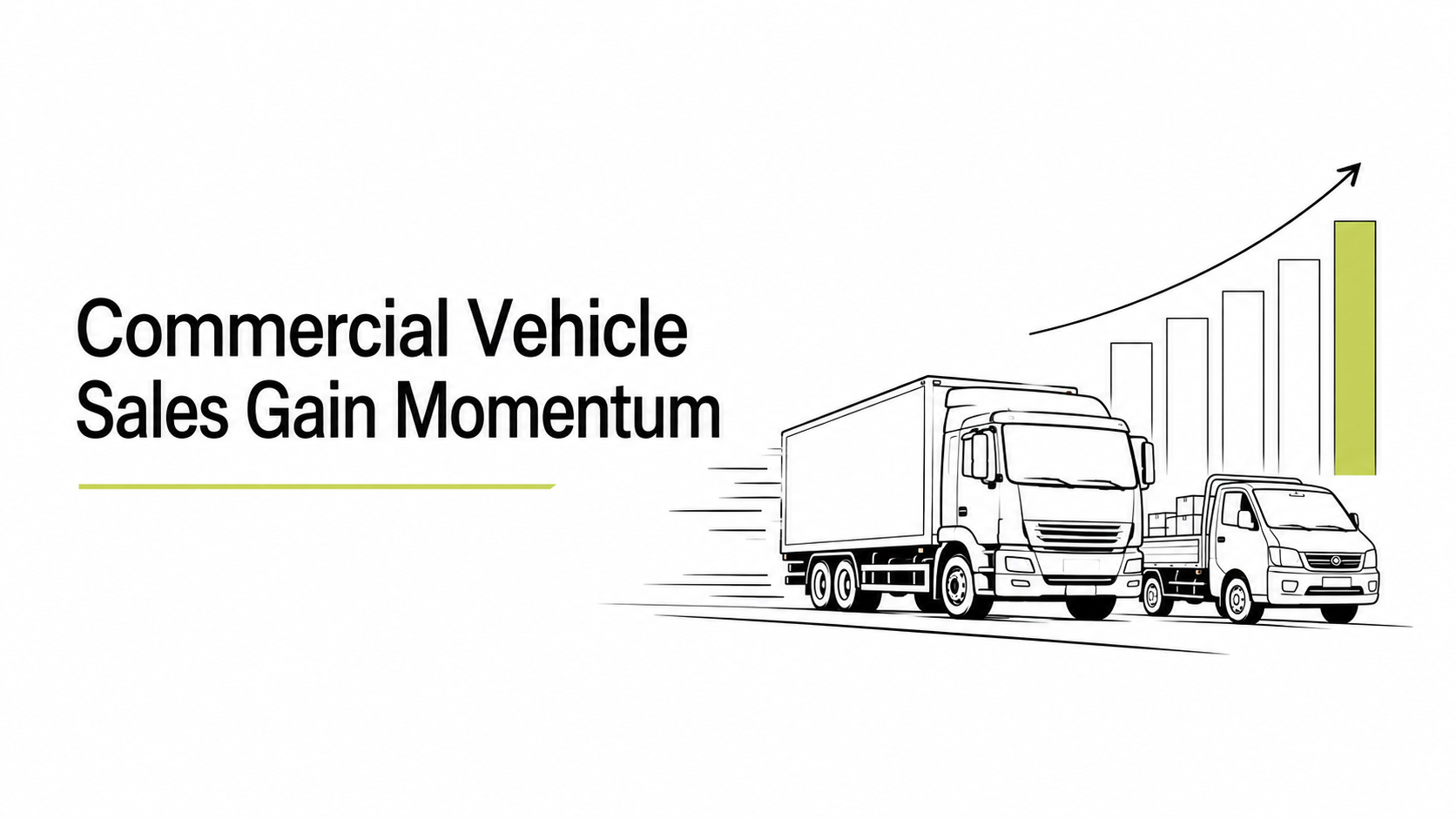
India’s commercial vehicle sales gained momentum in August 2026, with major manufacturers reporting strong double-digit year-on-year growth. Tata Motors, Ashok Leyland, Mahindra and VE Commercial Vehicles all recorded higher domestic volumes as freight activity, infrastructure demand and fleet replacement supported the market.
The numbers also suggest that the commercial vehicle industry is entering the festive period with stronger demand than a year ago. A favourable base contributed to the sharp growth rates, but sequential sales and vehicle registrations indicate that demand improvement was not driven by base effects alone.
How Did Commercial Vehicle Sales Perform in August?
Domestic commercial vehicle sales increased across major manufacturers.
| Manufacturer/segment | August 2026 | August 2025 | YoY growth |
|---|---|---|---|
| Tata Motors CV | 36,619 | 27,481 | 33% |
| Ashok Leyland | 19,438 | 13,622 | 43% |
| Mahindra CV below 3.5 tonnes | 27,415 | 22,427 | 22% |
| Mahindra Trucks & Buses | 2,495 | 1,701 | 47% |
| VECV/Eicher | 7,584 | 6,331 | 20% |
The data shows that the improvement was spread across multiple manufacturers rather than being concentrated in one company.
The heavier end of the market was especially strong, which can be an important signal for freight, construction and infrastructure-related activity.
Tata Motors CV Sales Rise 49%
Tata Motors reported total commercial vehicle sales of 44,411 units in August 2026, up 49% from 29,863 units in August 2025.
Domestic CV sales increased 33% year-on-year to 36,619 units.
The company’s international business recorded much faster growth. International commercial vehicle volumes increased from 2,382 units to 7,792 units, representing a 227% year-on-year jump.
Within the domestic business, heavy commercial vehicle truck sales rose 42% to 10,612 units. Small commercial vehicle cargo and pickup volumes increased 34% to 14,447 units.
The mix indicates strength across different parts of Tata Motors’ commercial vehicle portfolio.
“Start investing with confidence! Explore
0 demat account
and grow your wealth.”
Ashok Leyland Records 43% Domestic Growth
Ashok Leyland also reported a strong August.
Domestic commercial vehicle sales increased 43% year-on-year to 19,438 units from 13,622 units.
The medium and heavy commercial vehicle, or M&HCV, segment was particularly strong.
Domestic M&HCV sales jumped 55% to 12,408 units. Within this category, truck volumes rose 60% to 10,285 units, while bus sales increased 36% to 2,123 units.
Light commercial vehicle volumes increased 25% to 7,030 units.
This strength in heavier trucks is notable because demand for these vehicles tends to be closely connected with freight movement, construction and industrial activity.
Mahindra Commercial Vehicle Sales Also Improve
Mahindra’s domestic commercial vehicle sales in the sub-3.5-tonne category increased 22% to 27,415 units in August, compared with 22,427 units a year earlier.
Its trucks and buses operation, comprising Mahindra Truck & Bus Division and SML Mahindra, reported 2,495 units of overall sales including exports.
That represented growth of 47% from 1,701 units in August 2025.
The performance suggests that demand improvement extended beyond the two largest names in the heavy commercial vehicle segment.
VECV Records Nearly 20% Domestic Growth
VE Commercial Vehicles, the joint venture between Volvo Group and Eicher Motors, reported domestic sales of 7,584 units.
That was 19.8% higher than the 6,331 units sold during August 2025.
Together, the numbers from Tata Motors, Ashok Leyland, Mahindra and VECV point towards broad-based growth across the commercial vehicle industry.
What Is Driving Commercial Vehicle Demand?
Commercial vehicle demand depends heavily on economic activity.
Unlike passenger cars, trucks and many light commercial vehicles are primarily income-generating assets for businesses and fleet operators.
Several factors supported August sales.
1. Freight movement
Higher movement of goods can increase vehicle utilisation for transport companies.
When fleet utilisation and freight availability improve, operators may become more willing to replace ageing trucks or add vehicles.
2. Infrastructure activity
Road construction, mining, real estate and large infrastructure projects create demand for heavy trucks, tippers and other commercial vehicles.
Continued infrastructure spending can therefore support the M&HCV segment.
3. Fleet replacement
Commercial vehicles operate intensively and eventually become expensive to maintain.
When fleet operator confidence improves, businesses may replace older vehicles with newer models that offer better fuel efficiency, safety and operating economics.
4. Festive season preparation
Businesses often prepare inventories and logistics networks ahead of the festive period.
Stronger goods movement can support demand for vehicles used in both long-distance transport and last-mile delivery.
Is Growth Only Because of a Low Base?
The favourable base played a role.
Commercial vehicle volumes in August 2025 were subdued partly because of uncertainty around GST changes. This makes the year-on-year comparisons for August 2026 look particularly strong.
However, there are other signs of genuine improvement.
Domestic volumes at Tata Motors and Ashok Leyland increased nearly 8% compared with July. Mahindra’s sub-3.5-tonne commercial vehicle sales rose nearly 9% sequentially.
VECV’s domestic volumes were broadly stable month-on-month.
Commercial vehicle registrations on the government’s VAHAN platform also increased 22% year-on-year in August, according to InCred Research data cited by Business Standard.
That suggests retail demand was also healthy.
Why Are Heavy Commercial Vehicle Sales Important?
Medium and heavy commercial vehicles often provide useful clues about economic activity.
A business generally does not purchase an expensive heavy truck unless it expects sufficient utilisation to justify the investment.
Rising truck demand can therefore be associated with expectations of stronger freight movement, infrastructure work or industrial activity.
That does not make commercial vehicle sales a perfect economic indicator. Financing conditions, replacement cycles, regulations and base effects can significantly influence monthly numbers.
Still, sustained M&HCV demand over several months can provide useful information about business confidence.
What Are the Risks to Commercial Vehicle Growth?
The outlook is improving, but risks remain.
Fuel prices are one important variable because fuel is a major operating expense for fleet owners.
Higher input costs can also affect vehicle prices and manufacturer margins.
Other factors to monitor include:
- Interest rates and vehicle financing costs
- Freight rates
- Industrial production
- Infrastructure execution
- Commodity prices
- Export demand
- Geopolitical disruptions
- Fleet utilisation
West Asia tensions have already created uncertainty for manufacturers with greater export exposure, while input-cost inflation remains another factor to watch.
What Should Investors Watch Next?
For auto-sector investors, one strong month should be viewed alongside a longer sales trend.
The first indicator to watch is whether M&HCV growth continues after the favourable August base effect fades.
Second, investors can monitor retail registrations alongside wholesale dispatches. A large and sustained gap between the two can indicate inventory accumulation.
Third, margins matter. Strong volume growth does not necessarily translate into equally strong profit growth if raw-material costs rise or manufacturers rely heavily on discounts.
For now, August points to healthier commercial vehicle demand as the industry enters an important period for sales.
FAQs
How much did Tata Motors commercial vehicle sales grow in August 2026?
Tata Motors’ total commercial vehicle sales increased 49% year-on-year to 44,411 units. Domestic CV sales increased 33% to 36,619 units.
How did Ashok Leyland perform in August?
Ashok Leyland’s domestic sales increased 43% to 19,438 units, while domestic M&HCV volumes rose 55%.
Did Mahindra commercial vehicle sales increase?
Yes. Mahindra’s domestic sub-3.5-tonne CV sales increased 22% year-on-year to 27,415 units.
Why are commercial vehicle sales rising in India?
Freight movement, infrastructure activity, fleet replacement and improving fleet operator sentiment are among the factors supporting demand.
Did commercial vehicle retail registrations increase?
Yes. VAHAN commercial vehicle registrations increased 22% year-on-year in August, according to InCred Research data reported by Business Standard.
What could affect CV sales going forward?
Fuel prices, financing costs, freight demand, infrastructure spending, input costs and geopolitical developments could influence future commercial vehicle sales.
Key Takeaways
- India’s commercial vehicle market recorded broad-based growth in August.
- Tata Motors’ domestic CV sales increased 33% year-on-year.
- Ashok Leyland’s domestic sales rose 43%.
- Mahindra’s sub-3.5-tonne domestic CV volumes increased 22%.
- VECV domestic volumes grew nearly 20%.
- Heavy commercial vehicles were among the strongest segments.
- A low base helped headline growth, but sequential volumes and VAHAN registrations also pointed to underlying demand strength.
Disclaimer
The stocks mentioned in this article are not recommendations. Please conduct your own research and due diligence before investing. Investment in securities market are subject to market risks, read all the related documents carefully before investing. Please read the Risk Disclosure documents carefully before investing in Equity Shares, Derivatives, Mutual fund, and/or other instruments traded on the Stock Exchanges. As investments are subject to market risks and price fluctuation risk, there is no assurance or guarantee that the investment objectives shall be achieved. Lemonn (Formerly known as NU Investors Technologies Pvt. Ltd) do not guarantee any assured returns on any investments. Past performance of securities/instruments is not indicative of their future performance.
Related Posts

Download Lemonn
Download my app for share market trading, ipo investment, trading account, and all your investment needs.



