
BTST and ATST Trading: Margin, Settlement & Auction
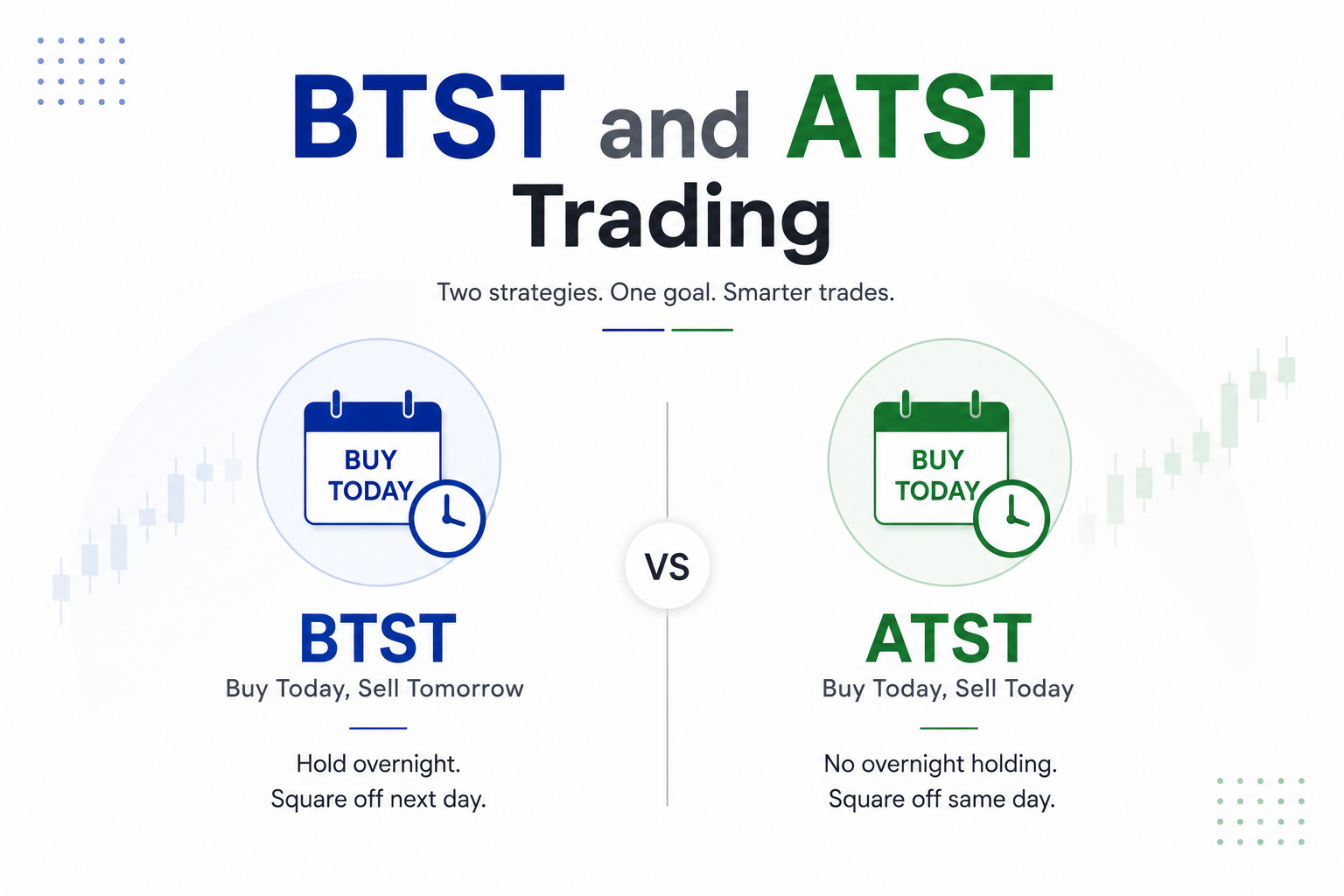
BTST, or Buy Today Sell Tomorrow, is a trading approach in which you buy shares on one trading day and sell them on the next, sometimes before the purchase has fully settled. ATST, or Acquire Today Sell Tomorrow, is another name commonly used for the same idea.
Under India’s T+1 settlement cycle, a normal equity trade executed on Monday settles on Tuesday. If you buy on Monday and sell those shares on Tuesday, the purchase and sale create separate settlement obligations. Normally, the shares received from your Monday purchase can be used toward the delivery obligation created by Tuesday’s sale.
The important risk is short delivery. If the seller from whom you originally bought the shares fails to deliver them, you may not have the securities required for your own sale. That can send the shortage into the exchange’s auction or close-out process, potentially turning a profitable-looking BTST trade into a loss. NSE currently conducts a T+1 buy-in auction for short deliveries in the normal segment, with settlement on T+2.
What Is BTST Trading?
BTST stands for Buy Today Sell Tomorrow.
You buy shares today and sell them on the next trading day instead of waiting to hold them for a longer period.
For example:
- Monday: Buy 100 shares at ₹500
- Tuesday: Sell 100 shares at ₹520
- Gross price difference: ₹20 per share
- Gross trading profit: ₹2,000
This example excludes brokerage, STT, exchange charges, GST, stamp duty, DP charges (where applicable), and any settlement-related costs.
BTST differs from intraday trading because you hold the position overnight.
It differs from conventional delivery investing because your intention is usually to exit almost immediately.
What Is ATST Trading?
ATST stands for Acquire Today Sell Tomorrow.
In Indian trading terminology, ATST and BTST are commonly used to describe essentially the same type of transaction. Zerodha, for example, has historically used BTST and ATST interchangeably.
You may see one broker use “BTST” while another uses “ATST.”
The important point is the settlement structure, not the label.
“Start investing with confidence! Explore
Lemonn
and grow your wealth.”
BTST vs ATST: Is There Any Difference?
For practical purposes, they usually refer to the same concept.
| BTST | ATST |
|---|---|
| Buy Today Sell Tomorrow | Acquire Today Sell Tomorrow |
| Common industry term | Alternative terminology |
| Buy shares and sell next trading day | Acquire shares and sell next trading day |
| Carries settlement risk | Carries the same settlement risk |
Neither term represents a separate exchange segment.
A broker may also use “BTST” as a specific product name with its own margin or funding rules. Those broker-specific products should not be confused with the general concept of BTST trading.
How Does BTST Work Under T+1 Settlement?
India’s normal equity market operates primarily on a T+1 rolling settlement cycle.
NSE states that securities and funds pay-in and pay-out for a normal T+1 trade occur on the next working day after the trade.
Here is a simplified timeline.
Monday: You Buy
You buy:
100 shares × ₹500 = ₹50,000
Monday is the trade date, or T.
Your purchase is scheduled to settle on Tuesday, which is T+1.
Tuesday: You Sell
The shares from Monday’s purchase are due to be received through the settlement process on Tuesday.
You sell:
100 shares × ₹520 = ₹52,000
Your Tuesday sale is, in itself, a new trade.
That sale settles on Wednesday, which is T+1 relative to Tuesday.
Wednesday: Your Sale Settles
The shares received from your Monday purchase can normally be earmarked and delivered against Tuesday’s sell obligation.
For example, Zerodha describes its current BTST settlement process as crediting purchased shares to the customer’s demat account when received from the clearing corporation, earmarking them against the sale, and subsequently debiting them for settlement.
The normal sequence therefore looks like this:
| Day | What happens |
|---|---|
| Monday | Buy 100 shares |
| Tuesday | Monday purchase settles, sell 100 shares |
| Wednesday | Tuesday sale settles |
When everything settles normally, the process is straightforward.
The risk arises when the Monday purchase does not settle as expected.
Why Do Older BTST Guides Mention T+2?
Because India’s settlement system has changed.
Many older articles describe a process in which shares bought on Monday were expected to settle on Wednesday under T+2 settlement.
That is outdated for India’s normal T+1 equity settlement cycle.
NSE currently states that trades under its normal rolling settlement are settled on T+1, while T+0 settlement is also available for applicable transactions under the exchange framework.
Whenever you read an older BTST example, check the publication date before relying on its settlement timeline.
What Is the Main Risk in BTST Trading?
The distinctive BTST risk is short delivery.
Suppose you buy 100 shares on Monday.
You expect those 100 shares to arrive through Tuesday’s settlement.
You therefore sell 100 shares on Tuesday.
But what if the seller on the other side of Monday’s purchase fails to provide the shares?
You may now have:
- A right to receive 100 shares from Monday’s purchase
- An obligation to deliver 100 shares from Tuesday’s sale
- No shares available when required because the earlier seller defaulted
This creates a settlement shortage.
Your trading decision may have been correct, but you can still face financial consequences due to a failure elsewhere in the settlement chain.
What Is Short Delivery?
Short delivery occurs when a seller fails to deliver some or all of the shares required to meet a settlement obligation.
NSE Clearing identifies shortages after accepting securities pay-in from clearing members.
For normal-market short deliveries, NSE Clearing conducts a buy-in auction to obtain the missing securities.
Short delivery can happen for reasons such as:
- A seller not having sufficient shares
- Operational failures
- Securities not being available for pay-in
- Extreme scarcity in a stock
- Market conditions that make delivery difficult
The individual BTST trader may have done nothing wrong in the original purchase.
But selling shares before settlement certainty creates exposure to the consequences.
How Does the Auction Risk in BTST Work?
This is the part every BTST trader should understand.
Consider this simplified sequence.
Monday
You buy 100 shares of XYZ at ₹1,000.
Cost:
₹1,00,000
Tuesday
You sell the same 100 shares at ₹1,040.
Sale value:
₹1,04,000
Your screen appears to show a gross profit of:
₹4,000
So far, the trade looks successful.
But the Monday Seller Short-Delivers
The person responsible for supplying the shares from your Monday purchase fails to deliver them.
The clearing corporation therefore identifies a shortage.
You were expecting those shares to satisfy the delivery chain connected with your Tuesday sale.
Now that expectation has failed.
The shortage can move into the exchange’s auction mechanism.
What Happens in an Exchange Auction?
An auction is a mechanism used by the clearing corporation to obtain securities that were not delivered during normal settlement.
NSE explains that when a seller defaults on delivery, the exchange can purchase the required securities through an auction and deliver them to the buyer. The financial difference arising from the auction can ultimately be recovered from the party responsible for the shortage under the applicable settlement process.
Under the current T+1 normal-market process:
- Trade happens on T
- Normal settlement takes place on T+1
- Shortage is identified
- Buy-in auction occurs on T+1
- Auction settlement occurs on T+2
NSE’s current settlement-cycle page confirms this timetable.
Why Can Auction Prices Be Painful?
The exchange needs to acquire shares to resolve the shortage.
If the stock has risen sharply or has very few sellers, obtaining those shares can be expensive.
Suppose your shortage relates to shares you sold at ₹1,040.
If replacement shares cost considerably more through the relevant auction or close-out mechanism, the difference can eat into your trading profit and potentially result in a loss.
This risk becomes particularly relevant when:
- The stock is illiquid
- The stock hits an upper circuit
- There are few sellers
- The security is experiencing unusual volatility
- A corporate event creates scarcity
A ₹4,000 expected BTST profit is therefore not necessarily your final economic outcome until settlement completes.
How Is an Unsuccessful Auction Closed Out?
Sometimes the exchange cannot acquire sufficient shares during the auction.
In that case, the shortage may be closed out financially in accordance with the clearing corporation’s applicable rules.
NSE states that shortages that are not bought in through the auction are deemed closed out.
The close-out mechanism can use a price that is unfavorable to the short-delivering side.
An NSE investor FAQ provides an example of normal market close-out methodology using the higher of specified market-price references or a percentage premium, subject to the rules applicable at the time.
Because exchange rules and calculations can change, traders should check the current clearing corporation framework rather than assume a fixed “20% auction penalty” applies to every case.
Is the Auction Penalty Always 20%?
No.
You will often see BTST articles saying an auction can cost “20%.”
That is an oversimplification.
Actual settlement consequences depend on:
- Auction price
- Valuation price
- Applicable close-out methodology
- Stock price movement
- Whether the auction succeeds
- Security category
- Current clearing corporation rules
- Broker-level treatment of the resulting debit
NSE states that the clearing member must make the difference if the buy-in auction price exceeds the valuation price. Unsuccessful shortages are handled under close-out rules.
So there is no universal fixed BTST penalty percentage that you can safely plug into every trade.
Why Is Auction Risk Higher in Illiquid Stocks?
Liquidity measures how easily you can buy or sell shares without significantly affecting their price.
Suppose Stock A trades 50 lakh shares per day.
Stock B trades only 5,000 shares.
If a shortage of 20,000 shares needs to be resolved:
- Stock A may have ample supply in the market.
- Stock B may have very little available supply.
That can make the second situation considerably more difficult.
BTST traders should therefore pay attention to:
- Daily traded volume
- Bid-ask spread
- Market depth
- Circuit limits
- Recent delivery shortages
- Unusual price movements
The fact that a stock can be bought through your broker does not mean it is a sensible candidate for BTST.
What Margin Is Required for BTST Trading?
There is no single “BTST margin” that applies across all brokers and products.
You need to distinguish between ordinary delivery buying and a broker-specific funded BTST product.
Standard Equity Purchase
NSE’s current margin FAQ states that trading members in the capital market segment must collect a minimum 20% upfront margin in lieu of VaR and ELM, while other applicable margins are collected as prescribed up to settlement.
However, this does not mean every broker must let you purchase ₹1 lakh of delivery shares with only ₹20,000.
A broker can require more money, including the full purchase amount, as part of its risk policy.
Broker-Specific BTST Products
Some brokers may separately offer a product called BTST that allows eligible securities to be carried overnight with partial funding or a prescribed margin.
For example, Geojit describes its BTST product as a leveraged facility in which approved cash-market purchases can be carried forward by paying margin, subject to its own interest and eligibility conditions.
Such facilities are broker-specific.
Always check:
- Required margin
- Eligible stocks
- Interest or funding charges
- Automatic square-off rules
- Conversion to delivery rules
- Settlement-shortage treatment
Do not assume one broker’s BTST margin applies at another broker.
Example of BTST Margin
Suppose you want to buy shares worth ₹1,00,000.
Your broker may require the full ₹1,00,000 for an ordinary delivery purchase.
Another broker-specific BTST facility might permit the position at a lower amount, subject to its own approved stock and margin framework.
If, purely for illustration, a broker required 40%:
Trade value = ₹1,00,000
Margin = ₹40,000
Effective exposure relative to margin:
₹1,00,000 ÷ ₹40,000 = 2.5x
A 3% adverse move in the stock equals:
₹1,00,000 × 3% = ₹3,000
Relative to ₹40,000 collateral, that is a 7.5% loss before other costs.
Margin reduces the cash you initially provide.
It does not reduce the position’s market exposure.
Do BTST Trades Get Intraday Leverage?
Do not assume so.
BTST involves carrying exposure overnight.
A broker’s intraday leverage, where available, does not automatically apply to a BTST or delivery position.
If the broker offers a dedicated funded BTST product, its margin schedule determines the required collateral.
Otherwise, the transaction follows the applicable delivery-market and broker risk framework.
Can BTST Margin Change?
Yes.
Broker risk requirements can differ by security and can change based on:
- Volatility
- Liquidity
- Surveillance measures
- Exchange margins
- Corporate actions
- Broker risk policy
- Market conditions
A broker may also remove a security from its eligible BTST or funded-product list.
Never plan a trade using an old margin screenshot or an example from another broker.
Can You Use BTST Sale Proceeds Immediately?
Not necessarily.
Availability of funds from a BTST sale is affected by settlement and regulatory rules.
For example, Zerodha states that credit from selling T1 holdings in a BTST transaction cannot be used on the same day.
The precise amount displayed as available for trading or withdrawal can depend on the broker and settlement status.
Check the broker’s current fund-utilization rules instead of assuming the entire sale value is immediately reusable cash.
What Happens If the Original Purchase Settles Normally?
This is the usual outcome.
Suppose:
- Monday: Buy 100 shares
- Tuesday: Shares from Monday settle
- Tuesday: Sell 100 shares
- Wednesday: Tuesday sale settles
The securities received from the purchase can be earmarked for your sell obligation.
Zerodha’s current process, for example, involves crediting BTST shares to the client’s demat account upon receipt and earmarking them to meet the pending delivery obligation.
When this happens normally, there is no auction problem.
BTST vs Intraday Trading
The major difference is overnight exposure.
| BTST | Intraday |
|---|---|
| Buy today, sell next trading day | Buy and sell on the same trading day |
| Position held overnight | Position normally closed before market close |
| Exposed to overnight gaps | No overnight position after square-off |
| Delivery settlement mechanics matter | Usually no delivery if properly squared off |
| Short-delivery risk can arise | Different settlement structure |
| Margin depends on delivery or broker product | Intraday margin rules apply |
BTST may look like a slightly longer intraday trade, but the settlement process changes the risk profile.
BTST vs Normal Delivery Trading
The distinction mainly comes into play when you sell.
BTST
You intend to sell on the next trading day, potentially while the purchase settlement is still being completed.
Normal Delivery
You allow the purchase to settle and hold the shares in your demat account before selling at a later date.
Waiting until shares have been successfully received removes the specific risk of relying on an unsettled purchase to support a subsequent sale.
You can still face normal market risk, of course.
BTST vs T+0 Settlement
India also has a T+0 settlement framework for eligible trades.
Under T+0, applicable trades can settle on the same trading day, rather than the next working day.
NSE currently states that both T+1 and T+0 settlement cycles operate within its equity settlement framework, with T+0 trades subject to their own timings and pay-in requirements.
This should not be confused with BTST.
BTST describes a trading approach.
T+0 and T+1 describe settlement cycles.
Can You Do BTST in Trade-to-Trade Stocks?
This requires particular caution.
Trade-to-trade securities require compulsory delivery, and netting benefits that apply in the normal segment may not apply in the same way.
NSE states that trade-for-trade surveillance transactions are settled on a gross basis, meaning each trade creates a deliverable and a receivable obligation.
Broker restrictions may also apply.
For example, Zerodha states that T2T stocks cannot be traded intraday and are subject to compulsory delivery requirements, and that specific rules apply to selling T1 holdings.
Check the stock’s current series and your broker’s rules before attempting any next-day trade.
What Is the Profit Calculation in BTST?
The basic gross calculation is straightforward:
Gross P&L = (Selling price – Buying price) × Quantity
Suppose:
- Buy price = ₹800
- Sell price = ₹825
- Quantity = 200
Then:
₹25 × 200 = ₹5,000 gross profit
But your net result needs to account for applicable costs.
These can include:
- Brokerage
- Securities Transaction Tax
- Exchange charges
- GST
- SEBI charges
- Stamp duty
- DP charges where applicable
- Funding or interest charges if using a broker-specific leveraged product
- Settlement or auction-related debits if a shortage occurs
The ₹5,000 shown by the price movement is therefore not necessarily the amount you keep.
What Happens If the Stock Gaps Down Overnight?
BTST carries overnight market risk.
Suppose you buy at ₹500 on Monday.
After market close, the company announces unexpectedly weak results.
On Tuesday morning, the stock opens at ₹450.
You are immediately facing:
₹50 × quantity
of adverse price movement before you have had an opportunity to exit during normal market hours.
A stop-loss placed based on Monday’s price cannot guarantee execution at your intended level if the stock gaps past it.
This is separate from auction risk.
A BTST trader therefore faces at least two important risks:
- Market risk, because the price can gap overnight.
- Settlement risk, because the original purchase may be short-delivered.
Can Upper Circuits Increase BTST Auction Risk?
They can make a shortage more difficult to resolve.
Suppose a stock rises to its upper circuit and has buyers but virtually no sellers.
A trader who needs shares to meet a delivery obligation may be unable to buy them easily.
If a settlement shortage occurs at the same time, limited supply can complicate the auction process.
This is one reason aggressively moving or illiquid circuit-bound stocks deserve additional caution.
Is BTST Suitable for IPO Shares?
Newly listed securities can experience sharp volatility and unusual liquidity conditions.
Whether a broker permits a particular next-day sale and how settlement works depends on the relevant listing, settlement, exchange, and broker rules.
Do not assume that a newly listed stock is automatically suitable for BTST simply because it appears in your holdings or positions screen.
Check its settlement status and broker restrictions first.
Is BTST Trading Risk-Free Because Shares Are Bought First?
No.
This is one of the biggest misconceptions.
You have executed a purchase first, but until settlement is completed successfully, there remains a possibility that the expected securities are not delivered.
You also face normal price risk during the overnight holding period.
BTST therefore combines elements of:
- Delivery-market settlement risk
- Overnight market risk
- Liquidity risk
- Gap risk
- Auction risk
The fact that your broker’s app allows you to press “sell” does not eliminate those risks.
How Can You Reduce BTST Auction Risk?
You cannot eliminate settlement risk entirely when selling before the relevant purchase has been successfully received, but you can avoid making it unnecessarily large.
Prefer Liquid Securities
Stocks with deep trading activity generally have more readily available supply than illiquid counters.
Liquidity does not guarantee settlement, but it reduces some of the conditions that can make shortages painful.
Avoid Treating Upper-Circuit Stocks as Easy BTST Trades
A stock with almost no sellers can become difficult to obtain if supply is tight.
Check the Stock’s Series
Understand whether the security trades in the normal segment, trade-to-trade segment, or under another applicable framework.
Settlement treatment can differ.
Understand Your Broker’s BTST Policy
Check:
- Whether BTST is allowed
- Which stocks are eligible
- Margin requirements
- Short-delivery treatment
- Auction debit policy
- Fund availability
- Square-off rules
Do Not Use Maximum Possible Leverage
Settlement risk becomes more damaging when a trader has little free capital to absorb an unexpected debit.
Wait for Delivery If Settlement Certainty Matters
The simplest way to avoid the distinctive unsettled-purchase risk is to wait until the shares have been successfully received before selling them.
You give up the BTST timing advantage, but you remove one important uncertainty.
Common BTST Trading Mistakes
Assuming T+2 Still Applies
India’s normal equity settlement cycle is now T+1. Examples based on T+2 can lead to misunderstandings about when securities and obligations settle.
Ignoring Short Delivery
The trade can appear profitable on the chart yet still be exposed to an unresolved settlement shortage.
Assuming Auction Cost Is Always 20%
Auction and close-out consequences follow exchange and clearing corporation rules. They are not a universal fixed 20% charge.
Using Illiquid Stocks
Thin market depth increases execution risk and can make settlement shortages harder to resolve.
Confusing BTST Margin With Intraday Margin
A leveraged broker-specific BTST facility and ordinary intraday leverage are different products.
Spending the Entire Sale Credit Immediately
BTST sale proceeds may not be immediately available for reuse due to settlement requirements.
Ignoring Overnight Gap Risk
An unexpected result, regulatory announcement, global market event, or company disclosure can cause a stock to open far above or below the previous closing price.
A Complete BTST Example
Suppose you identify a stock trading at ₹250 on Monday afternoon.
You buy:
400 shares × ₹250 = ₹1,00,000
You expect positive momentum the following day.
Tuesday Morning
The stock trades at ₹260.
You sell all 400 shares.
Sale value:
400 × ₹260 = ₹1,04,000
Gross expected profit:
₹4,000
Scenario 1: Normal Settlement
Your Monday purchase settles properly.
The required shares have been received and are available toward your Tuesday sell obligation.
Your net result is broadly the ₹4,000 gross price gain minus applicable trading costs.
Scenario 2: Short Delivery
The Monday seller fails to deliver all or part of the required shares.
The clearing system identifies the shortage and handles it through the applicable auction or close-out process.
Your final financial result may differ from the expected profit of ₹ 4,000.
That is the central risk behind BTST.
Your market call can be correct while settlement mechanics still hurt the trade.
Should Beginners Use BTST Trading?
BTST is easy to understand at the order level but more complicated at the settlement level.
Before attempting it, a beginner should know:
- What T+1 settlement means
- When purchased shares actually settle
- What short delivery means
- How the auction process works
- What margin the broker requires
- Whether the stock is liquid
- Whether the stock is in a special settlement category
- How overnight gaps affect risk
- When sale proceeds become usable
If those mechanics are unclear, normal delivery trading is easier to understand because you can wait for the shares to settle before deciding whether to sell.
FAQs About BTST and ATST Trading
What is BTST trading?
BTST means Buy Today Sell Tomorrow. You buy shares on one trading day and sell them on the next trading day, potentially while the original purchase is still completing settlement.
What does ATST mean in trading?
ATST means Acquire Today, Sell Tomorrow. It is commonly used as another name for BTST rather than a fundamentally different trading strategy.
Is BTST allowed in India?
BTST-style selling is available through many Indian brokers, subject to the stock, the settlement framework, the broker’s policy, and applicable market rules. It is not a separate exchange segment.
What is the settlement period for BTST trading?
India’s normal equity market follows a T+1 rolling settlement cycle. A Monday purchase normally settles on Tuesday, while a Tuesday sale normally settles on Wednesday.
What is auction risk in BTST?
Auction risk arises if shares expected from your original purchase are short-delivered, leaving securities unavailable for settlement of the subsequent sale. The clearing corporation uses its auction or close-out process to resolve shortages.
When does NSE conduct an auction for short delivery?
For short deliveries under the normal T+1 segment, NSE states that the buy-in auction is conducted on T+1 and the auction settlement is completed on T+2.
Is BTST auction penalty always 20%?
No. Actual financial consequences depend on the auction price, valuation debit, close-out methodology, security category, and applicable clearing corporation rules.
How much margin is required for BTST?
There is no universal BTST margin. Standard cash-market trades are subject to applicable upfront margin rules, and brokers can require higher amounts. Dedicated leveraged BTST products may have separate broker-specific margin requirements.
Can I sell shares on T+1 before they appear in my demat account?
Many brokers support selling eligible T1 holdings before the user sees final settled delivery in the usual way. The precise workflow depends on the broker’s settlement and earmarking system.
Is BTST the same as intraday trading?
No. An intraday trade is normally opened and closed during the same trading session. BTST carries the position overnight and involves separate settlement obligations on each trading day.
Can I lose money in BTST even if I sell above my purchase price?
Yes. Trading charges can reduce the profit, and settlement shortages or auction-related debits can change the final outcome. You are also exposed to overnight market risk before you sell.
Is BTST safer in highly liquid stocks?
Highly liquid stocks can reduce certain execution and scarcity risks, but they do not make BTST risk-free. Short delivery and overnight price risk can still occur.
Key Takeaways
- BTST means Buy Today Sell Tomorrow, while ATST means Acquire Today Sell Tomorrow. They generally describe the same trading concept.
- India’s normal equity settlement cycle is T+1, so a purchase made on Monday normally settles on Tuesday.
- A Tuesday sale creates a new settlement obligation that normally settles on Wednesday.
- BTST’s distinctive risk is selling while you are still dependent on successful settlement of the earlier purchase.
- If the original seller short-delivers shares, the shortage can enter the exchange’s auction or close-out process.
- Under NSE’s normal T+1 framework, a short-delivery auction occurs on T+1, with auction settlement on T+2.
- Auction loss is not a universal fixed 20% penalty. The financial impact depends on applicable auction and close-out rules.
- There is no single BTST margin across all brokers. Standard equity margin requirements and broker-specific leveraged BTST products need to be distinguished.
- BTST also carries overnight gap, liquidity, and execution risks.
- If you want to remove the distinctive unsettled-purchase risk, wait until the shares have been successfully received before selling them.
Disclaimer
The stocks mentioned in this article are not recommendations. Please conduct your own research and due diligence before investing. Investment in securities market are subject to market risks, read all the related documents carefully before investing. Please read the Risk Disclosure documents carefully before investing in Equity Shares, Derivatives, Mutual fund, and/or other instruments traded on the Stock Exchanges. As investments are subject to market risks and price fluctuation risk, there is no assurance or guarantee that the investment objectives shall be achieved. Lemonn do not guarantee any assured returns on any investments. Past performance of securities/instruments is not indicative of their future performance.
To read the RA disclaimer
Research Analyst - Gaurav Garg
Related Posts


Download Lemonn
Download my share market app for stock trading—trade stocks effortlessly in the market.



