
Block deals on Sept 3: Meesho, Clean Max see big trades
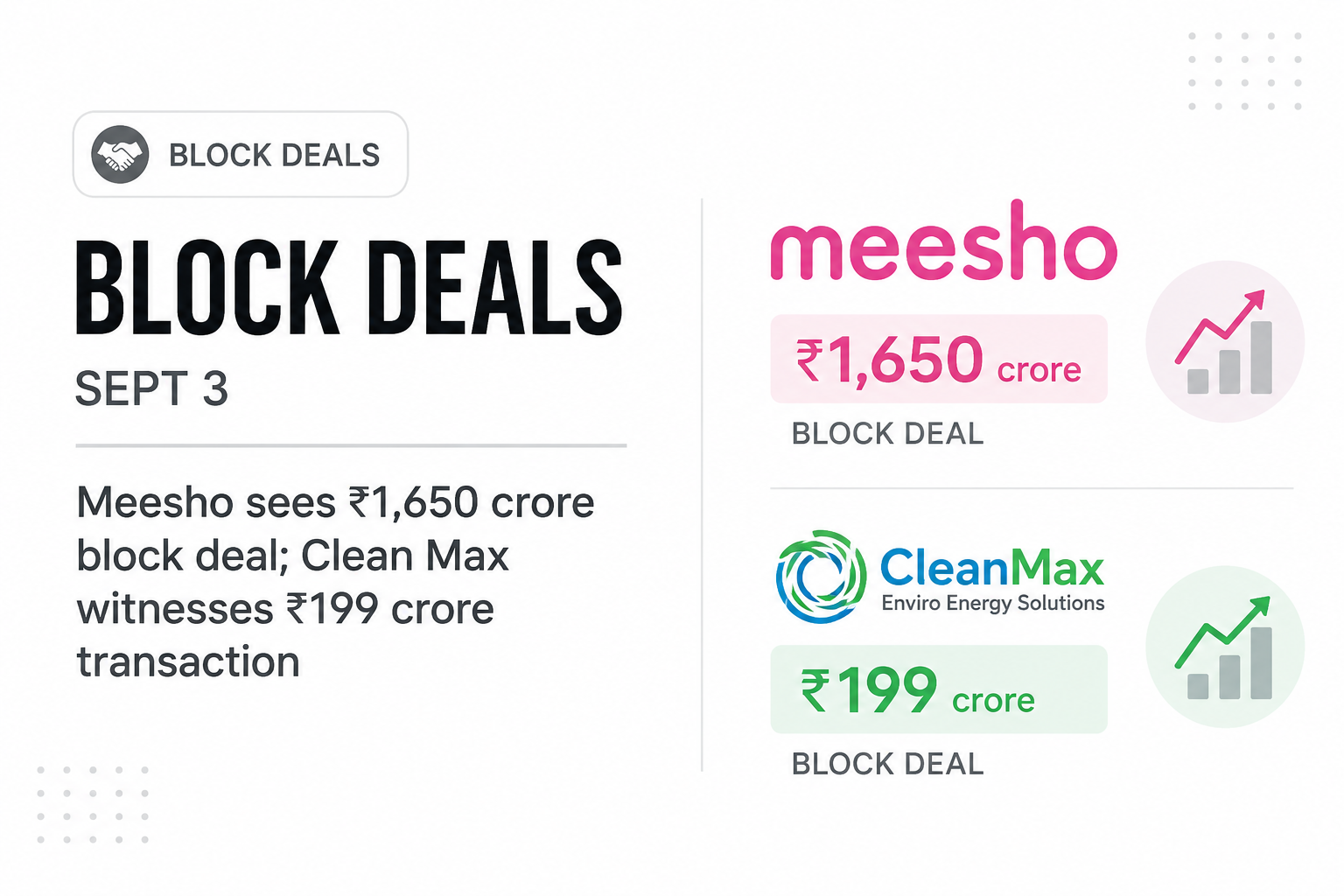
Meesho and Clean Max Enviro Energy Solutions saw significant block deal activity on September 3. Around ₹1,650 crore worth of Meesho shares changed hands, while Clean Max witnessed a transaction worth about ₹199 crore.
The Meesho transaction involved roughly 1.7% of the company’s equity, with SoftBank reported as the likely seller. In Clean Max, 1.63 million shares changed hands, although the buyers and sellers were not immediately known.
Meesho sees ₹1,650 crore block deal
Around 8 crore Meesho shares changed hands in block deals on Thursday, representing approximately 1.73% of the e-commerce company’s equity.
The shares were transacted at around ₹206 to ₹206.30 apiece, putting the total transaction value at approximately ₹1,650.4 crore. The deal price represented a discount of about 2.5% to Meesho’s previous closing price of ₹211.60.
SoftBank was reported to be the likely seller, although the buyers were not immediately disclosed.
Was SoftBank the seller in the Meesho block deal?
Reports ahead of the transaction indicated that SoftBank, through its investment vehicle SVF II Meerkat DE, was looking to reduce its stake in Meesho.
The initial plan was reportedly to sell around 7 crore shares, equivalent to a 1.5% stake, for approximately ₹1,435 crore. The proposed transaction was subsequently increased in size.
SVF II Meerkat DE held an 8.60% stake in Meesho as of the June 2026 quarter. BofA Securities India and J.P. Morgan India were expected to handle the transaction.
“Start investing with confidence! Explore
Lemonn
and grow your wealth.”
How did Meesho shares react?
Meesho shares saw some volatility following the block deal.
The stock fell nearly 2% to ₹207.05 in early trade after the transaction, according to Business Today. Other intraday readings showed the stock recovering as trading progressed.
The block deal follows a period of strong performance for the stock. Meesho shares had closed at ₹211.60 on September 2, up 3.14% for the session.
What do Meesho’s latest financials show?
The block deal also comes after Meesho reported improving financial performance for the June quarter.
The company’s consolidated net loss narrowed to ₹132.8 crore in Q1 FY27 from ₹289.4 crore in the year-ago quarter. Revenue from operations increased 48% year-on-year to ₹3,712.8 crore.
Net Merchandise Value, or NMV, increased 34% year-on-year to ₹11,614 crore, supported by user growth and higher engagement on the platform.
Clean Max sees ₹199 crore block deal
Clean Max Enviro Energy Solutions also witnessed sizeable block deal activity on September 3.
Around 1.63 million shares changed hands on the NSE, with the transaction valued at approximately ₹199.31 crore. The identities of the buyers and sellers were not immediately known.
How did Clean Max shares react to the block deal?
Unlike Meesho, Clean Max shares moved sharply higher following the transaction.
The Clean Max share price climbed as much as 6.9% to ₹1,344.40 during intraday trading, compared with its previous closing price of ₹1,257.60.
The sharp move suggests that investors were closely tracking the large transaction, although a block deal by itself does not necessarily indicate a change in a company’s fundamentals.
Meesho vs Clean Max block deals at a glance
| Company | Approx. deal value | Shares traded | Reported price | Market reaction |
|---|---|---|---|---|
| Meesho | ₹1,650.4 crore | 8 crore | ₹206 to ₹206.30 | Stock initially fell nearly 2% |
| Clean Max | ₹199.31 crore | 1.63 million | Not immediately disclosed | Stock rose as much as 6.9% |
Meesho’s transaction was substantially larger and represented roughly 1.73% of the company’s equity. SoftBank was reported as the likely seller. For Clean Max, the parties involved in the transaction were not immediately identified.
What is a block deal?
A block deal is a large transaction involving shares of a listed company that is executed through a dedicated trading mechanism on the stock exchange.
Such transactions are commonly used by institutional investors, promoters, private equity funds and other large shareholders to buy or sell substantial holdings.
For investors, the important factors to watch include:
- The size of the stake changing hands
- The price or discount at which the deal takes place
- The identity of the buyer and seller
- Whether the seller is reducing its holding significantly
- How the stock trades after the transaction
A large block deal does not automatically make a stock bullish or bearish. Investors should consider the reason for the transaction alongside the company’s earnings, valuation, ownership structure and business outlook.
FAQs
How much was the Meesho block deal on September 3?
Around 8 crore Meesho shares worth approximately ₹1,650.4 crore changed hands. The transaction represented roughly 1.7% to 1.73% of the company’s equity.
Who sold shares in the Meesho block deal?
SoftBank was reported as the likely seller. Its investment vehicle SVF II Meerkat DE held an 8.60% stake in Meesho as of the June 2026 quarter. The buyer or buyers were not immediately confirmed.
At what price did the Meesho block deal happen?
Around 8 crore shares changed hands at roughly ₹206 to ₹206.30 each. The transaction was executed at a discount to Meesho’s previous closing price of ₹211.60.
What was the value of the Clean Max block deal?
About 1.63 million Clean Max shares changed hands in a transaction valued at ₹199.31 crore on September 3.
Why did Clean Max shares rise after the block deal?
Clean Max shares rallied as much as 6.9% during intraday trading after the block deal. A large transaction can influence short-term market sentiment, but the deal alone does not establish the reason for a stock-price move.
Key takeaways
- Meesho saw around ₹1,650.4 crore worth of shares change hands in block deals on September 3.
- Around 8 crore Meesho shares, or roughly 1.73% equity, were traded at about ₹206 to ₹206.30 apiece.
- SoftBank was reported as the likely seller in the Meesho transaction.
- Clean Max witnessed a block transaction involving 1.63 million shares worth about ₹199.31 crore.
- Clean Max shares rallied as much as 6.9% following the transaction.
- The buyers and sellers in the Clean Max deal were not immediately identified.
Disclaimer
The stocks mentioned in this article are not recommendations. Please conduct your own research and due diligence before investing. Investment in securities market are subject to market risks, read all the related documents carefully before investing. Please read the Risk Disclosure documents carefully before investing in Equity Shares, Derivatives, Mutual fund, and/or other instruments traded on the Stock Exchanges. As investments are subject to market risks and price fluctuation risk, there is no assurance or guarantee that the investment objectives shall be achieved. Lemonn do not guarantee any assured returns on any investments. Past performance of securities/instruments is not indicative of their future performance.
To read the RA disclaimer
Research Analyst - Gaurav Garg
Related Posts


Download Lemonn
Download my share market app for stock trading—trade stocks effortlessly in the market.



