
Adani Energy Wins ₹4,700 Crore Project: Investor View
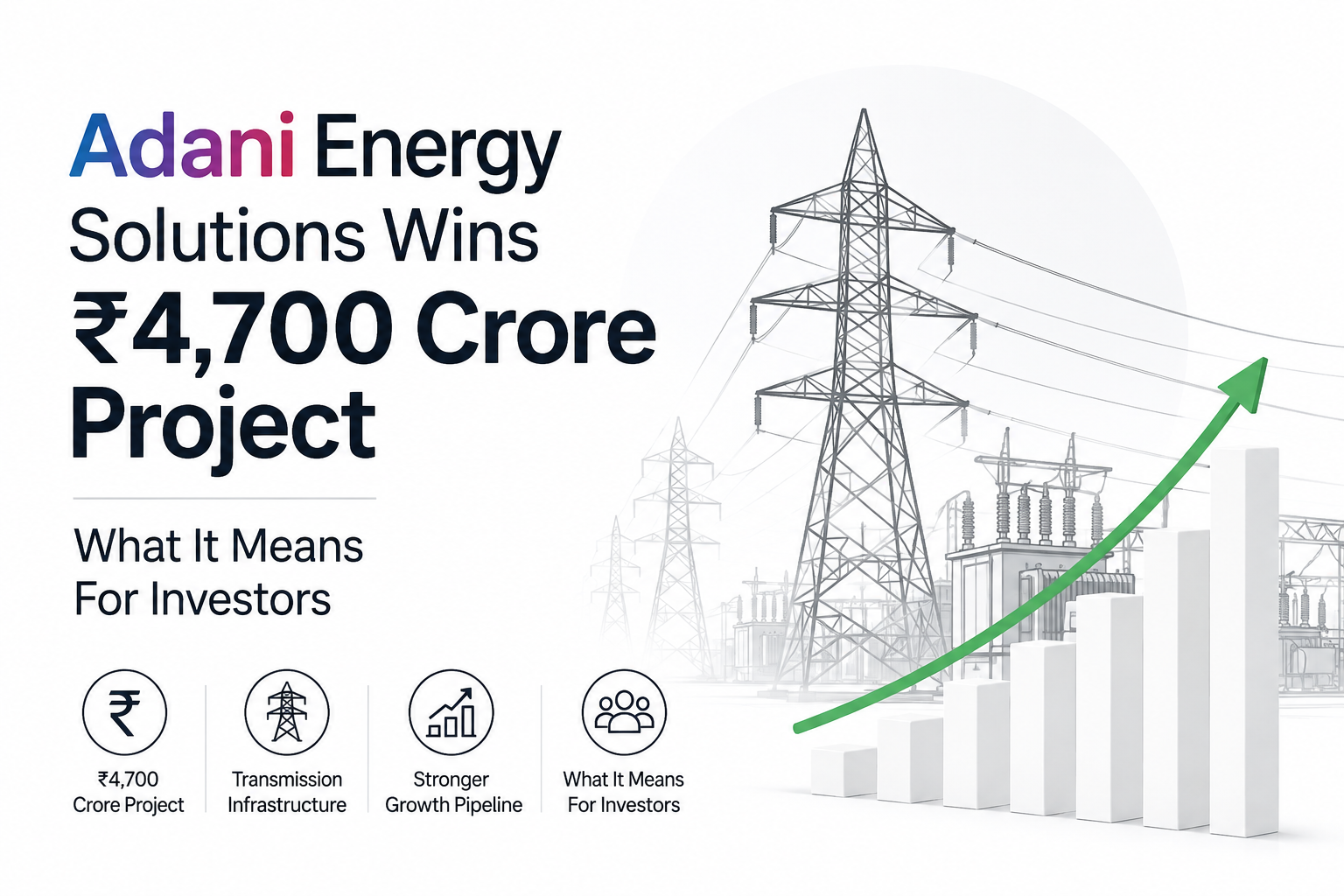
Adani Energy Solutions Ltd (AESL) has won a transmission project in Maharashtra involving an estimated capital expenditure of about ₹4,700 crore. The project strengthens the company’s already large transmission order book and gives investors greater visibility into its long-term growth pipeline.
For investors, the order win is positive, but it should not be viewed as ₹4,700 crore of immediate revenue or profit. The more important questions are how efficiently AESL executes the project, how the investment is funded, and what returns the asset generates once operational.
What is Adani Energy Solutions’ ₹4,700 crore project?
Adani Energy Solutions has won the “Network Expansion Scheme in Western Region to Cater to Pumped Storage Potential near Satara (up to 4500 MW) – Part A.”
AESL secured the project through Tariff Based Competitive Bidding (TBCB), after emerging as the lowest bidder. It will be housed under the special purpose vehicle Satara Power Transmission Ltd and is expected to be completed within 36 months.
The project is designed to help evacuate renewable energy generated in Karnataka to major power consumption centres in Maharashtra. It will also support pumped storage projects around Satara, Pune and the Mumbai Metropolitan Region.
Key project details
| Particular | Details |
|---|---|
| Estimated project capex | Around ₹4,700 crore |
| Location | Maharashtra |
| Project company | Satara Power Transmission Ltd |
| Completion timeline | 36 months |
| Transmission lines added | 562 circuit kilometres |
| Transformation capacity | 9,000 MVA |
| Renewable/storage capacity supported | Up to 4,500 MW |
| Award method | Tariff Based Competitive Bidding |
The infrastructure includes a 765/400 kV substation at Satara, a 765 kV double-circuit transmission line between Kolhapur and Satara, and augmentation of the Kolhapur pooling station.
“Start investing with confidence! Explore
Lemonn
and grow your wealth.”
Why is this project important for Adani Energy Solutions?
The ₹4,700 crore project matters for more than its headline value. It expands AESL’s transmission portfolio at a time when India’s renewable energy build-out is creating demand for new interstate transmission infrastructure.
AESL’s transmission order book rises to about ₹85,000 crore
Following the latest win, Adani Energy Solutions said its transmission order book stands at approximately ₹85,000 crore.
A large order book gives the company a pipeline of projects that can potentially translate into operating assets and cash flows over several years.
The latest project will also take AESL’s cumulative transmission network to 29,739 circuit kilometres and its transformation capacity to 143,425 MVA, according to the company.
That scale is important because transmission is a capital-intensive infrastructure business where the ability to win, finance, build and operate large projects can create long-duration earnings opportunities.
What does the Adani Energy project mean for investors?
For Adani Energy Solutions investors, there are four main implications.
1. The growth pipeline has become stronger
The most obvious benefit is an increase in AESL’s project pipeline.
A ₹4,700 crore project is meaningful on its own, but it becomes more significant when viewed alongside the company’s existing order book.
AESL had also announced an approximately ₹8,500 crore transmission project in Andhra Pradesh in July 2026. The series of wins suggests that transmission remains an important growth engine for the company.
2. Renewable energy creates structural transmission demand
Solar and wind projects are often located far from India’s biggest electricity-consuming regions. Generating more renewable power therefore solves only part of the problem.
India also needs transmission infrastructure capable of moving that electricity across states and balancing intermittent generation.
The Satara project connects directly with this requirement. It is intended to strengthen power flows between India’s Southern and Western grids while supporting renewable energy evacuation and pumped storage.
That gives AESL exposure not just to rising electricity consumption, but also to investment required for India’s energy transition.
3. Pumped storage could become another demand driver
Pumped storage works somewhat like a large-scale battery.
When excess electricity is available, water is pumped to a higher reservoir. When electricity demand rises, that water can be released to generate power.
Such storage becomes increasingly useful as solar and wind form a larger share of electricity generation.
The new transmission project is designed to facilitate up to 4.5 GW of pumped storage potential in Maharashtra, which makes the asset relevant to both renewable generation and energy storage infrastructure.
4. A project win does not immediately translate into profit
Investors should distinguish between project capex, revenue, earnings and cash flow.
The reported ₹4,700 crore figure represents the project’s estimated capital expenditure. It should not be interpreted as ₹4,700 crore being added immediately to AESL’s revenue or profit.
The project still has to be financed and constructed over its 36-month implementation period. Its ultimate value to shareholders will depend on execution, financing costs, project economics and the cash flows generated after commissioning.
How did Adani Energy Solutions shares react?
The initial stock market reaction was positive.
On August 26, Adani Energy Solutions shares gained around 3% intraday and touched roughly ₹1,637 after the project announcement.
The positive momentum continued on August 27, when the stock rose more than 2% during trading. Moneycontrol reported that Morgan Stanley maintained an Overweight rating and a ₹1,943 target price, while noting that AESL’s FY27 transmission order wins had already crossed half of the brokerage’s full-year base-case estimate.
Still, short-term share-price movement should not be confused with the project’s long-term financial impact. Markets can quickly price in good news, while project execution takes years.
What should investors watch next?
The order win strengthens the growth story, but investors evaluating Adani Energy Solutions should track more than new project announcements.
Project execution
AESL plans to complete the Satara project within 36 months.
Delays caused by land acquisition, right-of-way issues, regulatory approvals, equipment availability or construction challenges can affect project economics.
Timely commissioning will therefore be one of the clearest indicators to monitor.
Debt and funding costs
Large transmission projects require substantial upfront capital.
AESL reported net debt-to-EBITDA of around 4.5x in its FY2025-26 annual reporting. It also reported ₹14,232 crore of overall capital expenditure during the year.
Investors should watch whether rapid expansion causes leverage to rise materially and how efficiently the company funds its upcoming projects.
Interest rates matter too. Higher borrowing costs can influence returns in a capital-heavy infrastructure business.
Cash flow generation
AESL reported FY2025-26 EBITDA of ₹8,726 crore, up 12.7%, while adjusted profit after tax increased 32.3% to ₹2,393 crore. Cash profit stood at ₹4,700 crore.
Future investors will want to see new transmission assets translate from order-book numbers into commissioned projects and sustainable operating cash flows.
Return on capital
Winning more projects is not automatically good if returns are inadequate.
Since the Satara project was awarded through competitive bidding, investors should monitor whether AESL can maintain attractive returns while bidding aggressively enough to keep expanding its portfolio.
For its regulated transmission business, AESL reported a regulated equity return of 15.5% for FY2025-26.
Is the ₹4,700 crore project positive for Adani Energy Solutions stock?
Fundamentally, the project win is positive for Adani Energy Solutions because it expands the transmission pipeline, takes the order book to roughly ₹85,000 crore and increases the company’s exposure to India’s renewable energy and storage infrastructure build-out.
But an order win alone does not determine whether the stock is attractive at its current market price.
Investors need to separate two questions:
- Is AESL’s underlying business growing? The expanding transmission order book suggests a strong growth pipeline.
- Is that growth already reflected in the share price? This requires looking at valuation, expected earnings growth, leverage and future returns on invested capital.
A good company can still be an expensive stock, just as a large project can create less shareholder value than expected if financing costs or execution risks rise.
What are the main risks for Adani Energy Solutions investors?
The ₹4,700 crore project improves growth visibility, but investors should keep several risks in view:
- Execution risk: Transmission projects are complex and can face construction or right-of-way delays.
- Leverage: Rapid expansion requires large amounts of capital, making debt levels and interest costs important.
- Competitive bidding: Winning projects at aggressive tariffs could put pressure on returns.
- Regulatory risk: Transmission is closely connected to India’s regulatory and policy framework.
- Valuation risk: Positive growth expectations can already be reflected in the stock price.
- Concentration and group-related risk: Investors may also price AESL based on developments affecting the broader Adani Group, even when AESL’s operating performance remains unchanged.
The bigger picture for AESL
The latest project fits into a broader expansion strategy rather than being an isolated order.
Adani Energy Solutions operates across transmission, electricity distribution and smart metering. New transmission projects add long-duration infrastructure assets, while smart metering provides another avenue for growth.
For FY2025-26, the company reported adjusted PAT growth of 32.3% and continued substantial capital deployment.
The investment case therefore increasingly depends on whether AESL can convert its large pipeline into operating assets without stretching its balance sheet or compromising project returns.
FAQs
Q. How much is Adani Energy Solutions’ new project worth?
The Maharashtra transmission project involves estimated capital expenditure of approximately ₹4,700 crore. It is being developed through Satara Power Transmission Ltd.
Q. Where is the new Adani Energy Solutions project located?
The project is centred around Maharashtra and will help transmit renewable power from Karnataka to major demand centres in Maharashtra. It will also support pumped storage capacity around Satara, Pune and the Mumbai Metropolitan Region.
Q. When will Adani Energy Solutions complete the project?
AESL has said the project is expected to be delivered within 36 months.
Q. What is Adani Energy Solutions’ order book after the project win?
Following the ₹4,700 crore project win, AESL’s transmission order book stands at approximately ₹85,000 crore, according to the company.
Q. Is the ₹4,700 crore project good news for Adani Energy Solutions shareholders?
The project is positive from a business-growth perspective because it increases AESL’s transmission pipeline and exposure to renewable energy infrastructure. However, investors should also assess execution, leverage, financing costs, project returns and stock valuation before making an investment decision.
Q. Why does the project support renewable energy?
The infrastructure will help transmit renewable electricity generated in Karnataka to demand centres in Maharashtra. It is also designed to support pumped storage capacity of up to 4,500 MW, helping improve grid flexibility as renewable generation expands.
Key takeaways
- Adani Energy Solutions has won a Maharashtra transmission project involving estimated capex of around ₹4,700 crore.
- The project will add 562 circuit kilometres of transmission lines and 9,000 MVA of transformation capacity.
- AESL’s transmission order book has increased to approximately ₹85,000 crore.
- The project supports up to 4,500 MW of renewable and pumped storage capacity and is scheduled for completion within 36 months.
- For investors, the order strengthens AESL’s long-term growth pipeline, but execution, debt, financing costs, returns and valuation remain important factors.
- The ₹4,700 crore headline number represents estimated project capex, not immediate revenue or profit for AESL.
This article is for informational and educational purposes only and should not be considered investment advice.
Disclaimer
The stocks mentioned in this article are not recommendations. Please conduct your own research and due diligence before investing. Investment in securities market are subject to market risks, read all the related documents carefully before investing. Please read the Risk Disclosure documents carefully before investing in Equity Shares, Derivatives, Mutual fund, and/or other instruments traded on the Stock Exchanges. As investments are subject to market risks and price fluctuation risk, there is no assurance or guarantee that the investment objectives shall be achieved. Lemonn do not guarantee any assured returns on any investments. Past performance of securities/instruments is not indicative of their future performance.
To read the RA disclaimer
Research Analyst - Gaurav Garg
Related Posts


Download Lemonn
Download my share market app for stock trading—trade stocks effortlessly in the market.



