
Tata Power Stock Falls 4%: $490 Million Case Explained
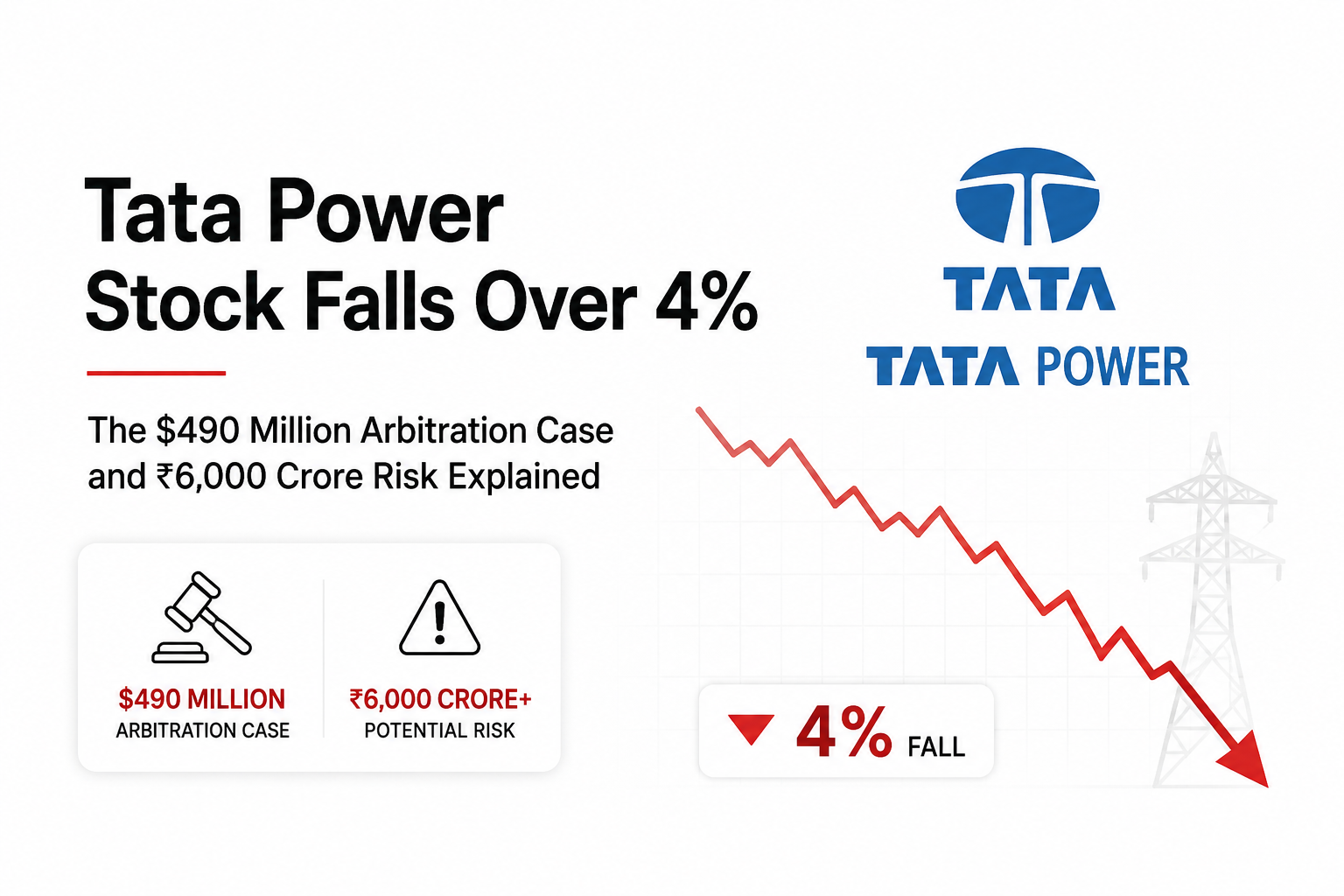
Tata Power shares fell more than 4% on August 27 after the Singapore International Commercial Court rejected the company’s challenge to a $490.32 million arbitration award involving Kleros Capital Partners.
The ruling does not create a brand-new liability. Tata Power has known about the award since 2025. What changed is the probability of the company eventually having to pay it. With interest and costs accumulating, Kleros says the amount now exceeds $640 million, potentially translating into a liability of more than ₹6,000 crore.
That explains why Tata Power stock reacted sharply even though the original arbitration award was already public.
Why Did Tata Power Stock Fall Over 4%?
Tata Power shares dropped more than 4% in Thursday’s trade after the Singapore court dismissed its attempt to set aside the arbitration awards.
The stock touched an intraday low of around ₹348.20, compared with the previous close of ₹365.35, taking it to its lowest level in roughly seven months.
The market reaction was largely about one thing: the legal risk has become more immediate.
Until now, investors could reasonably factor in the possibility that Tata Power might successfully challenge the award. The latest judgment reduces that possibility, although the legal process is not necessarily over.
Tata Power has said it intends to appeal the SICC decision. It has 28 days from August 26, 2026, to approach the Singapore Court of Appeal.
What Is Tata Power’s $490 Million Arbitration Case About?
The dispute goes back to 2013 and involves a proposed coal mining opportunity in Russia.
Kleros Capital Partners approached Tata Power with a proposal to jointly pursue a coal deposit. The two parties entered into agreements that included confidentiality obligations.
Their relationship later deteriorated.
Tata Power eventually pursued the mining opportunity through a Russian subsidiary and secured the licence after its non-disclosure agreement with Kleros had expired. The project was subsequently found to be economically unviable, and Tata Power surrendered the licence.
Kleros, however, alleged that Tata Power had misused confidential information and acted in bad faith by excluding it from the opportunity.
Kleros initiated arbitration proceedings at the Singapore International Arbitration Centre, or SIAC, in November 2020.
“Start investing with confidence! Explore
Lemonn
and grow your wealth.”
What Did the Arbitration Tribunal Decide?
In September 2023, the arbitral tribunal held that Tata Power had breached certain provisions of its agreements with Kleros, including contractual duties relating to good faith and confidence.
The financial consequences followed later.
On July 1, 2025, and August 27, 2025, the SIAC issued the quantum and final awards.
Tata Power’s FY26 financial disclosures state that it was directed to pay:
- $490.32 million as damages for loss of opportunity
- 5.33% simple annual interest on the damages from November 30, 2020
- SGD 11.34 million in costs
- 5.33% simple annual interest on those costs from July 1, 2025
The award was reached by a majority of the three-member tribunal.
Tata Power Arbitration Case Timeline
| Period | What happened |
|---|---|
| 2013 | Kleros approaches Tata Power regarding a Russian coal opportunity |
| 2013 onwards | Parties enter agreements covering confidential information |
| 2020 | Kleros begins SIAC arbitration |
| September 2023 | Tribunal finds Tata Power in breach of certain contractual obligations |
| July 2025 | Tribunal awards $490.32 million in damages plus interest |
| August 2025 | Final arbitration award is issued |
| October 2025 | Tata Power challenges the awards in Singapore |
| August 26, 2026 | SICC dismisses Tata Power’s challenges |
| Next step | Tata Power says it will approach the Singapore Court of Appeal |
What Changed After the Singapore Court Ruling?
The distinction between the arbitration award and the latest court ruling is important.
The $490.32 million damages award is not new. It dates to 2025.
Tata Power challenged the awards before the Singapore International Commercial Court. Among its objections were arguments concerning natural justice, the fair hearing rule, apparent bias, and how the tribunal dealt with issues such as causation and mitigation.
On August 26, 2026, the court dismissed the challenges.
The SICC concluded that there had been no breach of natural justice or the fair hearing rule by the tribunal majority.
In practical terms, the ruling means the arbitration award remains standing unless Tata Power obtains relief through the next stage of the legal process.
That change in probability is what investors are pricing in.
How Does $490 Million Become a ₹6,000 Crore Risk?
The headline damages figure is $490.32 million, but that is not necessarily the amount Tata Power could ultimately have to pay.
Interest has been accumulating for years.
The award carries simple interest of 5.33% annually from November 30, 2020. Costs also carry interest under the final award.
Kleros said following the August 26 judgment that the total amount owed had risen above $640 million, including damages and accumulated interest, with interest continuing to accrue at roughly $71,600 per day.
At prevailing exchange-rate levels, a liability above $640 million can translate into more than ₹6,000 crore.
This is why investors should not simply convert the original $490 million award into rupees and treat that as the maximum exposure.
Is ₹6,000 Crore Tata Power’s Confirmed Liability?
Not quite.
The ₹6,000 crore-plus figure is best understood as an estimate based on the amount Kleros says is currently payable, rather than a fresh ₹6,000 crore award issued by the court.
Tata Power is also continuing to contest the matter.
So investors should distinguish between three numbers:
| Figure | What it represents |
| $490.32 million | Principal damages awarded by the tribunal |
| 5.33% | Simple annual interest applicable to the damages |
| $640+ million | Amount Kleros says is currently due after interest and costs |
The final economic cost to Tata Power will depend on the outcome of further legal proceedings, timing of payment, accumulated interest and any other applicable costs.
How Big Is a ₹6,000 Crore Hit for Tata Power?
A ₹6,000 crore liability would be material even for a company of Tata Power’s size.
For FY26, Tata Power reported:
| FY26 financial metric | Amount |
| Revenue | ₹63,681 crore |
| EBITDA | ₹16,090 crore |
| PAT before exceptional items | ₹5,212 crore |
| Reported PAT | ₹5,118 crore |
Using ₹6,000 crore as an illustrative figure, the potential exposure would be:
- More than Tata Power’s entire FY26 annual profit
- About 37% of FY26 EBITDA
- Roughly 9% of FY26 revenue
Those comparisons show why the market is paying attention.
This does not automatically mean Tata Power faces a solvency problem. The company is a large, diversified power business with ₹63,681 crore in FY26 revenue and ₹16,090 crore in EBITDA.
But a payment running into several thousand crore rupees could still affect cash flows, leverage and capital allocation.
Why Could the Arbitration Matter for Tata Power’s Growth Plans?
Tata Power is investing heavily across India’s energy ecosystem.
Its businesses span conventional generation, renewable power, transmission and distribution, rooftop solar, solar cell and module manufacturing, and other energy solutions.
As of FY26, Tata Power had 16,716 MW of operational generation capacity, including 7,856 MW of clean and green capacity. It also served more than 13.1 million distribution customers.
That means the company has significant capital requirements.
If Tata Power ultimately has to make a large arbitration payment, the direct issue for shareholders is not only the accounting loss. Investors may also need to consider the opportunity cost.
Cash used to satisfy the award could otherwise have been available for:
- Renewable energy projects
- Transmission expansion
- Pumped-storage projects
- Solar manufacturing
- Debt reduction
- Other growth investments
The impact would depend heavily on how Tata Power funds any eventual payment.
Will Tata Power Have to Book a Provision?
This is one of the most important issues to watch in upcoming financial results.
In its FY26 results, Tata Power disclosed the arbitration award and said it had obtained legal advice indicating that it had justifiable grounds to seek the setting aside of the awards, with a high probability of a favourable outcome.
The August 2026 SICC ruling changes the legal backdrop behind that assessment.
That does not allow outside investors to conclude automatically that Tata Power must immediately recognise the entire amount as an expense or provision. Accounting treatment depends on management’s assessment, applicable accounting standards, legal advice and the status of further appeals.
But the next set of financial disclosures will be important.
Investors should look specifically for any change in:
- Contingent liability disclosures
- Provisions
- Exceptional items
- Management’s assessment of the legal case
- Auditor commentary
- Cash flow or borrowing expectations
A change in accounting treatment could have a significant one-time effect on reported earnings.
Does the Arbitration Case Change Tata Power’s Core Business?
The arbitration dispute and Tata Power’s operating businesses should be analysed separately.
Operationally, Tata Power entered FY27 after reporting an 11% increase in FY26 EBITDA to ₹16,090 crore. Reported PAT increased 7% to ₹5,118 crore. Renewables, transmission and distribution, rooftop solar and solar manufacturing were among the businesses contributing to growth.
So the Singapore judgment does not directly mean Tata Power’s power plants, renewable projects or distribution businesses have suddenly become weaker.
The concern is financial.
A large cash outflow could increase funding requirements or reduce the amount of internally generated capital available for expansion.
For long-term shareholders, the relevant question is therefore not simply, “Did Tata Power lose the case?”
It is, “How much will Tata Power ultimately have to pay, when will it have to pay, and how will that affect its balance sheet and growth spending?”
What Happens Next in the Tata Power Arbitration Case?
Tata Power has already indicated its next move.
The company says it has 28 days from August 26, 2026, to appeal the SICC decision to the Singapore Court of Appeal, and it intends to do so.
That means the legal dispute is not necessarily finished.
Investors should watch for the filing of the appeal, any decision on whether enforcement continues while the appeal proceeds, and subsequent disclosures from Tata Power regarding the financial treatment of the award.
Interest is another factor.
If the award remains unpaid while litigation continues, the 5.33% simple interest attached to the damages means the potential cost can continue increasing.
What Should Tata Power Investors Watch Now?
For shareholders, four developments matter most.
- The Court of Appeal proceedings: Tata Power’s success or failure at the next stage could materially alter the probability of payment.
- Accounting treatment: Watch whether management continues treating the award as a contingent matter or recognises a provision or exceptional charge.
- Cash flow and debt: Any eventual payment could affect borrowing requirements and the pace of deleveraging.
- Capital expenditure: Tata Power has substantial investment plans. Investors should monitor whether the dispute changes project timelines or funding decisions.
The 4% share-price fall reflects greater uncertainty, but a single day’s market reaction does not determine Tata Power’s long-term investment case.
The more useful approach is to separate the legal risk from the performance of the underlying businesses and then assess how the potential liability changes Tata Power’s financial position.
FAQs
Q. Why did Tata Power stock fall today?
Tata Power shares fell more than 4% on August 27, 2026, after the Singapore International Commercial Court dismissed the company’s challenge to a $490.32 million arbitration award in favour of Kleros Capital Partners.
Q. What is the Tata Power and Kleros arbitration case?
The dispute relates to a proposed Russian coal mining opportunity. Kleros alleged that Tata Power breached contractual obligations involving confidential information and acted in bad faith. Arbitration proceedings began in Singapore in 2020.
Q. How much does Tata Power have to pay Kleros?
The tribunal awarded $490.32 million in damages, plus 5.33% simple annual interest from November 30, 2020, along with costs and interest on those costs. Kleros says the amount now exceeds $640 million.
Q. Why is Tata Power’s potential liability above ₹6,000 crore?
The $490.32 million figure represents principal damages. Interest has been accumulating since November 2020, while legal costs and interest on those costs also apply. Kleros says the total amount has consequently risen above $640 million.
Q. Has Tata Power lost the arbitration case completely?
Tata Power has lost its latest challenge before the Singapore International Commercial Court, but it has said it will appeal the decision to the Singapore Court of Appeal. Therefore, further legal proceedings remain possible.
Q. Will Tata Power stock recover?
That cannot be predicted reliably from the court ruling alone. The stock’s future performance will depend on the appeal, the final financial cost of the dispute, Tata Power’s earnings, debt, growth execution and broader market conditions.
Key Takeaways
- Tata Power shares fell over 4% after a Singapore court rejected its challenge to a $490.32 million arbitration award.
- The original damages award is not new. The key development is that Tata Power’s attempt to overturn it has failed at the SICC.
- The award carries 5.33% simple annual interest from November 2020, plus costs and related interest.
- Kleros says the total amount now exceeds $640 million, creating potential exposure of more than ₹6,000 crore.
- A ₹6,000 crore hit would exceed Tata Power’s FY26 annual profit and equal roughly 37% of FY26 EBITDA.
- Tata Power intends to appeal to the Singapore Court of Appeal.
- Investors should now watch the appeal, accounting provisions, cash-flow implications and any impact on Tata Power’s growth capex.
This article is for informational and educational purposes only and should not be treated as investment advice.
Disclaimer
The stocks mentioned in this article are not recommendations. Please conduct your own research and due diligence before investing. Investment in securities market are subject to market risks, read all the related documents carefully before investing. Please read the Risk Disclosure documents carefully before investing in Equity Shares, Derivatives, Mutual fund, and/or other instruments traded on the Stock Exchanges. As investments are subject to market risks and price fluctuation risk, there is no assurance or guarantee that the investment objectives shall be achieved. Lemonn do not guarantee any assured returns on any investments. Past performance of securities/instruments is not indicative of their future performance.
To read the RA disclaimer
Research Analyst - Gaurav Garg
Related Posts


Download Lemonn
Download my share market app for stock trading—trade stocks effortlessly in the market.



