
E20 Stocks to Watch in India: Top Ethanol Plays
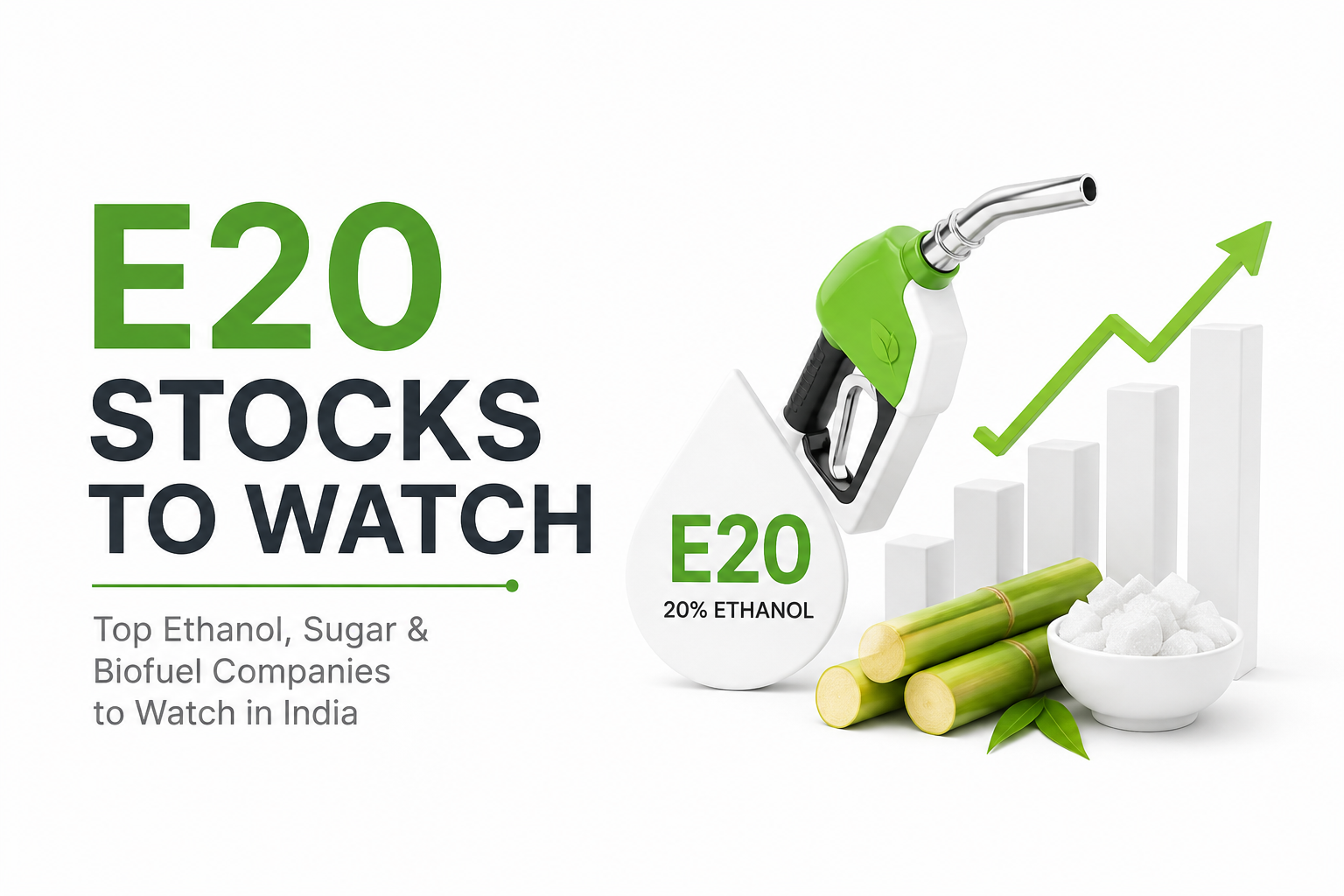
India’s shift to E20 petrol, a blend of 20% ethanol and 80% petrol, has created a long-term investment theme around ethanol, sugar, biofuels and ethanol plant technology. For investors looking for E20 stocks to watch in India, Praj Industries, Balrampur Chini Mills, Triveni Engineering, EID Parry and other ethanol-linked companies deserve closer attention.
The opportunity is significant, but not every ethanol stock benefits in the same way. Some companies manufacture ethanol, while others supply the technology and equipment needed to build ethanol plants.
Here are the key E20 stocks investors can put on their watchlist and the factors that could drive their performance.
What Is E20 Fuel?
E20 is petrol blended with 20% ethanol. Ethanol is a renewable fuel that can be produced from sugarcane, molasses, maize, damaged food grains and other approved feedstocks.
India’s Ethanol Blended Petrol (EBP) Programme aims to reduce dependence on imported crude oil while creating additional demand for domestically produced ethanol.
India’s average ethanol blending increased from around 1.5% in 2013-14 to 20% in 2025-26. The country reached the 20% target five years ahead of its original 2030 timeline.
Ethanol production capacity has also expanded sharply, from 421 crore litres in 2014 to around 2,000 crore litres in 2026. Ethanol procurement is projected to exceed 1,200 crore litres in the 2025-26 ethanol supply year.
That expansion is why E20 has become more than an auto-fuel story. It is also an investment theme spanning sugar companies, grain-based ethanol producers, engineering companies and bioenergy businesses.
Best E20 Stocks to Watch in India
The following companies have direct or indirect exposure to India’s ethanol ecosystem.
| E20 stock | E20 exposure | Key factor to track |
|---|---|---|
| Praj Industries | Ethanol technology and plant engineering | Bioenergy orders and margins |
| Balrampur Chini Mills | Sugar and ethanol production | Distillery utilisation and feedstock |
| Triveni Engineering | Sugar and distillery operations | Ethanol volumes and profitability |
| EID Parry | Sugar and distillery business | Ethanol production and cane economics |
| Dalmia Bharat Sugar | Sugar and ethanol | Capacity utilisation |
| Dhampur Sugar Mills | Sugar and biofuels | Ethanol sales and sugar prices |
| Shree Renuka Sugars | Sugar refining and ethanol | Debt, margins and ethanol contribution |
| Uttam Sugar Mills | Sugar and ethanol | Earnings and distillery utilisation |
Let’s look at some of the key names more closely.
“Start investing with confidence! Explore
Lemonn
and grow your wealth.”
1. Praj Industries
Praj Industries is one of the most distinctive E20 stocks because its exposure comes primarily from ethanol technology and engineering, rather than simply producing sugar and ethanol.
The company provides technologies and engineering solutions for bioenergy projects. As ethanol producers invest in new plants, expand existing distilleries or adopt newer feedstocks, companies supplying the underlying technology can participate in that capex cycle.
Why watch Praj Industries?
Investors should monitor:
- Bioenergy order inflows
- Domestic ethanol capacity additions
- International biofuel opportunities
- Project execution
- Operating margins
- Development of advanced biofuels
Praj can therefore be viewed as a “picks and shovels” play on India’s biofuel ecosystem.
Its risks are different from those of a sugar company. A slowdown in ethanol-related capital expenditure, weaker order execution or margin pressure could affect earnings even if ethanol blending itself remains strong.
2. Balrampur Chini Mills
Balrampur Chini Mills is one of India’s established integrated sugar companies, with exposure to sugar, ethanol and related businesses.
Its distillery operations make it a direct beneficiary of ethanol demand from oil marketing companies.
Why watch Balrampur Chini Mills?
Important factors include:
- Ethanol production volumes
- Distillery capacity utilisation
- Sugarcane availability
- Feedstock allocation
- Ethanol procurement prices
- Domestic sugar prices
- Government sugar and ethanol policies
For investors, the key point is that Balrampur is not a pure ethanol company. Its profitability can also be influenced substantially by the sugar cycle.
3. Triveni Engineering and Industries
Triveni Engineering and Industries combines sugar operations with distillery capacity, giving it direct exposure to India’s ethanol blending programme.
Higher distillery utilisation can potentially improve the revenue mix, particularly when ethanol economics are favourable compared with selling sugar.
What should investors track?
Watch:
- Ethanol sales volumes
- Distillery utilisation
- Feedstock mix
- Sugar realisations
- Cane costs
- Ethanol pricing
- Government allocation policies
The company’s diversified operations can be useful, but investors still need to understand how much of its earnings actually come from ethanol-related activities.
4. EID Parry
EID Parry is another established sugar producer with distillery operations.
Its scale and integrated business make it one of the larger listed companies investors may examine when researching the Indian ethanol theme.
Why is EID Parry an E20 stock to watch?
Key triggers include:
- Ethanol volumes
- Distillery expansion
- Sugarcane availability
- Sugar prices
- Production costs
- Changes in ethanol procurement policy
Investors should evaluate EID Parry on consolidated business fundamentals rather than treating it as a pure-play ethanol stock.
5. Dalmia Bharat Sugar and Industries
Dalmia Bharat Sugar operates across sugar, ethanol and power-related businesses.
Its ethanol operations provide exposure to the E20 theme, while integration with the sugar business can provide access to feedstock such as molasses and sugarcane-based inputs.
What matters for the stock?
Look at:
- Distillery capacity
- Ethanol production
- Capacity utilisation
- Feedstock economics
- Sugar production
- Debt and capital expenditure
A strong ethanol cycle does not automatically translate into stronger profits if input costs or other parts of the business deteriorate.
6. Dhampur Sugar Mills
Dhampur Sugar Mills is another listed sugar company with exposure to ethanol and biofuel production.
Its investment case is closely linked to both ethanol economics and the broader sugar cycle.
Investors should pay attention to ethanol sales, sugar prices, cane costs, debt and operating margins.
7. Shree Renuka Sugars
Shree Renuka Sugars is a major sugar and refining company with ethanol exposure.
Its size makes it a recognizable name within the sugar and ethanol theme, but investors need to consider its complete financial position rather than focusing only on India’s E20 policy.
Key factors to monitor
These include:
- Ethanol production
- Refining margins
- Debt levels
- Interest costs
- Sugar prices
- Operating cash flow
High ethanol demand cannot compensate indefinitely for weak balance-sheet fundamentals, so debt deserves particular attention when analysing companies in this sector.
8. Uttam Sugar Mills
Uttam Sugar Mills is a smaller sugar and ethanol-linked company that can also appear on an E20 stock watchlist.
Smaller companies can sometimes react sharply to changes in sugar prices, ethanol policy or earnings expectations.
That potential upside also comes with higher risk.
Investors should closely monitor earnings quality, leverage, distillery utilisation, cash flows and trading liquidity before considering smaller ethanol stocks.
Why Is E20 a Major Investment Theme in India?
The strongest argument behind the ethanol theme is the scale of India’s transition.
Average blending increased from roughly 8.1% in 2020-21 to 10% in 2021-22, 12.1% in 2022-23, 14.6% in 2023-24 and around 19.2% in 2024-25. It reached 20% during November 2025 to June 2026.
| Ethanol supply year | Average blending |
| 2020-21 | ~8.1% |
| 2021-22 | 10.0% |
| 2022-23 | ~12.1% |
| 2023-24 | 14.6% |
| 2024-25 | ~19.2% |
| 2025-26 (Nov-Jun) | 20% |
The expansion has required investments across the ethanol value chain, from feedstock and distilleries to storage, transportation and plant technology.
Is India Moving Beyond E20?
This is an important distinction for investors.
As of July 2026, the government said no decision had been taken to increase nationwide ethanol blending beyond 20%. Any move toward a higher blend would require technical studies and consultation with automakers, oil marketing companies and research institutions.
India has introduced E85 for compatible flex-fuel vehicles, but E85 should not be confused with a nationwide increase in the standard petrol blend.
Investors should therefore avoid building an investment thesis on assumptions that E25 or E30 is guaranteed to become India’s next nationwide standard.
What Could Drive E20 Stocks Higher?
Several factors could support ethanol-linked companies over the medium to long term.
Continued ethanol demand
Maintaining E20 requires a large and reliable supply of ethanol every year. That creates recurring demand for domestic producers.
India’s ethanol production capacity reached around 2,000 crore litres in 2026, compared with 421 crore litres in 2014.
Wider range of feedstocks
Ethanol is no longer only a sugarcane story.
Grain-based ethanol has become increasingly important. In August 2026, the government said nearly three-fourths of ethanol produced in India comes from grains, particularly maize.
This matters when selecting E20 stocks because companies with flexible feedstock capabilities may have different economics from traditional sugar-based ethanol producers.
Domestic sourcing
India’s fuel-blending ethanol is currently sourced domestically. In August 2026, the government clarified that ethanol used under the EBP Programme was sourced entirely from domestic producers and that there had been no policy change allowing large-scale US ethanol imports for fuel blending.
That provides an important policy backdrop for India’s domestic ethanol industry.
What Are the Risks of Investing in E20 Stocks?
E20 may be a structural theme, but E20 stocks are not automatically good investments.
1. Government policy risk
Ethanol is a policy-sensitive industry. Procurement prices, feedstock availability and blending requirements can materially affect producer economics.
2. Sugar price volatility
Many ethanol producers are also sugar companies.
Changes in sugar prices can therefore have a major effect on earnings, even when ethanol demand remains healthy.
3. Feedstock costs
Sugarcane, molasses, maize and other feedstocks have their own supply and pricing cycles.
Rising feedstock costs can squeeze ethanol margins.
4. Weather risk
Sugarcane and grain production depend partly on rainfall and crop conditions. Poor harvests can affect both availability and costs.
5. Valuation risk
A good industry theme does not necessarily mean a stock is available at a good price.
If future ethanol growth is already reflected in the valuation, investors may have limited room for error.
How to Choose an E20 Stock
Instead of buying a company simply because it is described as an “ethanol stock,” evaluate how ethanol actually affects its business.
A useful checklist includes:
- Ethanol capacity: How much ethanol can the company produce?
- Capacity utilisation: Is that capacity being used efficiently?
- Revenue contribution: How important is ethanol to overall earnings?
- Feedstock flexibility: Can the company use multiple feedstocks?
- Debt: Did capacity expansion create excessive leverage?
- Cash flow: Is the business generating cash from operations?
- Margins: Are ethanol operations actually profitable?
- Valuation: How much future growth is already priced into the stock?
- Management execution: Has the company delivered previous expansion plans?
- Policy sensitivity: How exposed are earnings to government pricing and allocation decisions?
This analysis can help separate companies that merely have ethanol capacity from businesses that can convert industry growth into sustainable earnings.
Which E20 Stocks Deserve the Closest Attention?
For investors building a focused E20 watchlist, Praj Industries, Balrampur Chini Mills, Triveni Engineering and EID Parry are useful starting points for research.
Praj Industries offers a different type of exposure because it supplies technology and engineering solutions to the bioenergy sector.
Balrampur Chini and Triveni Engineering provide more direct exposure through ethanol and sugar operations, while EID Parry offers exposure through a larger integrated business.
The right choice depends on whether an investor wants exposure to ethanol infrastructure, ethanol production or diversified sugar and bioenergy businesses.
FAQs About E20 Stocks in India
Q. What are E20 stocks?
E20 stocks are listed companies that could benefit directly or indirectly from India’s 20% ethanol-blended petrol programme. They can include ethanol producers, sugar companies, grain-based distilleries and companies supplying ethanol plant technology.
Q. Which are the top E20 stocks to watch in India?
Praj Industries, Balrampur Chini Mills, Triveni Engineering, EID Parry, Dalmia Bharat Sugar, Dhampur Sugar Mills, Shree Renuka Sugars and Uttam Sugar Mills are among the companies investors can research for ethanol-related exposure.
Q. Is Praj Industries an ethanol stock?
Praj Industries is an ethanol technology and engineering play rather than a conventional sugar-based ethanol producer. Its bioenergy business provides technology and engineering solutions used in ethanol and other biofuel projects.
Q. Which sugar stocks can benefit from E20?
Integrated sugar companies with meaningful distillery operations can potentially benefit from sustained ethanol demand. Balrampur Chini Mills, Triveni Engineering, EID Parry and Dalmia Bharat Sugar are examples worth researching.
Q. Has India achieved 20% ethanol blending?
Yes. Government data show average ethanol blending reached 20% during November 2025 to June 2026, compared with around 19.2% during 2024-25.
Q. Will India move from E20 to E30?
There is currently no confirmed nationwide E30 mandate. In July 2026, the government stated that no decision had been taken to increase the nationwide ethanol blending level beyond 20%.
Q. Are E20 stocks good for long-term investment?
India’s ethanol programme creates a structural opportunity, but individual stocks still need to be assessed on earnings, debt, margins, cash flow, feedstock economics and valuation. A growing industry does not guarantee strong returns from every company operating in it.
Key Takeaways
- India has reached the 20% ethanol blending level, making ethanol an established part of the country’s fuel ecosystem.
- Praj Industries, Balrampur Chini Mills, Triveni Engineering and EID Parry are among the key E20 stocks worth researching.
- India’s ethanol production capacity has increased to around 2,000 crore litres in 2026.
- Grain-based ethanol is becoming increasingly important, so the theme is broader than sugar stocks alone.
- Investors should track ethanol volumes, feedstock costs, sugar prices, debt, margins and government policy.
- There is no confirmed nationwide blending mandate beyond E20 at present.
- E20 is a promising investment theme, but company fundamentals and valuation remain more important than the theme itself.
Disclaimer: This article is for educational and informational purposes only and should not be considered investment advice. Investors should conduct independent research and consider their financial objectives and risk tolerance before making investment decisions.
Disclaimer
The stocks mentioned in this article are not recommendations. Please conduct your own research and due diligence before investing. Investment in securities market are subject to market risks, read all the related documents carefully before investing. Please read the Risk Disclosure documents carefully before investing in Equity Shares, Derivatives, Mutual fund, and/or other instruments traded on the Stock Exchanges. As investments are subject to market risks and price fluctuation risk, there is no assurance or guarantee that the investment objectives shall be achieved. Lemonn do not guarantee any assured returns on any investments. Past performance of securities/instruments is not indicative of their future performance.
To read the RA disclaimer
Research Analyst - Gaurav Garg
Related Posts


Download Lemonn
Download my share market app for stock trading—trade stocks effortlessly in the market.



