BSE to Replace Wipro in Nifty 50 From September 30
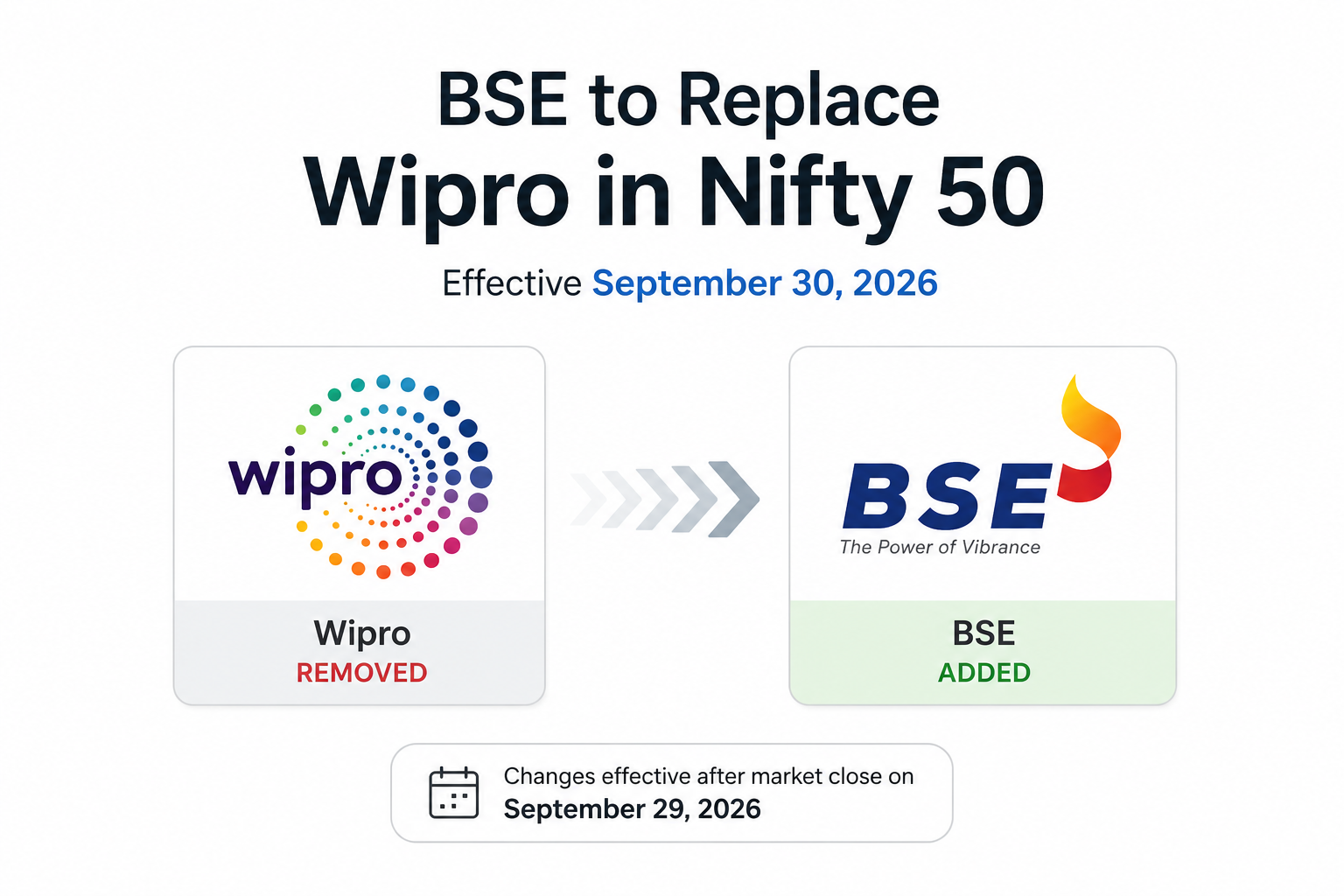
BSE Ltd will replace Wipro in the Nifty 50 index from September 30, 2026, following the latest semi-annual index review by NSE Indices. The changes will be implemented after the market closes on September 29.
The reshuffle is significant for both stocks. BSE could see substantial buying from passive funds that track the Nifty 50, while Wipro could face corresponding selling as these funds adjust their portfolios.
What is changing in the Nifty 50?
The upcoming Nifty 50 reshuffle involves one key replacement:
| Stock | Nifty 50 change | Effective date |
|---|---|---|
| BSE Ltd | Added | September 30, 2026 |
| Wipro Ltd | Removed | September 30, 2026 |
The adjustment is part of NSE Indices’ periodic review of its benchmark indices. The changes take effect after the close of trading on September 29, meaning the revised index will apply from September 30.
For investors, the important point is that an index inclusion or exclusion does not directly change a company’s underlying business. It changes which stocks index-tracking funds need to own.
Why is BSE replacing Wipro in the Nifty 50?
BSE had emerged as a strong candidate for Nifty 50 inclusion well before the final reshuffle.
Earlier analysis from Quiddity Advisors indicated that BSE met a key inclusion threshold because its average free-float market capitalisation was more than 1.5 times that of Wipro.
Free-float market capitalisation considers the value of shares that are readily available for public trading rather than a company’s entire market capitalisation.
This matters because the Nifty 50 is designed to represent large, liquid companies in India’s equity market. Its constituents are periodically reviewed as companies’ relative market size and eligibility change.
“Start investing with confidence! Explore
0 demat account
and grow your wealth.”
Why has BSE become large enough for the Nifty 50?
BSE has grown considerably as a listed exchange business, supported in part by its increasing presence in India’s derivatives market.
By May 2026, BSE’s market capitalisation stood at about ₹1.71 trillion, putting it 49th in the overall market-cap rankings cited by Business Standard at the time.
That rise strengthened its case for a place among India’s 50 benchmark stocks.
There is also an unusual detail to the inclusion. BSE shares are listed on the NSE, rather than on BSE itself, because stock exchanges cannot self-list under the current framework.
How much money could flow into BSE after Nifty 50 inclusion?
BSE’s Nifty 50 inclusion could generate hundreds of millions of dollars in passive buying.
Nuvama estimates cited after the announcement put potential passive inflows into BSE at approximately $695 million.
Earlier estimates varied depending on the stock price, index weights and assumptions used. For example:
- Quiddity Advisors estimated potential BSE inflows of around $639 million in May.
- Axis Capital had estimated approximately $657 million of inflows.
- More recent estimates cited after the confirmed reshuffle put the figure close to $695 million.
These numbers are estimates, not guaranteed inflows. Actual flows can change with BSE’s share price, index weight and assets tracking the Nifty 50.
Why does Nifty 50 inclusion create passive inflows?
Index funds and ETFs are designed to replicate an index as closely as possible.
When BSE enters the Nifty 50, funds tracking the benchmark generally need to purchase BSE shares so their portfolios reflect the new index composition.
The reverse happens to Wipro.
Funds that replicate the Nifty 50 will generally have to remove Wipro from their portfolios or reduce exposure associated with the index rebalance.
This creates what investors often call passive flows.
Simple example
Suppose a Nifty 50 index fund manages ₹10,000 crore.
If BSE receives a hypothetical 1% weight in the index, the fund would need roughly ₹100 crore of BSE shares to replicate that weight, subject to tracking methodology and market movements.
Multiply that adjustment across ETFs, index funds and institutional portfolios benchmarked against the Nifty 50, and the total trading requirement can become substantial.
What does the Nifty 50 exit mean for Wipro?
Wipro’s removal from the Nifty 50 is likely to result in mechanical selling by passive funds, but an index exclusion is not the same as a negative verdict on the company’s business.
Wipro can continue to gain or lose value based on factors such as:
- Revenue and earnings growth
- IT spending by global clients
- Deal wins and order pipeline
- Operating margins
- Currency movements
- Management execution
- Valuation
- Broader conditions in the IT sector
The index change primarily reflects whether Wipro continues to meet the relevant criteria relative to other eligible companies.
Will Wipro disappear from NSE indices?
No.
The broader NSE index reshuffle also changes the composition of indices such as the Nifty 100 and Nifty Next 50. Wipro features among the companies affected by those revisions.
Being removed from the Nifty 50 therefore does not mean Wipro is being delisted from the stock market.
Is BSE joining the Nifty 50 good for its share price?
Nifty 50 inclusion can create additional demand for BSE shares because passive funds need to adjust their portfolios.
That does not guarantee that BSE’s share price will rise.
Markets often anticipate index changes months before they become effective. In fact, analysts had identified BSE as the likely replacement for Wipro as early as May 2026.
By the time an inclusion becomes official, some investors may already have positioned themselves for the expected passive flows.
BSE’s longer-term share price will ultimately depend more on business fundamentals, including trading activity, transaction revenue, market share, costs, regulation, competition and earnings growth.
Should investors buy BSE because it is entering the Nifty 50?
Nifty 50 inclusion alone should not be treated as a reason to buy a stock.
Investors considering BSE need to separate two factors:
Short-term index impact
Passive funds may have to buy BSE shares around the index rebalance, potentially increasing trading activity.
Long-term investment case
Over longer periods, BSE’s valuation should depend primarily on the performance of its underlying exchange business.
Before investing, it is worth examining:
- Revenue and profit growth
- Market share across different trading segments
- Derivatives volumes
- Regulatory developments
- Competition with NSE and other market infrastructure businesses
- Valuation relative to expected growth
- Dependence on transaction-linked revenue
A company entering the Nifty 50 can still be expensive at a particular share price. Index membership and valuation are two separate questions.
What should Wipro shareholders do after the Nifty 50 exit?
Existing Wipro investors do not need to sell simply because the stock is leaving the Nifty 50.
An investor who owns Wipro shares directly will continue to own the same shares after September 30.
The more useful question is whether the reasons for owning Wipro have changed.
For a long-term investor, that means reviewing its earnings growth, margins, competitive position, client spending trends and valuation rather than making a decision solely on index membership.
Investors in a Nifty 50 index fund or ETF do not need to make any manual adjustment. The fund manager handles constituent changes as part of the index-tracking process.
Why does NSE change Nifty 50 companies?
The Nifty 50 is not a permanent list of India’s biggest companies.
Its composition is periodically reviewed so that the index continues to represent the country’s large and liquid listed companies.
Over time, businesses grow at different rates. Some companies become larger and more actively traded, while others fall behind on the metrics used for index eligibility.
Periodic rebalancing allows the benchmark to reflect those changes.
When will BSE officially enter the Nifty 50?
The revised Nifty 50 composition will become effective September 30, 2026.
The portfolio changes are scheduled to be implemented after the market closes on September 29, 2026.
Investors may therefore see elevated trading activity around the rebalance as index-tracking funds align their portfolios with the new composition.
What does the BSE-Wipro reshuffle mean for investors?
The biggest immediate impact is likely to come from passive fund rebalancing.
BSE’s inclusion requires Nifty 50-tracking portfolios to add the stock, while Wipro’s exclusion requires corresponding adjustments in the opposite direction.
For long-term investors, however, index membership should remain only one part of the analysis.
BSE still needs to deliver earnings that justify its valuation, while Wipro’s future returns will depend far more on its business performance than on whether it sits inside the Nifty 50.
FAQs
Q. When will BSE replace Wipro in the Nifty 50?
BSE will enter the Nifty 50 from September 30, 2026, replacing Wipro. The changes will be implemented after trading closes on September 29.
Q. Why is Wipro being removed from the Nifty 50?
The change follows NSE Indices’ periodic review of its benchmarks. BSE had surpassed the relevant relative free-float market-cap threshold identified by analysts ahead of the review, making it a leading candidate to replace Wipro.
Q. How much passive inflow could BSE receive?
Recent estimates cited by The Economic Times suggest BSE could receive approximately $695 million in passive inflows, although the actual amount can vary.
Q. Will Wipro shares be delisted after leaving the Nifty 50?
No. Removal from the Nifty 50 does not mean Wipro is being delisted. Its shares will continue to trade normally on the stock exchanges.
Q. Do Nifty 50 index fund investors need to buy BSE themselves?
No. Investors in Nifty 50 index funds or ETFs generally do not need to take any action. Fund managers adjust their portfolios to reflect changes in the underlying index.
Q. Does Nifty 50 inclusion guarantee that BSE shares will rise?
No. Inclusion can generate passive buying, but it does not guarantee higher returns. Share prices also reflect expectations, valuation, earnings, regulation and broader market conditions.
Key takeaways
- BSE will replace Wipro in the Nifty 50 from September 30, 2026.
- The index changes will be implemented after the market closes on September 29.
- BSE’s inclusion could generate substantial passive buying, with a recent estimate putting potential inflows at roughly $695 million.
- Wipro’s exclusion can lead to passive selling by Nifty 50-tracking funds, but it does not change Wipro’s underlying business or mean the stock is being delisted.
- Nifty 50 index fund and ETF investors generally do not need to take action because portfolio rebalancing is handled by the fund.
- Investors should evaluate BSE and Wipro based on business fundamentals and valuation rather than treating index inclusion or exclusion as a standalone buy or sell signal.
Disclaimer
The stocks mentioned in this article are not recommendations. Please conduct your own research and due diligence before investing. Investment in securities market are subject to market risks, read all the related documents carefully before investing. Please read the Risk Disclosure documents carefully before investing in Equity Shares, Derivatives, Mutual fund, and/or other instruments traded on the Stock Exchanges. As investments are subject to market risks and price fluctuation risk, there is no assurance or guarantee that the investment objectives shall be achieved. Lemonn (Formerly known as NU Investors Technologies Pvt. Ltd) do not guarantee any assured returns on any investments. Past performance of securities/instruments is not indicative of their future performance.
Related Posts


Download Lemonn
Download my app for share market trading, ipo investment, trading account, and all your investment needs.