Intimation u/s 143(1) Received? How to Get Your Refund
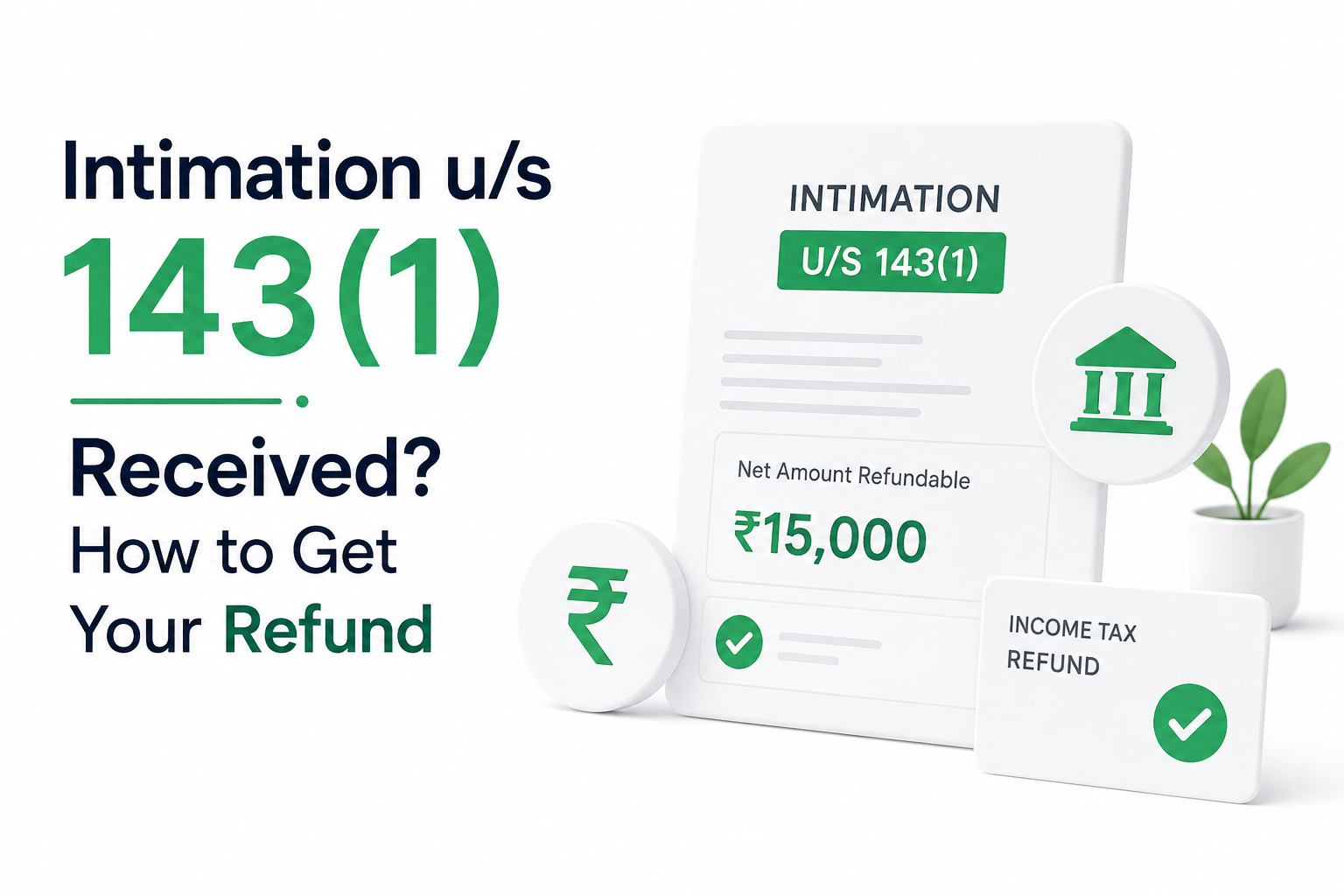
Received an intimation u/s 143(1) with a refund amount? In most cases, there is nothing to worry about. It means the Income Tax Department has processed your Income Tax Return (ITR) and, after its preliminary checks, determined that a refund is payable to you.
If the refund amount in the intimation is correct, you generally do not need to respond to the intimation. However, you should check your refund status and make sure your bank account is validated and nominated for receiving the refund.
Here is what to check and what to do next.
What Is an Intimation Under Section 143(1)?
An intimation under Section 143(1) is issued after your ITR is processed by the Income Tax Department’s Centralised Processing Centre (CPC).
During processing, the information reported in your return is checked and the tax calculation is determined. The resulting intimation may show:
- No tax payable and no refund
- An income tax refund
- A tax demand
- A refund amount different from what you claimed
So, receiving an intimation u/s 143(1) does not automatically mean there is a problem with your return.
What Does a Refund in Intimation u/s 143(1) Mean?
If your 143(1) intimation shows “Net Amount Refundable,” the Income Tax Department has determined that you have paid more tax than your final tax liability, subject to any applicable adjustments.
A refund may arise because of excess:
- Tax Deducted at Source (TDS)
- Tax Collected at Source (TCS)
- Advance tax
- Self-assessment tax
The Income Tax Department defines an income tax refund as an amount initiated when taxes paid exceed the actual tax due after considering the applicable deductions and exemptions.
“Start investing with confidence! Explore
0 demat account
and grow your wealth.”
Simple example
Suppose your final tax liability is ₹75,000, but ₹90,000 has already been paid through TDS.
Your calculation would broadly look like this:
| Particulars | Amount |
|---|---|
| Total tax liability | ₹75,000 |
| TDS already deducted | ₹90,000 |
| Excess tax paid | ₹15,000 |
| Refund, subject to processing | ₹15,000 |
If CPC accepts these figures during processing, the intimation may show a refund of ₹15,000, subject to applicable interest or adjustments.
What Should You Do After Receiving a 143(1) Intimation With Refund?
If you have received an intimation u/s 143(1) showing a refund, follow these steps.
1. Check the refund amount in the intimation
Open the intimation and compare the figures under the taxpayer’s return and the amount computed under Section 143(1).
Pay particular attention to:
- Total income
- Deductions
- Tax liability
- TDS and TCS
- Advance tax
- Self-assessment tax
- Interest, if applicable
- Net amount refundable
If the CPC computation matches your return and the refund looks correct, you usually do not need to file a response simply because the intimation was issued.
2. Check whether your bank account is validated
Your bank account details are particularly important when a refund is due.
According to the Income Tax Department, only a validated bank account can be nominated to receive an income tax refund.
On the e-Filing portal, check the bank account registered under your profile and make sure the relevant account is valid and eligible for receiving the refund.
A refund may fail if, for example:
- The bank account is not pre-validated
- The bank account holder’s name does not match PAN details
- The IFSC is invalid
- The bank account has been closed
These are among the refund failure reasons specifically identified by the Income Tax Department.
3. Check your income tax refund status
You can track the refund through the Income Tax e-Filing portal.
The current process given by the Income Tax Department is:
- Log in to the e-Filing portal.
- Go to e-File.
- Select Income Tax Returns.
- Click View Filed Returns.
- Select the relevant Assessment Year.
- Click View Details to check the ITR lifecycle and refund status.
The portal may show whether the refund has been issued, adjusted, partially adjusted, or failed.
How Long Does a Refund Take After Intimation u/s 143(1)?
Receiving the 143(1) intimation and receiving the money in your bank account are not necessarily the same event.
The Income Tax Department’s refund status guidance states that refund processing begins after the return has been e-verified and that a refund usually takes around four to five weeks to be credited. If it is not received within that period, taxpayers are advised to check their ITR for discrepancies, review communications from the department, and track the refund status online.
This is a general timeline, not a guaranteed deadline. Actual processing time can vary depending on the return and refund status.
What If 143(1) Shows a Refund but It Is Not Credited?
First, check the status of the refund rather than filing another return immediately.
The next step depends on what the portal shows.
| Refund status or issue | What to check |
| Refund determined but not received | Check refund status and bank details |
| Refund failed | Check bank validation, PAN details, IFSC and account status |
| Refund adjusted | Review the adjustment and outstanding demand |
| Refund lower than expected | Compare ITR figures with the 143(1) computation |
| PAN inoperative | Check PAN-Aadhaar linkage requirements |
| Bank account issue corrected | Consider refund reissue if the earlier refund failed |
What if the refund failed?
If the Income Tax Department issued the refund but it failed, you can use the Refund Reissue facility on the e-Filing portal.
The department states that a refund reissue request can be raised where an issued refund has failed. A validated bank account is required for the process.
The broad process is:
- Log in to the Income Tax e-Filing portal.
- Go to Services.
- Select Refund Reissue.
- Click Create Refund Reissue Request.
- Select the relevant refund record.
- Choose the validated bank account.
- Proceed with verification.
- Complete e-Verification.
Do not raise a refund reissue request merely because the refund has not arrived immediately after receiving the intimation. First check whether a refund was actually issued and whether it failed.
What If the Refund in 143(1) Is Less Than the Refund Claimed?
Suppose you claimed a refund of ₹30,000 in your ITR, but the 143(1) intimation determines only ₹18,000.
Do not focus only on the ₹12,000 difference. Compare the computation line by line to understand why the refund changed.
Check for differences relating to:
- Income considered
- Deductions
- TDS or TCS credit
- Advance tax
- Self-assessment tax
- Applicable interest
- Other adjustments reflected in the intimation
The correct course of action depends on the reason for the difference.
Can You File a Rectification for a Wrong 143(1) Intimation?
Yes, rectification may be available when there is a mistake apparent from the record in an intimation issued under Section 143(1).
The Income Tax Department specifically states that a rectification request can be submitted through the e-Filing portal for a mistake apparent from the record in a Section 143(1) intimation. If CPC processed the return and determined a lower refund or raised a demand, an online rectification request can be filed with CPC where appropriate.
However, rectification is not a way to rewrite your original ITR or make a fresh claim that was never part of the record.
Before filing one, identify whether the problem is genuinely a rectifiable mistake or whether another tax compliance route is required.
What If PAN Is Not Linked With Aadhaar?
PAN status can also affect the release of a refund where the PAN is required to be linked with Aadhaar.
The Income Tax Department’s refund guidance states that a refund can fail when the PAN is inoperative because it has not been linked with Aadhaar. The department has also issued communications stating that determined refunds and applicable interest may remain on hold under Section 139AA(2), read with Rule 114AAA, where PAN is inoperative.
Taxpayers who are subject to PAN-Aadhaar linking requirements should therefore check their PAN status if a determined refund remains on hold.
Do You Need to Respond to Intimation u/s 143(1) If a Refund Is Due?
If the intimation correctly shows your income, taxes and refund, you generally do not need to submit a response just because a refund has been determined.
Instead:
- Verify the computation.
- Check your bank account details.
- Track the refund status.
- Wait for the refund to be processed.
- Take corrective action only if there is a discrepancy, adjustment or refund failure.
Keep a copy of the intimation and your filed ITR for your records.
143(1) Refund Checklist
Before considering the matter complete, check these five points:
- Refund amount in the intimation is correct
- TDS/TCS and tax payments are correctly considered
- Bank account is validated and eligible for refund
- PAN status does not create a refund issue
- Refund status has been checked on the e-Filing portal
If all the details are correct and the refund is being processed, no immediate corrective filing may be required.
FAQs About Intimation u/s 143(1) and Income Tax Refund
Q. Is intimation u/s 143(1) an income tax notice?
A 143(1) intimation is a communication issued after processing your Income Tax Return. It can show a refund, demand, adjustment, or no amount payable/refundable. Receiving one does not by itself mean that you are facing detailed scrutiny or assessment.
Q. What should I do if intimation u/s 143(1) shows a refund?
Check whether the refund amount and tax computation are correct. If they are, verify your bank account details and monitor the refund status on the Income Tax e-Filing portal.
Q. Does receiving intimation u/s 143(1) mean my refund is approved?
A refund shown in the intimation means CPC has determined a refund based on the processed return. However, the amount may not have reached your bank yet. Check the refund status separately to confirm whether it has been issued or credited.
Q. How many days after 143(1) intimation will I get my refund?
There is no fixed number of days applicable to every taxpayer. The Income Tax Department’s current guidance says refunds usually take around four to five weeks to be credited after e-verification, although actual timelines can vary.
Q. Why is my income tax refund not credited even after receiving the intimation?
Possible reasons include the refund still being processed, a bank account validation issue, incorrect bank details, an invalid IFSC, a closed account, an adjustment against a demand, or an inoperative PAN. Check the refund status first to identify the specific issue.
Q. What should I do if my income tax refund has failed?
Correct the reason for failure, make sure you have an eligible validated bank account, and submit a Refund Reissue Request through the e-Filing portal where applicable.
Q. Can I file rectification if the refund amount in 143(1) is wrong?
A rectification request can be filed where there is a mistake apparent from the record in the 143(1) intimation. Review the computation carefully before choosing rectification, as not every difference can be corrected through Section 154.
Q. Is a bank account mandatory for receiving an income tax refund?
The Income Tax Department states that only a validated bank account can be nominated to receive an income tax refund. Taxpayers should check their bank account status on the e-Filing portal when a refund is due.
Key Takeaways
- An intimation u/s 143(1) showing a refund generally means your ITR has been processed and CPC has determined an amount refundable to you.
- If the calculation and refund are correct, you generally do not need to respond simply because the intimation was issued.
- Check the refund amount, tax credits and bank account details carefully.
- Track the refund under View Filed Returns on the Income Tax e-Filing portal.
- The Income Tax Department says refunds usually take around four to five weeks after e-verification, but actual timelines can vary.
- If an issued refund fails, correct the underlying issue and use the Refund Reissue facility where applicable.
- If the 143(1) computation contains a mistake apparent from the record, a rectification request under Section 154 may be appropriate.
- Do not assume that receiving the 143(1) intimation means the refund has already been credited to your bank account.
Disclaimer
The stocks mentioned in this article are not recommendations. Please conduct your own research and due diligence before investing. Investment in securities market are subject to market risks, read all the related documents carefully before investing. Please read the Risk Disclosure documents carefully before investing in Equity Shares, Derivatives, Mutual fund, and/or other instruments traded on the Stock Exchanges. As investments are subject to market risks and price fluctuation risk, there is no assurance or guarantee that the investment objectives shall be achieved. Lemonn (Formerly known as NU Investors Technologies Pvt. Ltd) do not guarantee any assured returns on any investments. Past performance of securities/instruments is not indicative of their future performance.
Related Posts

Download Lemonn
Download my app for share market trading, ipo investment, trading account, and all your investment needs.