Broker Native Algo Investing in India Explained Simply
Many investors hear terms like algo trading, robo-advisory, automation, and systematic investing and assume they all mean the same thing. They do not.
For a non-technical retail investor, the real question is simpler: Can I use a broker app to follow a rules-based investment strategy without coding, without juggling multiple logins, and without manually placing every trade?
That is where broker native algo investing in India comes in.
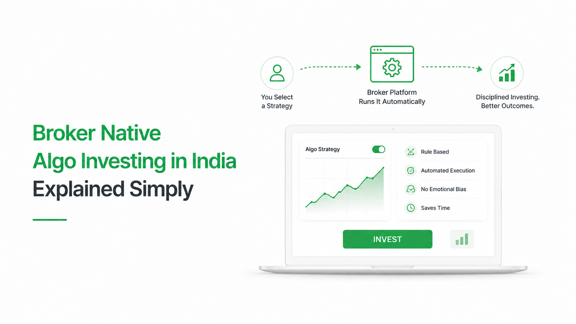
In simple terms, broker-native algo investing means the automation experience sits inside the broker ecosystem itself. Instead of building your own strategy on a technical platform or connecting a third-party tool to your broker account, you use a rules-based investing product that is already integrated with the broker’s app, account flow, and execution layer. For many retail users, that can cut friction, reduce confusion, and lower the chance of missed actions.
This matters because India’s regulatory environment around retail algorithmic participation has also become more structured. SEBI issued a circular on safer participation of retail investors in algorithmic trading in February 2025, and later extended aspects of the implementation timeline in September 2025. Exchange-level implementation standards and FAQs have further clarified operational requirements. Investors should now think not only about returns, but also about approval flow, broker dependence, execution ownership, and platform compliance. SEBI’s circular on safer participation of retail investors in algorithmic trading and the later SEBI timeline extension are useful reference points.
If you are looking at no code algo investing India options, this guide explains what broker-native really means, how it differs from trading automation, how it compares with third-party tools, and who should avoid it altogether.
What does broker-native algo investing mean?
Broker native algo investing refers to a setup where strategy discovery, onboarding, approvals, and execution are tied closely to the broker platform.
Think of it this way:
- You open and maintain your broking account in one place
- You browse strategy-led or rules-based options in the same ecosystem
- You authorise participation without stitching together outside software
- The execution workflow is designed to work with the same broker environment
This is different from the older model where an investor had to:
- Open a broker account
- Sign up on a separate algo platform
- connect APIs or authorisations
- configure deployment rules
- track whether the signal engine and the broker execution layer were both working properly
For highly active traders, that extra flexibility may be acceptable. For investors who want a simpler, more guided experience, algo investing built into broker app environments can feel easier to use.
Lemonn has already covered the broader category of algorithmic investing platforms in India and its own integrated approach in Broker Native Algo Investing in India With SmartInvest. This article goes one step further and explains the idea in plain language.
Broker-native investing is not the same as high-frequency algo trading
One of the biggest sources of confusion is simple: people hear “algo” and imagine complex, ultra-fast trading systems.
That is not what most retail investors want.
A retail-facing broker-native investing product is usually closer to rules-based portfolio participation than to institutional-style execution engineering. The goal is not microsecond infrastructure. The goal is to reduce emotional decision-making and help the investor follow a defined process.
That distinction matters.
Investing automation usually emphasizes:
- predefined rules
- strategy discipline
- reduced manual interference
- easier onboarding for non-coders
- lower monitoring burden
Trading automation often emphasizes:
- custom logic
- signal generation
- execution triggers
- technical setup
- faster iteration by advanced users
If you are a salaried professional or a busy investor, the first category is usually more relevant than the second. That is why many people comparing wealth tools should also understand the difference between robo advisory in India, what is algo trading, and broker-native systematic investing.
“Start investing with confidence! Explore
0 demat account
and grow your wealth.”
How broker-native algo investing works in practice
Although platforms differ, the user journey usually looks something like this:
1. You start inside the broker environment
You already have, or create, a broking account with the platform. If you are new, opening the account is often the first step, similar to the process explained in this beginner demat account guide.
2. You review available strategies
Instead of coding one from scratch, you review pre-built strategies or rules-based models. These may include market participation approaches, defined allocation rules, or strategy frameworks designed for retail accessibility.
3. You understand the operating rules
Before starting, you should know:
- what asset universe the strategy covers
- whether decisions are discretionary or rule-bound
- how often positions may change
- what kind of drawdown history is shown
- whether capital requirements apply
- what costs or brokerage may be involved
This is especially important for investors who assume automation means guaranteed returns. It does not. Automated execution can remove hesitation and inconsistency, but it cannot remove market risk.
4. You provide approvals
Depending on the setup and applicable rules, there may be consent, activation, or broker-side authorisation steps involved. Under India’s evolving regulatory framework, retail algo participation is no longer something investors should treat casually. Official standards from SEBI and NSE make it clear that investor protection, traceability, and platform-side accountability matter. See the NSE implementation standards circular and the NSE retail algo FAQ.
5. Execution happens through the broker-linked flow
This is one of the main benefits of broker native algo investing india. When the strategy and execution stack are aligned, there are fewer moving parts than in a third-party bridge model.
That does not mean there is zero operational risk. It means the path is usually simpler.
Third party vs broker native algo platform: what really changes?
This is the comparison many investors actually need.
Third-party algo platform
In a third-party model, the investing or signal engine sits outside the broker. You may need separate credentials, external setup, technical permissions, or integration layers.
Potential advantages
- more choice and experimentation
- access to external strategy builders
- may suit advanced users
Potential drawbacks
- extra operational complexity
- more chances of setup errors
- multiple dashboards and logins
- dependence on integration stability
- harder for first-time retail investors
Broker-native algo platform
In a broker-native model, the automation flow is built into the broker experience.
Potential advantages
- simpler onboarding
- fewer layers between strategy and execution
- easier approvals and account linkage
- better experience for non-coders
- less context switching across platforms
Potential drawbacks
- less flexibility than a fully open external setup
- product quality varies by broker
- strategy choice may be narrower
- you remain more dependent on one ecosystem
So when evaluating third party vs broker native algo platform, the main trade-off is usually flexibility vs simplicity.
For many everyday investors, simplicity wins.
Why non-coders care about broker-native experiences
Retail investors often do not want to become quant developers. They want process, not programming.
That is why retail algo investing India is increasingly about usability, not just technology. The most useful questions are:
- Do I need to code?
- Do I need to maintain APIs?
- Do I need to monitor markets all day?
- Do I need another app or vendor?
- Can I view activity in the same broker environment?
When the answer to most of these is “no,” adoption gets easier.
This is also why integrated products can feel closer to a guided investing workflow than to a trading laboratory. Lemonn’s SmartInvest launch update and its SmartInvest review reflect this broader shift toward rules-based participation for retail users.
What to compare before choosing a broker-native algo product
If you are assessing a platform, do not stop at “automated” or “AI-powered.” Those words are not enough.
Compare these instead:
1. Strategy clarity
Can you understand, in plain English, what the strategy is trying to do? If you cannot explain the logic at a high level, you probably should not allocate money to it.
2. Historical context, not just recent wins
Look for historical performance presentation that includes more than upside snapshots. Ask whether the platform shows:
- drawdowns
- losing phases
- strategy behavior across changing market conditions
- turnover or rebalancing style
A trustworthy product should not market only the best-looking periods.
3. Execution dependence
What happens if there is a technical issue, user action is required, or the strategy needs confirmation? Broker-native systems reduce friction, but investors should still understand the human and operational dependencies involved.
4. Cost visibility
Every automation layer still sits on top of a broking cost structure. Review pricing carefully with tools like a brokerage calculator and understand the platform’s brokerage charges and fees.
5. Compliance and trust signals
This is critical.
You should verify whether the broker operates within India’s regulated securities framework and whether there are public disclosures, grievance mechanisms, and investor-facing compliance information. Useful references include Lemonn’s SEBI registered trading app explainer and SEBI’s Investor Charter, which outlines investor rights, responsibilities, and grievance redressal principles.
6. Suitability for your lifestyle
The best product for you depends less on jargon and more on behavior. If you do not have time to track markets daily, a process-led product may be more relevant than a manual discretionary workflow. If you frequently override rules or panic during volatility, even a strong setup may not help.
Who should consider broker-native algo investing?
This category may suit:
- salaried professionals with limited market-screen time
- investors who want process-led participation
- non-coders who prefer guided automation
- users who want fewer platform dependencies
- people who value integrated broker workflows
It may be especially relevant if you are looking for something between traditional DIY investing and fully outsourced advisory. In that sense, it overlaps with systematic investing more than speculative trading.
Who should avoid it?
Broker-native algo investing is not for everyone.
You may want to avoid it if:
- you do not understand the underlying strategy
- you expect guaranteed returns from automation
- you are uncomfortable with market drawdowns
- you want full control over every entry and exit
- you are seeking ultra-custom strategy building
- you cannot tolerate platform or execution dependency
- you are using money needed for near-term essential goals
In short, automation is not a substitute for suitability.
The trust advantage of staying inside one broker ecosystem
The strongest case for a broker-native setup is not that it is “smarter” by default. It is that the user experience can be cleaner.
When strategy discovery, account setup, execution, and reporting happen closer together, the investor has fewer chances to get lost between platforms. The operational story is easier to understand. For beginners and busy professionals, that drop in friction can be more valuable than advanced customization.
This is why the category deserves its own label. Broker native algo investing is not just “algo trading without code.” It is a specific operating model that tries to keep the investing journey inside one environment.
Lemonn’s own positioning around broker-native algo investing in India with SmartInvest and algo trading in India under newer SEBI rules reflects that same reality: for retail investors, user flow and compliance structure matter almost as much as strategy logic.
Final thoughts
If you strip away the jargon, broker native algo investing india is about this: using a broker-linked, rules-based investing experience that minimizes technical setup and helps retail users stay systematic.
For the right investor, that can mean:
- less manual decision fatigue
- fewer platform handoffs
- easier onboarding
- more consistent execution discipline
But it also requires realism.
Automation does not remove risk. It does not guarantee profits. And it should never replace understanding. The best use case is for investors who want a process-led framework, trust the broker environment they are using, and are willing to learn how the strategy behaves before allocating capital.
In other words, the value is not in the word “algo.”
The value is in clarity, structure, and staying invested through a system you can actually understand.
FAQs
What is broker native algo investing in India?
Broker native algo investing in India means using a rules-based investing product that is built into the broker’s own ecosystem, instead of relying on a separate third-party platform. The strategy access, approvals, and execution flow are more integrated.
Is broker-native algo investing the same as algo trading?
No. Broker-native algo investing is usually more focused on process-led investing for retail users, while algo trading can include more advanced, customized, or execution-heavy trading setups.
Do I need coding knowledge for broker native algo investing?
Usually no. That is one of the main appeals of no code algo investing India products. They are generally designed for investors who want systematic execution without building strategies themselves.
What is the difference between third party vs broker native algo platform?
A third-party setup often involves extra tools, integrations, and logins. A broker-native setup is usually more streamlined because strategy access and broker execution are tied together.
Is broker-native algo investing safe for retail investors?
It can be more operationally convenient, but it is not risk-free. Market risk, drawdowns, and platform dependence still exist. Investors should review strategy logic, costs, approvals, and compliance details before starting.
Who should consider retail algo investing in India?
Busy professionals, non-coders, and investors who want a more disciplined, rules-based approach may find retail algo investing useful, especially when they do not want to monitor markets every day.
Disclaimer
The stocks mentioned in this article are not recommendations. Please conduct your own research and due diligence before investing. Investment in securities market are subject to market risks, read all the related documents carefully before investing. Please read the Risk Disclosure documents carefully before investing in Equity Shares, Derivatives, Mutual fund, and/or other instruments traded on the Stock Exchanges. As investments are subject to market risks and price fluctuation risk, there is no assurance or guarantee that the investment objectives shall be achieved. Lemonn (Formerly known as NU Investors Technologies Pvt. Ltd) do not guarantee any assured returns on any investments. Past performance of securities/instruments is not indicative of their future performance.
Related Posts


Download Lemonn
Download my app for share market trading, ipo investment, trading account, and all your investment needs.