
ITR-1 & ITR-2 for Salaried Individuals: The Complete Guide to Filing Your Income Tax Return for AY 2026-27
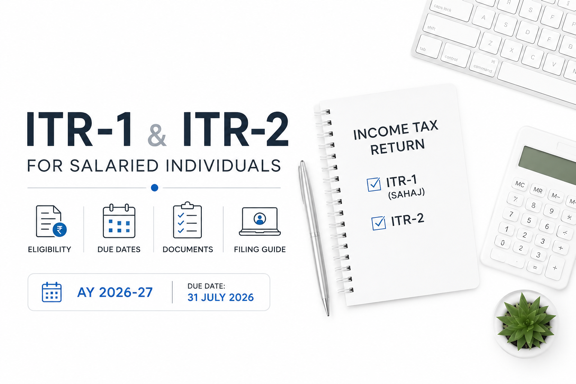
Filing an Income Tax Return (ITR) is one of the most important financial responsibilities for every salaried individual in India. Whether you’re working in the private sector, employed by the government, receiving a pension, or earning additional income through investments, filing your tax return accurately and on time ensures compliance with tax laws while helping you claim refunds and maintain a strong financial record.
For Assessment Year (AY) 2026-27 (Financial Year 2025-26), the Income Tax Department has notified the latest ITR forms with updated reporting requirements. Most salaried individuals will file either ITR-1 (Sahaj) or ITR-2, depending on the nature of their income.
This comprehensive guide explains everything a salaried individual needs to know, including eligibility, due dates, documents, deductions, tax regimes, capital gains reporting, common mistakes, and a step-by-step filing process.
Quick Summary
| Particular | Details |
|---|---|
| Financial Year | FY 2025-26 |
| Assessment Year | AY 2026-27 |
| Forms Covered | ITR-1 & ITR-2 |
| Applicable Taxpayers | Salaried individuals, pensioners, non-business taxpayers |
| Due Date | 31 July 2026 |
| Filing Mode | Online |
Why Every Salaried Individual Should File an Income Tax Return
Many salaried employees believe that if their employer deducts TDS every month, they don’t need to worry about filing an ITR. This is one of the biggest misconceptions.
Even if your employer has deducted tax correctly, filing an Income Tax Return remains important because it:
- Helps claim excess TDS refunds.
- Acts as proof of income.
- Is required for home loans and personal loans.
- Supports visa applications.
- Helps maintain financial credibility.
- Allows correction of tax mismatches.
- Keeps you compliant with tax laws.
Even if your taxable income is below the exemption limit, filing your return voluntarily can be beneficial.
“Start investing with confidence! Explore
0 demat account
and grow your wealth.”
Latest Updates for AY 2026-27
The Income Tax Department has introduced several updates for this filing season.
1. ITR Forms Have Been Updated
CBDT has notified revised ITR-1 and ITR-2 forms with enhanced reporting requirements.
2. Improved Pre-filled Returns
The e-Filing portal now imports information from:
- Form 16
- Form 26AS
- AIS
- TIS
- Banks
- Employers
- Mutual fund companies
This reduces manual errors.
3. Better Capital Gains Reporting
ITR-2 contains improved schedules for reporting gains from:
- Equity shares
- Mutual funds
- Property
- Bonds
Understanding ITR-1 (Sahaj)
ITR-1 is the simplest tax return form available for eligible resident taxpayers.
A salaried individual can generally use ITR-1 if income comes from:
- Salary
- Pension
- One house property
- Interest income
- Family pension
- Agricultural income up to ₹5,000
It is designed for taxpayers with relatively straightforward financial situations.
Who Can File ITR-1?
A salaried individual can file ITR-1 if all applicable eligibility conditions prescribed by the Income Tax Department are satisfied.
Typical eligible taxpayers include:
- Private employees
- Government employees
- PSU employees
- Pensioners
- First-time taxpayers
Who Cannot File ITR-1?
A salaried individual should not file ITR-1 if they have:
- Capital gains from shares or property
- More than one house property
- Business income
- Freelancing income
- Foreign assets
- Foreign income
- Agricultural income exceeding ₹5,000
- Directorship in a company
- Investment in unlisted equity shares
Such taxpayers generally need to file ITR-2 or another applicable return.
Understanding ITR-2
ITR-2 is designed for individuals and Hindu Undivided Families (HUFs) who do not have business or professional income but have more complex income sources.
Many salaried individuals mistakenly assume that ITR-2 is only for investors. In reality, it covers a broader range of situations.
Who Should File ITR-2?
A salaried individual should file ITR-2 if they have:
- Capital gains from equity shares
- Mutual fund gains
- Property sale gains
- Multiple house properties
- Foreign assets
- Foreign bank accounts
- Foreign income
- Agricultural income above ₹5,000
- Income as a partner in a partnership firm (without business income)
ITR-1 vs ITR-2 Comparison
| Feature | ITR-1 | ITR-2 |
| Salary Income | ✔ | ✔ |
| Pension | ✔ | ✔ |
| One House Property | ✔ | ✔ |
| Two or More House Properties | ✘ | ✔ |
| Capital Gains | ✘ | ✔ |
| Foreign Assets | ✘ | ✔ |
| Foreign Income | ✘ | ✔ |
| Business Income | ✘ | ✘ |
Due Date for Salaried Individuals
For AY 2026-27, the due date for most salaried individuals filing ITR-1 or ITR-2 is:
31 July 2026
Filing early offers several advantages, including quicker refunds and more time to resolve any discrepancies.
Documents Required
Before you begin filing, keep these documents ready:
Personal Documents
- PAN
- Aadhaar
- Mobile number
- Email ID
Salary Documents
- Form 16
- Salary slips
Tax Documents
- Form 26AS
- AIS
- TIS
Banking Documents
- Savings account statements
- Fixed deposit interest certificates
Investment Documents
- ELSS statements
- PPF contributions
- Insurance premium receipts
- NPS contribution receipts
- Home loan certificate
Capital Gains Documents
If applicable:
- Broker statement
- Mutual fund statement
- Property purchase documents
- Sale deed
- Improvement cost records
Tax Deductions Every Salaried Individual Should Know
Many taxpayers miss legitimate deductions.
Popular deductions include:
Section 80C
Maximum deduction up to the prescribed limit for eligible investments such as:
- EPF
- PPF
- ELSS
- Life Insurance
- Home Loan Principal
- Sukanya Samriddhi
Section 80CCD(1B)
Additional deduction for NPS contributions.
Section 80D
Health insurance premium.
Section 24(b)
Home loan interest.
Section 80E
Education loan interest.
Section 80G
Eligible charitable donations.
Old Tax Regime vs New Tax Regime
A salaried individual should compare both tax regimes before filing.
Old Tax Regime
Suitable for taxpayers claiming multiple deductions and exemptions.
New Tax Regime
Features lower tax rates but limits many deductions and exemptions.
Choosing the right regime depends on your salary structure, investments, and eligible deductions.
Step-by-Step Guide to Filing ITR-1 or ITR-2
Step 1
Log in to the Income Tax e-Filing portal.
Step 2
Select Assessment Year 2026-27.
Step 3
Choose ITR-1 or ITR-2.
Step 4
Verify personal information.
Step 5
Review salary details.
Step 6
Verify Form 26AS and AIS.
Step 7
Report deductions.
Step 8
Report capital gains if filing ITR-2.
Step 9
Calculate tax.
Step 10
Pay outstanding tax.
Step 11
Submit.
Step 12
Complete e-verification.
Common Mistakes Made by Salaried Individuals
Avoid these mistakes:
- Filing ITR-1 despite capital gains.
- Ignoring savings account interest.
- Not reporting dividend income.
- Forgetting foreign assets.
- Missing employer TDS mismatch.
- Incorrect bank details.
- Failure to e-verify.
Benefits of Filing Early
Early filing offers numerous benefits:
- Faster refunds
- Reduced stress
- Better financial planning
- Easier correction of errors
- Smoother loan processing
- Less portal congestion
What Happens If You Miss the Due Date?
Late filing may result in:
- Late filing fees under applicable provisions.
- Interest on unpaid tax.
- Delay in refunds.
- Loss of certain carry-forward benefits.
- Additional compliance requirements.
Frequently Asked Questions
Q. Can every salaried individual file ITR-1?
No. A salaried individual with capital gains, foreign assets, or multiple house properties will generally need to file ITR-2.
Q. Is Form 16 enough for filing?
Form 16 is important, but you should also verify Form 26AS, AIS, and TIS.
Q. Can I change my tax regime while filing?
Eligibility to opt for or change the tax regime depends on your category of taxpayer and the applicable provisions of the Income-tax Act. Check the current rules before filing.
Q. Can pensioners file ITR-1?
Yes, if they satisfy the eligibility conditions.
Q. Is reporting capital gains mandatory?
Yes. If you have capital gains, they must be reported in the applicable ITR form.
Pro Tips for Salaried Individuals
- Download AIS before filing.
- Match every TDS entry with Form 16.
- Report all bank interest.
- Keep investment proofs safely.
- File well before 31 July.
- Verify your return immediately after submission.
- Retain a copy of the filed return and acknowledgement for future reference.
Key Takeaways
- Most salaried individuals with simple income can file ITR-1 (Sahaj).
- Salaried individuals with capital gains, multiple properties, or foreign assets generally need to file ITR-2.
- File your return by 31 July 2026 if you are not subject to audit.
- Keep Form 16, AIS, Form 26AS, and investment proofs ready.
- Verify your return after filing to complete the process.
Conclusion
For a salaried individual, selecting the correct ITR form is just as important as filing on time. While ITR-1 is ideal for straightforward salary and pension income, ITR-2 is the appropriate choice for those with capital gains, multiple house properties, or foreign assets.
By understanding your eligibility, reviewing pre-filled information, matching your income with AIS and Form 26AS, and filing before the due date, you can complete your tax return confidently and reduce the risk of notices or delays.
If your tax situation is more complex, consider seeking guidance from a qualified Chartered Accountant or tax professional to ensure accurate reporting and compliance.
Disclaimer
The stocks mentioned in this article are not recommendations. Please conduct your own research and due diligence before investing. Investment in securities market are subject to market risks, read all the related documents carefully before investing. Please read the Risk Disclosure documents carefully before investing in Equity Shares, Derivatives, Mutual fund, and/or other instruments traded on the Stock Exchanges. As investments are subject to market risks and price fluctuation risk, there is no assurance or guarantee that the investment objectives shall be achieved. Lemonn (Formerly known as NU Investors Technologies Pvt. Ltd) do not guarantee any assured returns on any investments. Past performance of securities/instruments is not indicative of their future performance.
Related Posts


Download Lemonn
Download my app for share market trading, ipo investment, trading account, and all your investment needs.



