
ITR Filing AY 2026-27: Latest Due Dates, Updates, Eligibility & Step-by-Step Guide
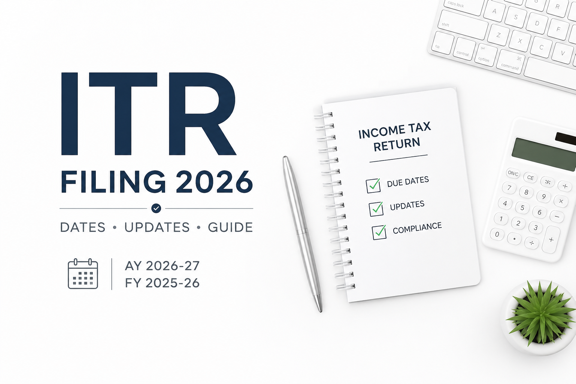
Filing your Income Tax Return (ITR) is an essential part of financial planning and tax compliance. Whether you’re a salaried employee, freelancer, business owner, or pensioner, filing your ITR on time helps you avoid penalties, claim tax refunds, and maintain a strong financial record.
For the Assessment Year (AY) 2026-27 (Financial Year 2025-26), the Income Tax Department has notified all ITR forms and introduced a few important changes. Understanding the latest deadlines and filing requirements will help you complete your return accurately and without last-minute stress.
ITR Filing 2026: Quick Overview
| Particular | Details |
|---|---|
| Financial Year | FY 2025-26 |
| Assessment Year | AY 2026-27 |
| ITR-1 & ITR-2 Due Date (Non-audit taxpayers) | 31 July 2026 |
| ITR-3 & ITR-4 Due Date (Non-audit business/profession) | 31 August 2026 |
| Tax Audit Cases | 31 October 2026 |
| Transfer Pricing Cases | 30 November 2026 |
| Belated Return | 31 December 2026 |
| Revised Return | 31 March 2027 |
Latest Updates for ITR Filing AY 2026-27
The Income Tax Department has introduced several updates for this year’s filing season.
“Start investing with confidence! Explore
0 demat account
and grow your wealth.”
1. All ITR Forms Have Been Notified
The Central Board of Direct Taxes (CBDT) has notified ITR-1 to ITR-7 for AY 2026-27. Taxpayers should carefully select the appropriate form based on their income sources and eligibility.
2. Extended Deadline for ITR-3 and ITR-4
Individuals and businesses filing ITR-3 or ITR-4, who are not subject to tax audit, now have until 31 August 2026 to file their returns.
3. More Time to Revise Returns
Taxpayers can revise their returns until 31 March 2027, allowing additional time to correct mistakes after filing.
4. Improved Online Filing Experience
The Income Tax e-filing portal continues to offer:
- Pre-filled taxpayer information
- Auto-populated TDS details
- AIS and Form 26AS integration
- Online tax payment facility
- Faster processing of eligible refunds
Who Should File an Income Tax Return?
You should file an ITR if you:
- Have taxable income above the applicable exemption limit.
- Want to claim a tax refund.
- Have foreign assets or foreign income.
- Earn capital gains from shares, mutual funds, or property.
- Are carrying on business or professional activities.
- Need ITR copies for visa applications or loan approvals.
- Meet any mandatory filing conditions prescribed under the Income Tax Act.
Even if your income is below the taxable limit, filing an ITR can be beneficial for maintaining financial records and claiming refunds.
Important ITR Due Dates for AY 2026-27
Salaried Individuals and Non-Audit Taxpayers (ITR-1 & ITR-2)
Due Date: 31 July 2026
Business and Professional Taxpayers (ITR-3 & ITR-4)
Due Date: 31 August 2026
Tax Audit Cases
Due Date: 31 October 2026
Transfer Pricing Cases
Due Date: 30 November 2026
Belated Return
Last Date: 31 December 2026
Revised Return
Last Date: 31 March 2027
Filing your return before the applicable due date helps you avoid late fees, interest, and delays in refund processing.
Documents Required for Filing ITR
Keep these documents ready before filing:
- PAN Card
- Aadhaar Card
- Form 16 (for salaried employees)
- Form 26AS
- Annual Information Statement (AIS)
- Salary slips
- Bank statements
- Interest certificates
- Investment proofs
- Home loan interest certificate
- Capital gains statements
- Business or professional income records, if applicable
Which ITR Form Should You Choose?
ITR-1 (Sahaj)
Suitable for resident individuals with:
- Salary or pension income
- One house property
- Income from other sources such as interest
- Income within the prescribed eligibility conditions
ITR-2
Applicable for individuals and HUFs having:
- Capital gains
- Multiple house properties
- Foreign assets or foreign income
- Income not covered under ITR-1
ITR-3
For individuals and HUFs earning income from business or profession.
ITR-4 (Sugam)
For eligible taxpayers opting for the presumptive taxation scheme under Sections 44AD, 44ADA, or 44AE.
Choosing the correct ITR form helps avoid defective return notices and processing delays.
How to File Your ITR Online
Follow these simple steps:
- Visit the Income Tax e-filing portal.
- Log in using your PAN credentials.
- Click File Income Tax Return.
- Select Assessment Year 2026-27.
- Choose the applicable ITR form.
- Verify the pre-filled information.
- Enter additional income and claim eligible deductions.
- Calculate your tax liability.
- Pay any outstanding self-assessment tax.
- Submit the return.
- Complete e-verification using Aadhaar OTP, Net Banking, DSC, or other available methods.
Your ITR is considered filed only after successful verification.
Common Mistakes to Avoid
Avoid these common errors while filing:
- Selecting the wrong ITR form
- Not reporting interest income
- Ignoring AIS and Form 26AS details
- Entering incorrect bank account information
- Forgetting to e-verify the return
- Waiting until the last day to file
Review your return carefully before submission to avoid notices or delays.
Benefits of Filing ITR on Time
Timely filing offers several advantages:
- Faster income tax refunds
- Avoidance of late filing fees
- Reduced interest on unpaid taxes
- Easier loan approvals
- Smooth visa processing
- Better financial credibility
- Timely compliance with tax laws
What Happens If You Miss the Due Date?
If you fail to file your return within the applicable due date:
- You may have to pay a late filing fee under Section 234F.
- Interest may be charged on outstanding tax dues under Section 234A.
- Refund processing may be delayed.
- Certain losses may not be eligible for carry forward.
- You can still file a belated return until 31 December 2026, subject to applicable provisions.
Frequently Asked Questions
Q. What is the due date for filing ITR-1 and ITR-2 for AY 2026-27?
The due date is 31 July 2026 for individuals who are not required to get their accounts audited.
Q. What is the last date for filing ITR-3 and ITR-4?
The due date for eligible non-audit taxpayers filing ITR-3 or ITR-4 is 31 August 2026.
Q. Can I revise my ITR after filing?
Yes. You can file a revised return up to 31 March 2027 if you discover any mistakes.
Q. Is Aadhaar mandatory for filing ITR?
Yes. PAN should generally be linked with Aadhaar where applicable under the Income Tax Act.
Q. How can I check my refund status?
You can track your refund through the Income Tax e-filing portal after your return is processed.
Key Takeaways
- File ITR-1 or ITR-2 by 31 July 2026 if you are a salaried or non-audit taxpayer.
- File ITR-3 or ITR-4 by 31 August 2026 if you have business or professional income and are not subject to audit.
- Keep Form 16, AIS, Form 26AS, and supporting documents ready before filing.
- Verify your return after submission to complete the filing process.
- Filing on time helps avoid penalties, interest, and delays in refunds.
Conclusion
The Income Tax Department has made the filing process more convenient through pre-filled information, online verification, and enhanced digital services. By understanding the latest due dates, choosing the correct ITR form, and keeping your documents ready, you can complete your tax filing smoothly and stay compliant with the law.
If your income includes capital gains, foreign assets, multiple income sources, or business income, consider consulting a qualified Chartered Accountant or tax professional to ensure accurate reporting and compliance.
Disclaimer
The stocks mentioned in this article are not recommendations. Please conduct your own research and due diligence before investing. Investment in securities market are subject to market risks, read all the related documents carefully before investing. Please read the Risk Disclosure documents carefully before investing in Equity Shares, Derivatives, Mutual fund, and/or other instruments traded on the Stock Exchanges. As investments are subject to market risks and price fluctuation risk, there is no assurance or guarantee that the investment objectives shall be achieved. Lemonn (Formerly known as NU Investors Technologies Pvt. Ltd) do not guarantee any assured returns on any investments. Past performance of securities/instruments is not indicative of their future performance.
Related Posts

Download Lemonn
Download my app for share market trading, ipo investment, trading account, and all your investment needs.



