
How to Do Intraday Trading in India and Earn ₹1,000 Per Day
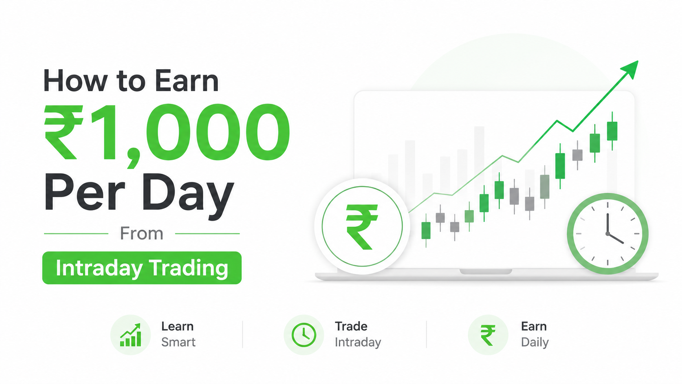
Many new traders enter the stock market hoping to generate a steady daily income. One of the most popular ways to do this is through intraday trading.
If you’re wondering how to do intraday trading in India, the process is simple to understand but requires discipline, risk management, and the right strategy. Intraday trading involves buying and selling stocks within the same trading day to profit from short-term price movements.
Can you earn ₹1,000 per day from intraday trading? Yes, it is possible. However, it is not guaranteed. Success depends on your capital, experience, stock selection, risk management, and market conditions.
In this guide, you’ll learn everything you need to know about intraday trading in India, including legal requirements, stock selection, profitable strategies, taxes, and common mistakes to avoid.
What Is Intraday Trading?
Intraday trading refers to buying and selling a stock within the same trading session. Any position opened during the day is closed before the market closes.
For example:
- Buy 100 shares of a stock at ₹200
- Sell them later the same day at ₹210
- Profit = ₹10 per share × 100 shares = ₹1,000
The objective is to capture small price movements during market hours.
Intraday Trading vs Long-Term Investing
| Feature | Intraday Trading | Long-Term Investing |
|---|---|---|
| Holding Period | Same day | Months or years |
| Goal | Short-term profit | Wealth creation |
| Risk Level | High | Moderate |
| Time Required | Daily monitoring | Minimal |
| Capital Turnover | High | Low |
Many traders prefer intraday trading because it provides opportunities to generate profits without waiting months or years for returns.
“Start investing with confidence! Explore
0 demat account
and grow your wealth.”
Is Intraday Trading Legal and Safe in India?
Yes, intraday trading is completely legal in India.
It is regulated by:
- Securities and Exchange Board of India (SEBI)
- National Stock Exchange (NSE)
- Bombay Stock Exchange (BSE)
As long as you trade through a registered stockbroker and follow market regulations, intraday trading is fully legal.
Risks You Should Know Before Starting
While legal, intraday trading carries significant risks.
Capital Loss
Prices can move against your position quickly, causing losses.
Leverage Risk
Many brokers offer margin facilities that increase both profits and losses.
Emotional Trading
Fear and greed often cause traders to make poor decisions.
Overtrading
Taking too many trades can lead to unnecessary losses.
A successful trader focuses first on protecting capital and then on making profits.
How to Start Intraday Trading in India (Step-by-Step)
If you’re new to trading, follow these five steps.
Step 1: Open a Demat and Trading Account
To trade stocks in India, you need:
- Demat account
- Trading account
- Linked bank account
Choose a SEBI-registered broker that offers:
- Fast order execution
- Low brokerage charges
- Advanced charts
- Risk management tools
Opening an account typically takes less than a day.
Step 2: Fund Your Trading Account
How much money should you start with?
For beginners, a capital of:
- ₹10,000 to ₹25,000 for learning
- ₹25,000 to ₹50,000 for consistent trading
is generally sufficient.
Avoid borrowing money or using funds meant for essential expenses.
Step 3: Choose the Right Stocks
Stock selection is one of the most important parts of intraday trading.
The best intraday stocks usually have:
- High trading volume
- Good liquidity
- Daily price movement
- Strong market participation
Examples often include:
- Reliance Industries
- HDFC Bank
- ICICI Bank
- Infosys
- Tata Motors
The goal is to trade stocks that move enough to create opportunities.
Step 4: Use a Stock Heatmap to Find Opportunities
A stock heatmap provides a visual representation of market performance.
Benefits include:
- Identifying strong sectors
- Finding momentum stocks
- Spotting market leaders
- Discovering unusual activity
Many professional traders use heatmaps during the first hour of trading to identify opportunities quickly.
Step 5: Place Your Intraday Order
After selecting a stock:
- Decide your entry price.
- Set a stop-loss.
- Set a profit target.
- Place an MIS (Margin Intraday Square-Off) order.
- Monitor the trade.
Never enter a trade without a predefined stop-loss.
Best Strategies to Earn ₹1,000 Per Day From Intraday Trading
There is no guaranteed strategy, but several proven approaches are widely used by successful traders.
1. Momentum Trading
Momentum trading focuses on stocks moving strongly in one direction.
Example
If a stock breaks above a key resistance level with high volume, traders enter expecting further upward movement.
Why It Works
- Strong buying interest
- Institutional participation
- Trending market conditions
This is one of the most popular intraday trading tips in India.
2. Breakout Trading
A breakout occurs when a stock moves beyond a significant support or resistance level.
Example
Suppose a stock repeatedly faces resistance at ₹500.
If it breaks above ₹500 with strong volume, traders may buy expecting further gains.
Advantages
- Clear entry point
- Defined stop-loss
- Good risk-to-reward ratio
3. Scalping
Scalping involves capturing very small price movements multiple times during the day.
Characteristics
- High trade frequency
- Small profit per trade
- Requires quick execution
Scalping is generally recommended for experienced traders rather than beginners.
How Much Capital Is Needed to Earn ₹1,000 Per Day?
Many beginners assume they can earn ₹1,000 daily with a small account.
In reality, profits depend on:
- Trading capital
- Risk management
- Win rate
- Market conditions
Example
If you trade with ₹50,000 and achieve a 2% gain:
₹50,000 × 2% = ₹1,000
However, achieving 2% consistently every day is difficult.
Focus on building skills first rather than chasing daily income targets.
How to Select Stocks for Intraday Trading
Learning how to choose stocks for intraday trading is critical.
Look for High Liquidity
High liquidity means:
- Easy entry and exit
- Lower slippage
- Better price execution
Focus on Volume
Stocks with heavy trading volume generally provide better opportunities.
Look for stocks trading above their average daily volume.
Trade Stocks With Volatility
Stocks should move enough to generate profits.
Extremely stable stocks often provide limited opportunities.
Follow Sector Momentum
If the banking sector is strong, focus on leading banking stocks.
If IT stocks are rallying, look for opportunities within the IT sector.
Sector trends often drive individual stock movements.
Avoid Penny Stocks
Many beginners are attracted to low-priced stocks.
However, penny stocks often suffer from:
- Low liquidity
- Price manipulation
- Wide bid-ask spreads
Stick to well-known NSE-listed companies.
Risk Management Rules Every Trader Must Follow
Even the best strategy fails without proper risk management.
Never Risk More Than 1-2% Per Trade
For a ₹50,000 account:
- 1% risk = ₹500
- 2% risk = ₹1,000
This protects your capital during losing streaks.
Always Use Stop-Loss Orders
A stop-loss automatically exits your trade if the market moves against you.
Benefits include:
- Limits losses
- Removes emotional decisions
- Preserves trading capital
Maintain Risk-to-Reward Ratio
Aim for at least:
1:2 Risk-Reward
Example:
- Risk ₹500
- Target ₹1,000
Even with a moderate win rate, this approach can be profitable.
Avoid Revenge Trading
After a loss, many traders immediately enter another trade to recover money.
This often leads to larger losses.
Follow your trading plan instead.
Common Intraday Trading Mistakes
Most beginners lose money because of avoidable mistakes.
Trading Without a Plan
Entering trades randomly rarely works.
Ignoring Stop-Loss
One bad trade can wipe out several profitable trades.
Overtrading
More trades do not necessarily mean more profits.
Quality is more important than quantity.
Following Tips Blindly
Avoid relying solely on social media or messaging groups.
Always conduct your own analysis.
Using Excessive Leverage
Leverage magnifies losses just as quickly as profits.
Use it cautiously.
Intraday Trading Taxes in India
A common question is whether intraday trading taxable in India.
The answer is yes.
How Intraday Income Is Classified
Intraday profits are treated as:
Speculative Business Income
They are not considered capital gains.
How Intraday Profits Are Taxed
Profits are:
- Added to your total income
- Taxed according to your income tax slab
The exact rate depends on your total annual income.
Can Intraday Losses Be Set Off?
Yes.
However, speculative losses can only be adjusted against speculative gains.
Unused losses may generally be carried forward according to prevailing tax rules.
Documents Required for Tax Filing
Keep records of:
- Broker statements
- Contract notes
- Profit and loss reports
- Bank statements
These documents simplify tax filing.
Can Beginners Make Money Through Intraday Trading?
Yes, beginners can make money in intraday trading.
However, successful traders focus on:
- Learning before earning
- Managing risk
- Maintaining discipline
- Following proven strategies
The goal during the first few months should be skill development rather than income generation.
Consistent profits usually come after gaining experience and refining your process.
Key Takeaways
- Intraday trading involves buying and selling stocks on the same day.
- It is fully legal and regulated in India.
- A Demat and trading account are required to start.
- High-volume and liquid stocks are best for intraday trading.
- Momentum and breakout trading are beginner-friendly strategies.
- Risk management is more important than stock selection.
- Intraday profits are taxable as speculative business income.
- Consistency matters more than chasing daily profit targets.
Frequently Asked Questions
Q. Can a beginner do intraday trading in India?
Yes. Beginners can start intraday trading with proper education, risk management, and a small amount of capital.
Q. How much money do I need to start intraday trading?
Many traders start with ₹10,000 to ₹50,000. Start with an amount you can afford to risk while learning.
Q. Is intraday trading profitable every day?
No. Even experienced traders have losing days. The objective is long-term profitability, not daily profits.
Q. What time is best for intraday trading in India?
The first 60 to 90 minutes after market opening (9:15 AM onwards) often provide the highest volatility and trading opportunities.
Q. Which stocks are best for intraday trading?
High-volume, liquid stocks from sectors such as banking, IT, auto, and financial services are often preferred by traders.
Conclusion
Learning how to do intraday trading in India is easier than ever, but becoming consistently profitable requires patience, discipline, and proper risk management.
If your goal is to earn ₹1,000 per day from intraday trading, focus first on building a repeatable process. Choose liquid stocks, use proven strategies, follow strict stop-loss rules, and never risk money you cannot afford to lose.
The traders who survive and succeed are not the ones who chase quick profits. They are the ones who manage risk, continue learning, and stay disciplined through every market cycle.
Ready to start your trading journey? Open a Demat and trading account with Lemonn and begin exploring India’s stock markets with the right tools and resources.
Disclaimer
The stocks mentioned in this article are not recommendations. Please conduct your own research and due diligence before investing. Investment in securities market are subject to market risks, read all the related documents carefully before investing. Please read the Risk Disclosure documents carefully before investing in Equity Shares, Derivatives, Mutual fund, and/or other instruments traded on the Stock Exchanges. As investments are subject to market risks and price fluctuation risk, there is no assurance or guarantee that the investment objectives shall be achieved. Lemonn (Formerly known as NU Investors Technologies Pvt. Ltd) do not guarantee any assured returns on any investments. Past performance of securities/instruments is not indicative of their future performance.
Related Posts

Download Lemonn
Download my app for share market trading, ipo investment, trading account, and all your investment needs.



