Instant Exit Feature vs Auto Square Off: Which Protects Traders?
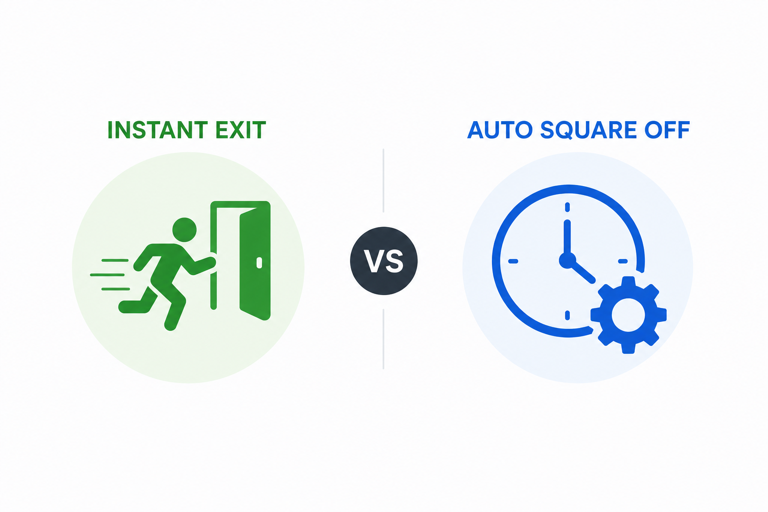
Expiry day trading rewards speed, but it punishes confusion.
A common mistake among options traders is assuming that every “exit protection” feature does the same thing. It does not. An instant exit feature is usually a trader-controlled tool designed for faster manual position closure. Auto square off, on the other hand, is a broker or risk-management action that forcibly closes positions based on internal cut-offs, margin rules, or product restrictions.
That difference matters most when volatility spikes, premiums collapse, spreads widen, and every second changes your P&L. On weekly expiry sessions especially, traders often search for answers like how to exit options quickly on expiry day, which broker offers auto square off protection in India, or which app supports quick position closure in volatile markets. The right answer depends less on marketing labels and more on who controls the exit, when it triggers, and what happens if markets move faster than you do.
If you are new to F&O mechanics, it helps to first understand the basics of what is options trading and how does options trading work before evaluating platform exit tools.
In this guide, we will compare instant exit feature vs auto square off, explain where each helps, where each fails, and which setup gives traders more control on expiry day.
Why this comparison matters on weekly and expiry day trading
Expiry day is different from a normal session. Time decay accelerates, OTM contracts can lose value very quickly, and margin conditions can become more demanding as exchanges and brokers manage risk more tightly. NSE Clearing notes that derivatives margins are monitored online and on an intraday basis as part of its risk containment framework, which helps explain why brokers become more sensitive to open risk during volatile sessions. (nseclearing.in)
SEBI has also tightened the equity index derivatives framework to improve investor protection and market stability, including measures specifically linked to expiry-day risk behaviour. (sebi.gov.in)
That is why platform-level exit handling is not a small UX detail. It is part of your risk workflow.
If you actively trade weekly contracts, reading Share Market Expiry Days in India 2026: Complete Guide and How to trade in futures and options: Everything you need to know can help you frame the broader expiry context.
What is an instant exit feature?
An instant exit feature is a user-initiated tool that helps close a live position quickly with fewer steps. It is meant to reduce friction between the trader’s decision and the order execution.
Depending on the platform, this may look like:
- a one-tap “Exit Now” button
- a bulk exit or “Exit All” command
- a fast-exit option from positions or charts
- a shortcut that bypasses extra confirmation layers
- a position-closing workflow designed for live volatility
The key point is simple: you decide to exit, and the feature helps you do it faster.
On Lemonn, this idea is closely tied to trader control and reduced execution friction. For example, Exit Smarter, Exit Faster: Exit Now & Exit All on Lemonn explains the role of streamlined exit actions for active traders. If speed is central to your setup, Fastest Options Broker India: Which Platform Feels Quickest? is also relevant.
“Start investing with confidence! Explore
0 demat account
and grow your wealth.”
What instant exit does well
An instant exit tool is useful when:
- you are watching the position live
- you want to cut risk early, not wait for the broker
- you trade momentum, scalps, or quick expiry moves
- you want to close multiple legs or positions quickly
- you value control over pre-emptive risk reduction
This makes it especially relevant for traders following short-duration F&O setups such as those discussed in Options Scalping in India: A Beginner Guide to Structured Trading.
Where instant exit can still fail
Despite the name, “instant” does not mean guaranteed price or guaranteed fill.
It can still be affected by:
- market illiquidity
- bid-ask spread expansion
- exchange-side volatility
- order type selected
- network lag or app responsiveness
- partial fills in fast-moving strikes
An instant exit feature reduces delay in placing the exit. It does not eliminate market impact.
What is auto square off?
Auto square off is a broker-enforced closure of open positions, usually triggered by policy, product cut-off timing, margin shortfall, or risk management rules.
In plain English, this means the broker closes your position because keeping it open no longer fits platform risk rules.
This usually happens when:
- intraday positions are not converted or closed before a cut-off
- required margin falls short
- expiry-related exposure becomes too risky
- a product is not allowed to carry forward beyond a certain point
- RMS systems trigger forced closure to prevent larger risk
This is less about trader convenience and more about broker protection, regulatory discipline, and clearing risk. SEBI’s broader derivatives framework and NSE Clearing’s intraday margin architecture explain why brokers cannot simply allow open-ended exposure when margin or settlement risk rises. (nseclearing.in)
Instant exit feature vs auto square off: the core difference
Here is the cleanest way to understand the comparison:
| Factor | Instant Exit Feature | Auto Square Off |
| Who triggers it? | The trader | The broker/RMS |
| Main purpose | Faster manual exit | Risk control and forced closure |
| Timing | When you choose | When broker policy or risk rules trigger |
| Trader control | High | Low |
| Best for | Active monitoring, quick reaction | Last-layer risk containment |
| Price certainty | Not guaranteed | Not guaranteed |
| Can it prevent panic? | Often yes, if used early | Sometimes no, because it may come late |
| Can you rely on it as a strategy? | Yes, as part of execution workflow | No, it should be a fallback, not a plan |
That is the heart of instant exit feature vs auto square off. One is a proactive execution tool. The other is a reactive control mechanism.
Which one actually protects traders better?
The honest answer is: instant exit protects decision-making better; auto square off protects the broker and system better.
That does not mean auto square off is useless. It exists for a real reason. But if your goal is lower execution stress, better timing, and more control on expiry day, an instant/manual exit workflow is usually superior.
Instant exit protects traders better when:
- you trade short-lived momentum
- you know your invalidation level
- you are monitoring live charts
- you want to avoid waiting for RMS action
- you need fast closure during sudden premium collapse
Auto square off protects traders better when:
- you forget to close intraday positions
- you lose track of timing near the cut-off
- margin deteriorates unexpectedly
- you are underprepared for expiry-day volatility
- the position has become non-compliant with broker risk settings
But the important nuance is this: auto square off is not precision risk management. It is emergency handling.
If you rely only on forced broker closure, you are handing over timing control in the most sensitive phase of the trade.
Why expiry day traders should prefer proactive exit tools
Weekly expiry is one of the few trading environments where even a small delay can be expensive. Theta decay accelerates as contracts approach expiry, and intraday moves can reprice options violently. That is why many experienced traders prefer broker features built around manual speed, not just broker safety nets.
A practical expiry day setup typically includes:
- predefined entry and exit rules
- live margin awareness
- stop-loss discipline
- fast position closure tools
- no dependency on last-minute forced exits
For traders who need platform support around speed and structured execution, BOLT by Lemonn: Simplifying FnO Trading for Everyone and the Trade FnO Fast page are relevant entry points into Lemonn’s F&O ecosystem.
You can also improve your planning by understanding What is option expiry? and What is margin in F&O?, because many forced closures happen when traders underestimate either timing or margin pressure.
Common failure points traders ignore
When comparing auto square off protection options India versus manual fast-exit tools, traders often miss these realities:
1. Auto square off is not always “protective” in a trader-first sense
If liquidity thins or spreads widen near cut-off time, forced closure may happen at a less favorable level than an earlier voluntary exit. The system is trying to close exposure, not optimize your trade outcome.
2. A quick position closure app is only helpful if the workflow is simple
Too many taps, slow screen transitions, or unclear position management can create friction at the exact moment traders need speed. That is why execution experience matters as much as brokerage. If you are comparing platforms overall, How To Choose A Good Stockbroker In India: A Guide and Lemonn Review 2026: Charges, Features, and Who It Fits can help.
3. Margin shocks can trigger forced action faster than expected
Since margining in derivatives is dynamic and monitored intraday, brokers may tighten internal controls in volatile markets. NSE Clearing explicitly states that margining is done online on an intraday basis. (nseclearing.in)
4. Regulatory risk controls are not the same as platform UX features
SEBI’s role is investor protection and market stability, while grievance handling for regulated entities can escalate through SCORES if needed. That framework governs market conduct, but it does not replace the need for trader-friendly execution tools. (sebi.gov.in)
Which setup is best for different traders?
Best for beginners: both, but with different expectations
Beginners should prefer platforms that offer fast manual exits and clearly disclosed auto square-off policies. You need proactive tools for control and a safety backstop for mistakes.
If you are still getting started, Can beginners trade options? and How to start options trading? are worth reading before attempting expiry-day setups.
Best for active expiry traders: instant exit first
If you trade weekly expiries, scalp, or react to sudden event-driven moves, choose an instant exit trading app in India that minimizes taps and lets you close positions quickly from the positions view or a similar workflow.
Best for low-attention traders: auto square off still matters
If you cannot monitor every minute, auto square off acts as a useful last-resort protection layer. But it should not be the reason you take larger risks.
How to exit options quickly on expiry day
If your real search intent is how to exit options quickly on expiry day, use this checklist:
- know your broker’s square-off timing in advance
- define stop-loss and target before entry
- avoid waiting for “one more candle” once exit conditions hit
- keep margin headroom; don’t trade at the edge
- use a platform with a clean, fast exit workflow
- avoid relying on forced square-off as your first plan
- reduce position complexity if the market becomes chaotic
For broader risk discipline in leverage and margin-led products, MTF: A Complete Guide to Margin Trading Facility and Margin Shortfall: Understanding Risk Management provide useful supporting context, even though MTF and F&O are different products.
What to check before choosing a broker for expiry day exits
When comparing platforms, do not stop at fees. Ask these five questions:
1. Can I manually close positions in one or two actions?
This is the real test of a strong instant exit experience.
2. Are the auto square-off rules clearly disclosed?
If timings and conditions are vague, traders usually discover them at the worst possible moment.
3. Does the app stay usable during volatility?
A platform that feels smooth in calm markets may feel very different on expiry spikes.
4. Are there features for bulk exits or emergency flattening?
These matter for traders holding multiple positions or multiple legs.
5. Is the platform built for active F&O behavior, not just passive investing?
That distinction affects everything from chart access to order flow to position handling.
The better framework: use instant exit for control, auto square off as backup
The smartest way to think about this is not either-or.
Use them as layers:
- Layer 1: your trade plan
- Layer 2: your stop-loss and discipline
- Layer 3: your instant exit feature for fast manual closure
- Layer 4: auto square off as the final backstop
That hierarchy is important. If auto square off becomes Layer 1, you are no longer managing the trade well.
Conclusion
In the debate around instant exit feature vs auto square off, the winner depends on what you mean by protection.
If you want control, speed, and a better expiry-day trading experience, an instant exit feature is usually more valuable. It lets you act before broker risk systems step in. If you want a last-resort safety net, auto square off still has a role, especially for traders who may miss cut-offs or face sudden margin issues.
But the two are not interchangeable.
An instant exit tool helps you trade better.
Auto square off helps prevent unmanaged exposure from staying open too long.
For serious weekly and expiry day traders, the ideal broker setup is one that offers both: fast trader-controlled exits and transparent broker-side risk policies. That combination reduces execution stress, improves control, and makes volatility-heavy sessions easier to handle with discipline.
FAQs
What is the difference between instant exit feature vs auto square off?
An instant exit feature is triggered by the trader for quick manual closure. Auto square off is triggered by the broker or RMS when policy, timing, or margin rules require forced closure.
How to exit options quickly on expiry day?
Use a platform with a fast position-closing workflow, define your exit before entry, monitor margin closely, and avoid waiting for broker auto square off to manage your trade.
Is auto square off protection enough for options trading in India?
No. Auto square off is a useful fallback, but it is not a substitute for active risk management. It may close positions late relative to your own planned exit.
Which is better for expiry day trading: instant exit or auto square off?
For active traders, instant exit is usually better because it offers more control. Auto square off is better viewed as an emergency backup.
What should I check in a quick position closure app in India?
Look for low-friction exit flow, clear positions display, reliable app performance during volatility, and transparent broker policies on cut-off timings and forced closure.
Can beginners rely on auto square off?
Beginners should not rely on it alone. It can help reduce damage from oversight, but beginners still need stop-loss rules, margin awareness, and a broker with a clear manual exit process.
Disclaimer
The stocks mentioned in this article are not recommendations. Please conduct your own research and due diligence before investing. Investment in securities market are subject to market risks, read all the related documents carefully before investing. Please read the Risk Disclosure documents carefully before investing in Equity Shares, Derivatives, Mutual fund, and/or other instruments traded on the Stock Exchanges. As investments are subject to market risks and price fluctuation risk, there is no assurance or guarantee that the investment objectives shall be achieved. Lemonn (Formerly known as NU Investors Technologies Pvt. Ltd) do not guarantee any assured returns on any investments. Past performance of securities/instruments is not indicative of their future performance.
Related Posts



Download Lemonn
Download my app for share market trading, ipo investment, trading account, and all your investment needs.