
Intrinsic Value and DCF Valuation for Indian Stocks: A Simplified Guide
What is Intrinsic Value?
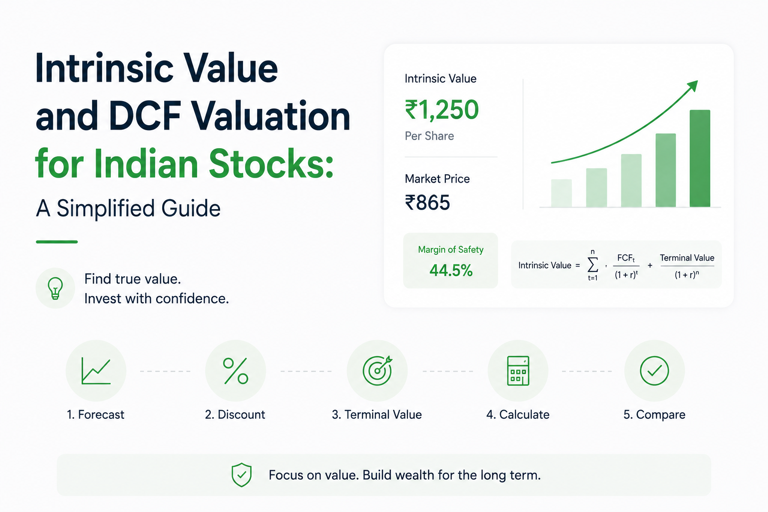
Intrinsic value is the present value of all future cash flows a business will generate for its owners. If a stock trades below intrinsic value, it is undervalued (potential buy). Above intrinsic value, it is overvalued (potential sell or avoid). DCF (Discounted Cash Flow) is the method to estimate intrinsic value.
DCF Model: The Concept
Money today is worth more than money tomorrow. A DCF model discounts future cash flows back to today’s value using a discount rate (required rate of return). Sum all discounted cash flows = intrinsic value of the business.
“Start investing with confidence! Explore
0 demat account
and grow your wealth.”
DCF for Indian Stocks: Step-by-Step
- Find Free Cash Flow (FCF): FCF = Operating Cash Flow – Capital Expenditure (from cash flow statement)
- Estimate FCF growth rate for next 5–10 years based on business analysis
- Choose discount rate: 12–15% for Indian equities (risk-free rate + equity risk premium)
- Calculate terminal value: FCF in final year × (1 + terminal growth) / (discount rate – terminal growth)
- Discount all future FCFs and terminal value back to today
- Sum of all discounted values = Intrinsic Value. Compare to market cap
Example: Simplified DCF for Infosys
| Year | FCF Growth Assumed | FCF (₹ Cr) | Discount Factor (13%) | Present Value (₹ Cr) |
|---|---|---|---|---|
| FY26 (base) | — | 28,000 | 1.00 | 28,000 |
| FY27 | 12% | 31,360 | 0.885 | 27,753 |
| FY28 | 12% | 35,123 | 0.783 | 27,501 |
| FY29 | 10% | 38,635 | 0.693 | 26,774 |
| FY30 | 10% | 42,499 | 0.613 | 26,052 |
| Terminal Value (4% growth) | — | 5,15,000 | 0.613 | 3,15,695 |
Sum of PV = ~₹4.5 lakh crore. Divide by shares outstanding to get per-share intrinsic value. Compare to current share price to determine if the stock is over or undervalued.
Limitations of DCF for Indian Stocks
- Highly sensitive to assumptions: 1% change in terminal growth rate changes value by 20–30%
- Indian companies often have lumpy FCF — use 3-year average for base FCF
- For capital-light businesses (IT, FMCG): DCF works well. For capex-heavy (infrastructure, real estate): use different methods
Disclaimer
The stocks mentioned in this article are not recommendations. Please conduct your own research and due diligence before investing. Investment in securities market are subject to market risks, read all the related documents carefully before investing. Please read the Risk Disclosure documents carefully before investing in Equity Shares, Derivatives, Mutual fund, and/or other instruments traded on the Stock Exchanges. As investments are subject to market risks and price fluctuation risk, there is no assurance or guarantee that the investment objectives shall be achieved. Lemonn (Formerly known as NU Investors Technologies Pvt. Ltd) do not guarantee any assured returns on any investments. Past performance of securities/instruments is not indicative of their future performance.
Related Posts

Download Lemonn
Download my app for share market trading, ipo investment, trading account, and all your investment needs.



