
Dividend Yield vs Growth Stocks: Which Investment Strategy Fits Your Goals?
Defining the Two Approaches
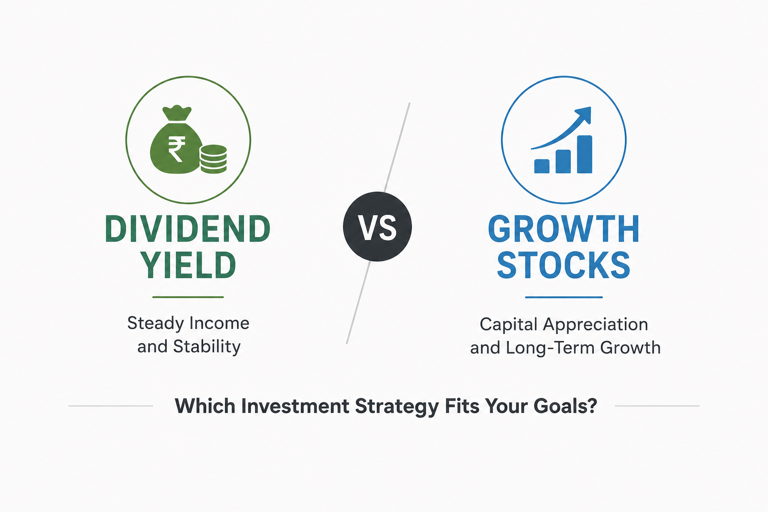
Dividend Yield Investing
Focus on companies paying high, sustainable dividends. The investor receives regular cash income. Capital appreciation is secondary. Typical stocks: Coal India, Power Grid, ITC, Infosys.
“Start investing with confidence! Explore
0 demat account
and grow your wealth.”
Growth Investing
Focus on companies reinvesting all profits into growth — no or minimal dividends. Capital appreciation is the primary return. Typical stocks: Bajaj Finance, Zomato, Trent, Dixon Technologies.
Total Return Comparison (Hypothetical)
| Scenario | Dividend Yield Stock | Growth Stock |
|---|---|---|
| Annual dividend yield | 5% | 0.5% |
| Annual capital appreciation | 8% | 20% |
| Total pre-tax return | 13% | 20.5% |
| Tax (30% bracket) on dividends | 1.5% drag on yield | Minimal (deferred till sale) |
| Net total return (approx) | 11.5% | 20% |
| Cash flow during holding | Regular income | None until sale |
When to Choose Dividend Investing
- Retired or near-retirement: regular income without selling shares
- Conservative investors: prefer certainty of dividend over capital gain hope
- Low marginal tax rate (< 20%): dividend tax drag is manageable
- Wealth preservation phase: protecting corpus while earning income
When to Choose Growth Investing
- Long horizon (10+ years): compounding of retained earnings far exceeds dividends
- High marginal tax rate (30%): defer tax until sale, then LTCG at 12.5%
- Accumulation phase: building wealth, don’t need current income
- High risk tolerance: growth stocks are more volatile
The Hybrid Approach: Best of Both Worlds
For most Indian investors aged 30–50, a hybrid approach works best: 60% growth-oriented companies (reinvesting earnings for expansion) and 40% quality dividend payers (ITC, Infosys, Power Grid). This provides some income while not sacrificing long-term compounding.
| Life Stage | Dividend % | Growth % | Rationale |
|---|---|---|---|
| 25–35 (Accumulation) | 20% | 80% | Maximum compounding |
| 35–50 (Building) | 35% | 65% | Balanced growth + income |
| 50–60 (Pre-retirement) | 55% | 45% | Rising income need |
| 60+ (Retirement) | 75% | 25% | Income priority |
Disclaimer
The stocks mentioned in this article are not recommendations. Please conduct your own research and due diligence before investing. Investment in securities market are subject to market risks, read all the related documents carefully before investing. Please read the Risk Disclosure documents carefully before investing in Equity Shares, Derivatives, Mutual fund, and/or other instruments traded on the Stock Exchanges. As investments are subject to market risks and price fluctuation risk, there is no assurance or guarantee that the investment objectives shall be achieved. Lemonn (Formerly known as NU Investors Technologies Pvt. Ltd) do not guarantee any assured returns on any investments. Past performance of securities/instruments is not indicative of their future performance.
Related Posts



Download Lemonn
Download my app for share market trading, ipo investment, trading account, and all your investment needs.



