Top 10 Weakest Currencies in the World in 2026
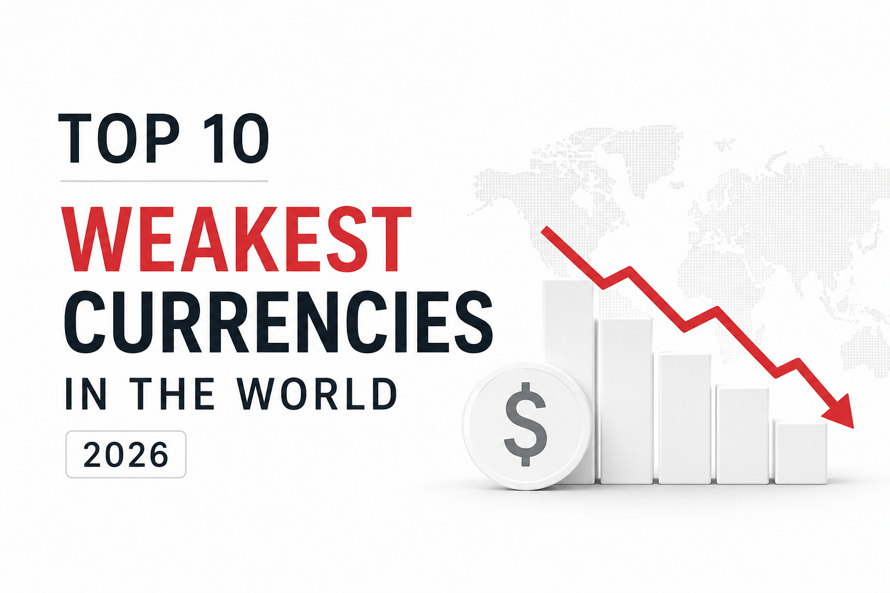
Currencies around the world constantly fluctuate based on inflation, economic stability, debt, sanctions, and market demand. Some currencies have become extremely weak against the US dollar due to economic crises, political instability, or long-term inflation.
In this guide, we’ll explore the weakest currencies in the world in 2026 with updated exchange rate numbers, reasons behind their low value, and how weak currencies affect economies.
Top 10 Weakest Currencies in the World (2026)
| Rank | Currency | Country | Approx. Exchange Rate vs USD | Main Reason for Weakness |
|---|---|---|---|---|
| 1 | Iranian Rial (IRR) | Iran | 1 USD ≈ 42,000–600,000 IRR | Sanctions and inflation |
| 2 | Lebanese Pound (LBP) | Lebanon | 1 USD ≈ 89,000+ LBP | Economic collapse |
| 3 | Sierra Leonean Leone (SLE/SLL) | Sierra Leone | 1 USD ≈ 22–25 SLE | Inflation and debt |
| 4 | Vietnamese Dong (VND) | Vietnam | 1 USD ≈ 25,000+ VND | Large money supply |
| 5 | Indonesian Rupiah (IDR) | Indonesia | 1 USD ≈ 16,000+ IDR | Historical inflation |
| 6 | Laotian Kip (LAK) | Laos | 1 USD ≈ 21,000+ LAK | Rising debt crisis |
| 7 | Uzbekistani Som (UZS) | Uzbekistan | 1 USD ≈ 12,500+ UZS | Inflation history |
| 8 | Guinean Franc (GNF) | Guinea | 1 USD ≈ 8,500+ GNF | Political instability |
| 9 | Paraguayan Guarani (PYG) | Paraguay | 1 USD ≈ 7,500+ PYG | Developing economy |
| 10 | Cambodian Riel (KHR) | Cambodia | 1 USD ≈ 4,000+ KHR | Dollarized economy |
Note: Exchange rates fluctuate daily depending on international currency markets.
What Makes a Currency Weak?
A currency becomes weak when its value falls significantly compared to stronger global currencies like:
- US Dollar (USD)
- Euro (EUR)
- British Pound (GBP)
Major Reasons Behind Weak Currencies
| Factor | Impact on Currency |
|---|---|
| High inflation | Reduces purchasing power |
| Political instability | Lowers investor confidence |
| Economic sanctions | Limits foreign trade |
| Excessive money printing | Weakens currency value |
| Debt crisis | Creates financial instability |
| Low exports | Reduces foreign currency inflow |
1. Iranian Rial (IRR)
The Iranian Rial remains the world’s weakest currency in 2026.
Approximate Value
- 1 USD ≈ 42,000 official IRR
- Black market rates are much higher
Why It Is Weak
- International sanctions
- Inflation crisis
- Restricted banking access
- Oil export limitations
2. Lebanese Pound (LBP)
The Lebanese Pound suffered one of the worst currency collapses in recent history.
Approximate Value
- 1 USD ≈ 89,000+ LBP
Main Causes
- Banking crisis
- Hyperinflation
- Political instability
- Debt default
3. Sierra Leonean Leone (SLE)
Sierra Leone introduced a redenominated currency system, but inflation still affects value.
Approximate Value
- 1 USD ≈ 22–25 SLE
Main Challenges
- Economic instability
- High import dependency
- Inflation pressures
4. Vietnamese Dong (VND)
Vietnam’s currency has a low nominal value but the economy itself remains strong.
Approximate Value
- 1 USD ≈ 25,000 VND
Why It Appears Weak
- Controlled exchange rate
- Large money circulation
- Export-focused strategy
5. Indonesian Rupiah (IDR)
Indonesia’s Rupiah has traded at low values for decades.
Approximate Value
- 1 USD ≈ 16,000 IDR
Reasons
- Historical inflation
- Currency volatility
- Large denominations
Despite this, Indonesia has one of Southeast Asia’s biggest economies.
6. Laotian Kip (LAK)
The Lao Kip weakened sharply because of debt and inflation.
Approximate Value
- 1 USD ≈ 21,000 LAK
Main Reasons
- Foreign debt pressure
- Weak reserves
- Inflation
7. Uzbekistani Som (UZS)
Uzbekistan continues economic reforms while facing inflationary pressure.
Approximate Value
- 1 USD ≈ 12,500 UZS
Challenges
- Inflation
- Limited international demand
- Currency transition reforms
8. Guinean Franc (GNF)
The Guinean Franc struggles because of political and economic instability.
Approximate Value
- 1 USD ≈ 8,500 GNF
Key Factors
- Weak infrastructure
- Inflation
- Political uncertainty
9. Paraguayan Guarani (PYG)
The Paraguayan Guarani has maintained a low international value for many years.
Approximate Value
- 1 USD ≈ 7,500 PYG
Why It Is Weak
- Historical inflation
- Lower foreign investment
- Developing economy status
10. Cambodian Riel (KHR)
Cambodia heavily relies on the US dollar in everyday transactions.
Approximate Value
- 1 USD ≈ 4,000 KHR
Main Causes
- Dollarized economy
- Limited international demand
- Developing banking system
Weakest vs Strongest Currencies
| Feature | Weak Currencies | Strong Currencies |
|---|---|---|
| Purchasing Power | Lower | Higher |
| Inflation Risk | High | Low |
| Investor Confidence | Weak | Strong |
| Import Costs | Expensive | Cheaper |
| Examples | IRR, LBP | KWD, BHD, CHF |
Strongest Currencies in the World
Some currencies remain extremely strong due to stable economies and strong investor confidence.
| Currency | Approx Value vs USD |
|---|---|
| Kuwaiti Dinar (KWD) | 1 KWD ≈ 3.25 USD |
| Bahraini Dinar (BHD) | 1 BHD ≈ 2.65 USD |
| Omani Rial (OMR) | 1 OMR ≈ 2.60 USD |
| British Pound (GBP) | 1 GBP ≈ 1.25 USD |
How Weak Currencies Affect Citizens
Weak currencies often lead to:
- Higher fuel prices
- Expensive imports
- Reduced savings value
- Lower purchasing power
- Rising food prices
In severe cases, hyperinflation can create economic crises.
Key Takeaways
- The Iranian Rial remains among the weakest currencies globally.
- Lebanon’s currency collapse continues affecting daily life.
- Some low-value currencies belong to growing economies like Vietnam and Indonesia.
- Inflation, sanctions, and debt are major reasons behind currency weakness.
- Exchange rates alone do not fully determine economic strength.
FAQs
Q. Which is the weakest currency in the world in 2026?
The Iranian Rial is widely considered the weakest currency based on exchange value against the US dollar.
Q. Why do currencies become weak?
Currencies weaken due to inflation, sanctions, political instability, debt, and poor economic policies.
Q. Is a weak currency always bad?
Not always. Some countries intentionally maintain lower currency values to support exports.
Q. Which countries have the strongest currencies?
Kuwait, Bahrain, Oman, Switzerland, and the United Kingdom have some of the strongest currencies globally.
Conclusion
The world’s weakest currencies often reflect deeper economic challenges such as inflation, sanctions, debt, and political instability. While some currencies struggle because of economic collapse, others maintain lower values as part of long-term trade and export strategies.
Understanding global currency values helps explain broader economic trends and how financial stability affects countries and citizens worldwide.
Disclaimer
The stocks mentioned in this article are not recommendations. Please conduct your own research and due diligence before investing. Investment in securities market are subject to market risks, read all the related documents carefully before investing. Please read the Risk Disclosure documents carefully before investing in Equity Shares, Derivatives, Mutual fund, and/or other instruments traded on the Stock Exchanges. As investments are subject to market risks and price fluctuation risk, there is no assurance or guarantee that the investment objectives shall be achieved. Lemonn (Formerly known as NU Investors Technologies Pvt. Ltd) do not guarantee any assured returns on any investments. Past performance of securities/instruments is not indicative of their future performance.