
Stock Trading for Students in India: A Complete Beginner’s Guide (2026)
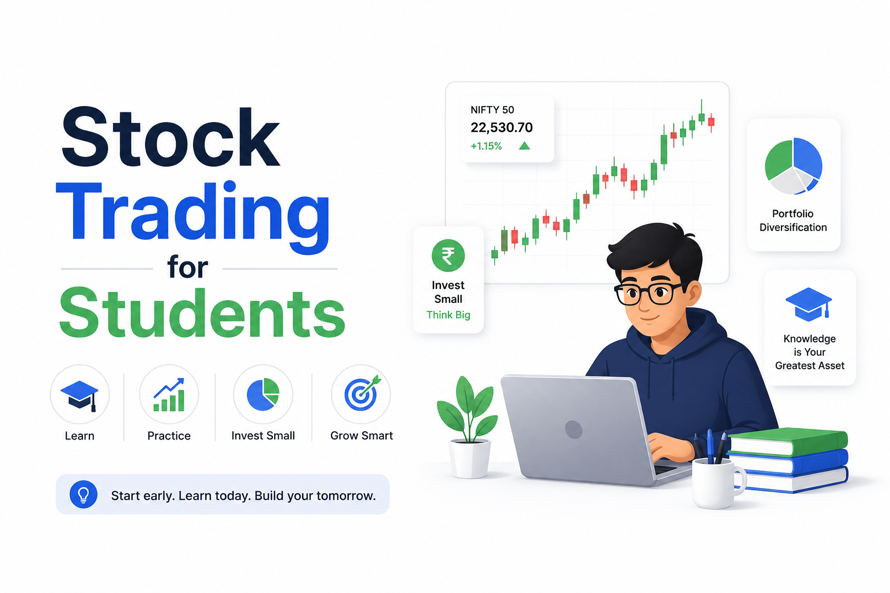
College is the best time in your life to start investing – even if you only have ₹500 to spare. The decisions you make about money between ages 18 and 25 will shape your financial life more than anything you do in your 30s. This guide is built specifically for Indian students who want to start stock trading the right way, without blowing up their pocket money on F&O bets they do not understand.
Can students legally trade stocks in India?
Yes – if you are 18 years or older with a PAN card, you can open a Demat account in your name and trade stocks on NSE/BSE. SEBI does not impose any minimum income or age requirement beyond 18.
If you are under 18, you cannot operate your own Demat account, but a guardian Demat (opened by a parent on your behalf) is allowed. The account remains in your name; the parent controls transactions until you turn 18.
International students from Indian universities studying in India typically follow the same process. NRIs studying abroad need an NRI-specific Demat account.
Why students should start investing now
Three reasons compound into life-changing results.
1. Time is your biggest asset. A ₹1,000/month SIP started at age 19 and continued until 60 will likely outperform a ₹5,000/month SIP started at 35. The Rule of 72 says money doubles every (72 ÷ rate) years – at 12% returns, that is every 6 years. Start at 19, and you can have 6–7 doublings before you are 60.
2. Real-world financial literacy. Reading 10 books on the market is less useful than placing one real trade with your own money. Tracking your first ETF teaches you more than any course.
3. Low cost of entry. Discount brokers like Zerodha and Groww charge ₹0 to open an account, and many AMCs accept ₹100 monthly SIPs. There is no longer any financial barrier.
“Start investing with confidence! Explore
0 demat account
and grow your wealth.”
Step 1: Open a Demat account (15 minutes online)
Here is exactly what you need:
- PAN card (mandatory – get one online if you do not have it)
- Aadhaar linked to a working mobile number
- A savings bank account in your name (not a joint account with parents, unless explicitly allowed by broker)
- A selfie for in-person verification
- A signed selfie video or e-signature
Recommended brokers for students:
- Zerodha – ₹0 opening, ₹0 AMC for BSDA accounts under ₹10 lakh holdings, free Varsity educational content
- Groww – Simple app, mutual funds + stocks in one place
- Upstox – Strong charts, low pricing
- Angel One – Free advisory tools
- Lemonn – Zero AMC, 100% digital KYC, TradingView charts, and Power SIP for small monthly stock investments – built around first-time investors
Skip full-service brokers (HDFC Securities, ICICI Direct) for now – their advisory features cost more than students need.
Step 2: Start with the basics – understand the instruments
Do not start by reading about F&O strategies. Start by understanding what you can actually buy:
- Equity shares – Ownership in a company (e.g., 1 share of HDFC Bank)
- ETFs – A basket of stocks that trade like a single share (NIFTYBEES tracks Nifty 50)
- Mutual funds – Professionally managed pools of stocks, accessible via SIP
- Government bonds – Low risk, modest returns, useful for emergency money
As a student, 90% of your investing should be in ETFs and mutual funds for the first 1–2 years. Individual stock picking is fun but unreliable until you have studied 20+ companies in depth.
Step 3: How much should a student invest?
Use a simple rule: invest 30% of any inflow – pocket money, internship stipend, side-hustle income.
Realistic targets for college students:
| Income Source | Amount/Month | Suggested Invest |
| Pocket money only | ₹2,000–₹5,000 | ₹500–₹1,000 |
| Tutoring / part-time | ₹5,000–₹10,000 | ₹1,500–₹3,000 |
| Internship stipend | ₹15,000–₹25,000 | ₹3,000–₹6,000 |
The exact rupee amount matters less than consistency. ₹500/month for 4 years of college builds a ₹24,000 corpus plus returns – enough to fund your first major purchase debt-free.
Step 4: A beginner-friendly student portfolio
The Quad Portfolio is simple and works for 90% of students:
- 40% in a Nifty 50 index fund or NIFTYBEES ETF – Core large-cap exposure
- 30% in a Nifty Next 50 fund or NEXT50 ETF – Higher growth, slightly higher risk
- 20% in a flexi-cap or mid-cap mutual fund – For diversification
- 10% in cash/liquid fund – Emergency money
A ₹1,000 monthly investment splits as ₹400, ₹300, ₹200, ₹100 across these categories. Set up automatic SIPs and forget about them.
Avoid: thematic funds, small-cap funds, sector ETFs (banking only, IT only). They are exciting but unnecessarily volatile for a student portfolio.
Step 5: Learn for free with Indian content
Quality investing education is now free:
- Zerodha Varsity – Comprehensive free modules covering everything from basics to options
- Groww Learn – Bite-sized explainers in Hindi and English
- NSE Pathshala – Official NSE educational portal
- YouTube channels – Pranjal Kamra, CA Rachana Ranade, Asset Yogi (cross-check claims, do not blindly trust)
- Books – “Let’s Talk Money” by Monika Halan, “The Intelligent Investor” by Benjamin Graham
Spend 30 minutes a day for 90 days on Varsity, and you will know more than 90% of casual traders. How to read stock charts is a good follow-up after the basics.
What students should avoid
Some warnings that could save you literally years of progress:
Avoid intraday trading. SEBI’s 2023 study showed that 89% of individual F&O traders lost money. Intraday equity is not much better. You do not have the screen time, capital, or experience yet.
Avoid F&O completely until age 22+. The leverage looks magical and the losses arrive faster than you can react. There is no reason for a student to be in F&O.
Avoid Telegram tip channels. Free “sure-shot intraday tips” are typically pump-and-dump schemes. Many channels are run by paid promoters of small-cap manipulators.
Avoid penny stocks. Stocks priced ₹2–₹20 that “could 10x” overwhelmingly do not. Most lose 80%+ of their value over 3 years.
Avoid borrowing to invest. No student credit card debt or “buy now, pay later” should ever fund stock purchases.
Tax basics for student traders
Students often think investing income does not count for tax. It does – but in most cases your overall income is below the basic exemption limit (₹3 lakh under new regime, ₹2.5 lakh under old).
Key rules:
- Capital gains are taxable regardless of total income – Short Term Capital Gains (STCG) at 20%, Long Term Capital Gains (LTCG) at 12.5% above ₹1.25 lakh per year
- Dividend income is taxed at slab rate (likely 0% for students below the exemption)
- You must file ITR if your gross income (including capital gains) crosses the basic exemption limit, even if all of it is below taxable level
Save your contract notes – many brokers provide a downloadable Tax P&L statement at year-end.
Building habits that compound
The students who become wealthy investors share four habits:
- Automate everything. Set up SIPs on the salary/pocket-money date so investing happens before spending.
- Track net worth monthly, not the market daily. Markets bounce; net worth compounds.
- Read 4–6 quality books per year. Free or library editions are fine.
- Talk about money with friends who are also investing. Peer accountability beats willpower.
The compounding of habits in your 20s is more powerful than the compounding of money. You can earn back ₹50,000; you cannot earn back 5 years of compounding lost to procrastination.
A 12-month student investing plan
- Month 1: Open Demat, study Varsity Module 1
- Month 2: Start ₹500 SIP in Nifty 50 index fund
- Month 3: Buy 1 unit of NIFTYBEES, observe how it moves
- Month 4–6: Add ₹200/month to Nifty Next 50 fund, total ₹700
- Month 7–9: Add ₹100/month liquid fund for emergency money
- Month 10–12: Increase total to ₹1,000–₹1,500/month
At the end of 12 months you will have ~₹12,000+ invested, a working Demat account, knowledge of Indian markets, and habits that compound for decades.
FAQs
Q.What is the minimum age to open a Demat account in India?
You must be 18 years old to open a Demat account in your own name. Minors can use a guardian Demat operated by a parent until they turn 18.
Q. How much money do I need to start investing as a student?
You can start with ₹100 in a monthly SIP or ₹500 to buy 1–2 shares of a low-priced ETF like NIFTYBEES. There is no minimum balance requirement from SEBI or your broker.
Q. Is stock trading safe for students?
Long-term investing in diversified index funds and ETFs is reasonably safe. Active intraday trading and F&O are very risky and not suitable for students.
Q. Can I do intraday trading as a college student?
You technically can after 18, but it is not recommended. Brokerage costs, screen time requirements, and high failure rate (89% of F&O traders lose money) make it unsuitable for students.
Q. Do students need to pay tax on stock profits?
Yes, capital gains are taxable regardless of total income. STCG at 20% (under 12 months) and LTCG at 12.5% above ₹1.25 lakh/year. You must file an ITR if your gross income crosses the exemption limit.
Conclusion
The best time to start investing was 5 years ago. The second best time is today – and as a student, you have something professionals would pay for: 40+ years of compounding ahead of you. Open a Demat account this week, set up a ₹500 monthly SIP into NIFTYBEES or a Nifty index fund, and do nothing else for 12 months except keep adding. The market will reward your patience more than your cleverness.When you are ready to graduate to picking individual stocks, our stock-picking guide takes you through fundamental analysis the right way. You can open a zero-AMC Demat on Lemonn directly from your phone if you want to skip the broker-comparison step and start today.
Disclaimer
The stocks mentioned in this article are not recommendations. Please conduct your own research and due diligence before investing. Investment in securities market are subject to market risks, read all the related documents carefully before investing. Please read the Risk Disclosure documents carefully before investing in Equity Shares, Derivatives, Mutual fund, and/or other instruments traded on the Stock Exchanges. As investments are subject to market risks and price fluctuation risk, there is no assurance or guarantee that the investment objectives shall be achieved. Lemonn (Formerly known as NU Investors Technologies Pvt. Ltd) do not guarantee any assured returns on any investments. Past performance of securities/instruments is not indicative of their future performance.
Related Posts

Download Lemonn
Download my app for share market trading, ipo investment, trading account, and all your investment needs.



