MTF (Margin Trade Funding) Explained: How to Use Leverage in Stock Market Investing
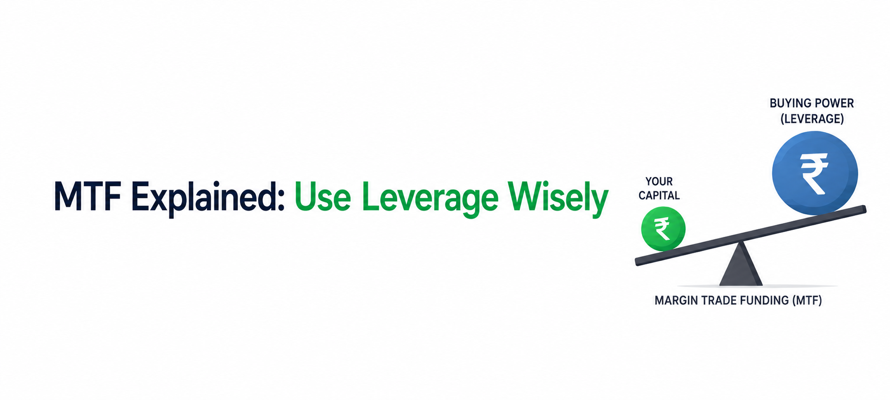
What is Margin Trade Funding (MTF)?
Margin Trade Funding (MTF) is a facility offered by SEBI-registered brokers that allows investors to buy more securities than their available capital by borrowing the additional funds from the broker. The purchased securities serve as collateral for the loan.
How MTF Works
- You want to buy ₹1,00,000 worth of TCS shares but have only ₹40,000
- Under MTF, you contribute ₹40,000 (40% margin); broker lends ₹60,000
- ₹1,00,000 of TCS is purchased and held in your demat account
- Shares are pledged to broker as collateral for the loan
- Interest accrues at broker’s MTF rate (Lemonn: 12.99% p.a.) daily
- You can sell shares anytime to repay the loan, keeping any profits (minus interest)
| MTF Parameter | SEBI Rules / Lemonn Terms |
|---|---|
| Minimum Margin | 50% of purchase value (SEBI mandated) |
| Maximum LTV | 50% (broker can lend up to 50% of stock value) |
| Eligible Securities | SEBI-approved list (Nifty 500 + select others) |
| Holding Period | No minimum, hold as long as margin is maintained |
| Interest Rate (Lemonn) | 12.99% per annum (charged daily) |
| Margin Call Trigger | Portfolio value falls below required margin ratio |
| Margin Call Action | Top up cash or reduce position within 24–48 hours |
“Start investing with confidence! Explore
0 demat account
and grow your wealth.”
MTF vs Intraday Margin: Key Differences
| Feature | MTF (Margin Trade Funding) | Intraday Margin |
|---|---|---|
| Holding period | Multi-day / indefinite | Same day only |
| Position squares off | Only if margin call breached | Automatically at 3:20 PM |
| Interest charged | Yes (daily) | No |
| Delivery of shares | Yes (pledged in demat) | No |
| Capital required | 50% of position value | 5%–20% (varies) |
Eligible Stocks for MTF
SEBI maintains a list of approved securities for MTF. Generally, this includes stocks in the Nifty 500 index and other liquid, large/mid-cap stocks. Penny stocks, illiquid securities, and stocks under exchange surveillance are excluded.
Risk Management for MTF Users
- Never use MTF for the full permissible limit, maintain buffer margin
- Avoid MTF on high-volatility stocks or during earnings season
- Set a personal stop-loss: if portfolio falls X%, repay MTF immediately
- Track interest cost weekly, it compounds and erodes returns in flat markets
- Use MTF only for high-conviction, fundamentally strong stocks
Tax Treatment of MTF Interest
Interest paid on MTF is treated as a business expense if you are classified as a trader for income tax purposes. If you are an investor (capital gains), MTF interest cannot be deducted against capital gains. This distinction significantly affects the net cost of using MTF. Consult your CA before deploying MTF at scale.
Disclaimer
The stocks mentioned in this article are not recommendations. Please conduct your own research and due diligence before investing. Investment in securities market are subject to market risks, read all the related documents carefully before investing. Please read the Risk Disclosure documents carefully before investing in Equity Shares, Derivatives, Mutual fund, and/or other instruments traded on the Stock Exchanges. As investments are subject to market risks and price fluctuation risk, there is no assurance or guarantee that the investment objectives shall be achieved. Lemonn (Formerly known as NU Investors Technologies Pvt. Ltd) do not guarantee any assured returns on any investments. Past performance of securities/instruments is not indicative of their future performance.
Related Posts


Download Lemonn
Download my app for share market trading, ipo investment, trading account, and all your investment needs.