Nifty 50 Index Fund vs ETF: Which Is Better for Long-Term Investors in 2026?
The Rise of Passive Investing in India
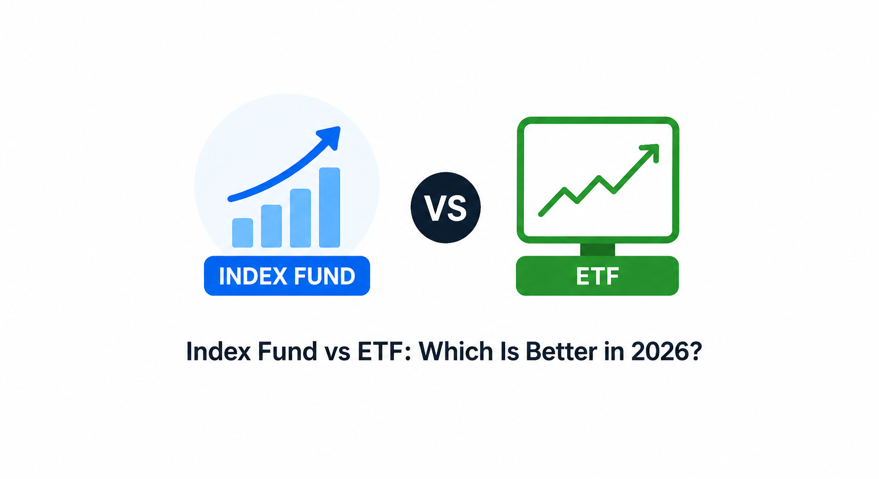
Assets under management in passive funds in India crossed ₹10 lakh crore in 2025, reflecting a fundamental shift in how retail investors approach equity markets. Both Nifty 50 Index Funds and ETFs offer exposure to India’s top 50 companie but they work differently and suit different investor profiles.
Understanding Nifty 50 Index Funds
An index fund is a regular open-ended mutual fund that replicates the Nifty 50 index. You invest and redeem at the NAV declared at end of day. There is no need for a demat account. SIP is straightforward, the fund house automatically processes your monthly investment.
“Start investing with confidence! Explore
0 demat account
and grow your wealth.”
Understanding Nifty 50 ETFs
An Exchange Traded Fund trades on NSE/BSE like a stock throughout market hours. You need a demat and trading account to buy ETFs. The price fluctuates during the day based on supply and demand. For SIP in ETFs, you must manually place orders each month or use a broker’s auto-SIP feature.
| Feature | Nifty 50 Index Fund | Nifty 50 ETF |
|---|---|---|
| Trading mechanism | Bought/sold at EOD NAV | Traded on exchange (live price) |
| Demat account needed | No | Yes |
| SIP available | Yes (automatic) | Manual or broker auto-SIP |
| Expense ratio (typical) | 0.10%–0.20% | 0.05%–0.10% |
| Tracking error | Slightly higher | Generally lower |
| Liquidity | High (T+3 redemption) | Depends on market depth |
| Minimum investment | ₹100–₹500 | 1 unit (price of ETF) |
| Dividend reinvestment | Growth option available | Paid out (no reinvestment) |
Tracking Error: The Critical Metric
Tracking error measures how closely a fund replicates its benchmark index. Lower is better. ETFs generally have lower tracking error than index funds because they can hold securities in exact index proportions without managing daily SIP inflows. However, top index funds from AMCs like UTI and HDFC have brought tracking error below 0.05% annually.
Top Nifty 50 Index Funds in 2026
| Fund Name | Expense Ratio | Tracking Error (1Y) | Min SIP |
|---|---|---|---|
| UTI Nifty 50 Index Fund | 0.20% | ~0.04% | ₹500 |
| HDFC Nifty 50 Index Fund | 0.20% | ~0.03% | ₹100 |
| Nippon India Index Nifty 50 | 0.20% | ~0.05% | ₹100 |
| ICICI Pru Nifty 50 Index Fund | 0.17% | ~0.03% | ₹100 |
Top Nifty 50 ETFs in 2026
| ETF Name | Expense Ratio | AUM | Avg Daily Volume |
|---|---|---|---|
| Nippon India ETF Nifty BeES | 0.04% | ₹25,000+ Cr | Very High |
| HDFC Nifty 50 ETF | 0.05% | ₹8,000+ Cr | High |
| SBI ETF Nifty 50 | 0.07% | ₹1,60,000+ Cr | Very High |
| UTI Nifty 50 ETF | 0.07% | ₹11,000+ Cr | High |
Which Should You Choose?
- For SIP investors: Index Fund; automation, no demat needed, ELSS-like simplicity
- For lump sum or active portfolio managers: ETF; real-time pricing, lower expense ratio
- For small amounts (< ₹5,000/month): Index Fund wins on convenience
- For institutional or large amounts: ETF for tighter tracking and lower cost
Disclaimer
The stocks mentioned in this article are not recommendations. Please conduct your own research and due diligence before investing. Investment in securities market are subject to market risks, read all the related documents carefully before investing. Please read the Risk Disclosure documents carefully before investing in Equity Shares, Derivatives, Mutual fund, and/or other instruments traded on the Stock Exchanges. As investments are subject to market risks and price fluctuation risk, there is no assurance or guarantee that the investment objectives shall be achieved. Lemonn (Formerly known as NU Investors Technologies Pvt. Ltd) do not guarantee any assured returns on any investments. Past performance of securities/instruments is not indicative of their future performance.
Related Posts


Download Lemonn
Download my app for share market trading, ipo investment, trading account, and all your investment needs.