
How to Build a Rs.1 Crore Portfolio in 10 Years in India
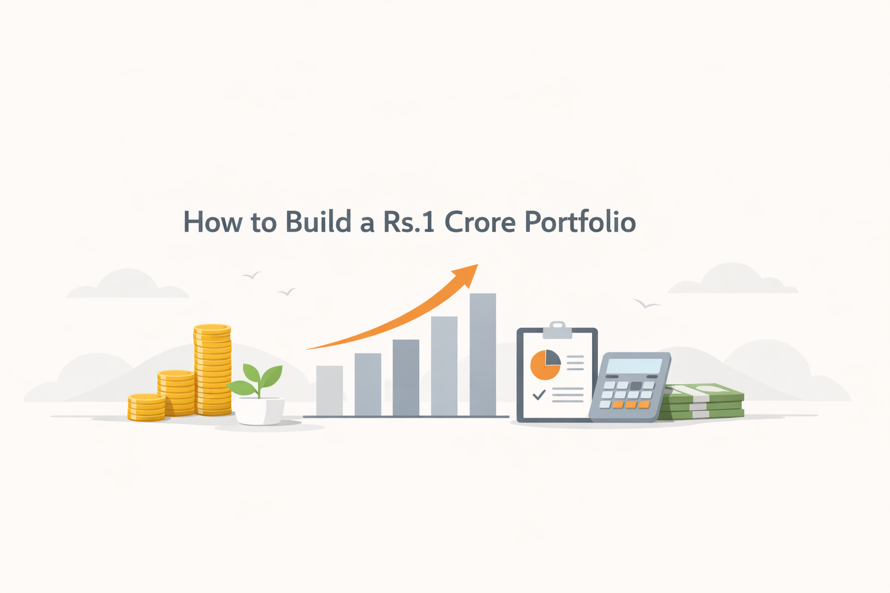
Rs.1 crore. For most Indians, it represents financial freedom – enough to retire early, fund a child’s education abroad, or simply never worry about money again. And while Rs.1 crore sounds like a distant dream, the mathematics of compounding makes it achievable for a disciplined investor with a 10-year horizon.
This guide gives you the exact blueprint: the monthly SIP amounts required, the asset allocation to follow, the step-by-step portfolio construction process on Lemonn, and the mistakes to avoid.
The Math Behind Rs.1 Crore in 10 Years
The future value formula for SIP is: FV = P x [((1+r)^n – 1) / r] x (1+r), where P is monthly investment, r is monthly return rate, and n is number of months (120 for 10 years).
Working backwards from Rs.1 crore at different expected annual return rates:
Required Monthly SIP for Rs.1 Crore
| Expected Annual Returns | Monthly SIP Needed | Total Invested | Wealth Created |
|---|---|---|---|
| 10% p.a. | Rs.51,440/month | Rs.61.7 lakh | Rs.38.3 lakh |
| 12% p.a. | Rs.43,470/month | Rs.52.2 lakh | Rs.47.8 lakh |
| 15% p.a. | Rs.33,380/month | Rs.40.1 lakh | Rs.59.9 lakh |
At 12% p.a. (approximately what Nifty 50 has delivered historically), you need to invest approximately Rs.43,470 per month for 10 years to accumulate Rs.1 crore. Higher returns through smart stock/fund selection reduce the monthly requirement significantly.
“Start investing with confidence! Explore
0 demat account
and grow your wealth.”
The Rs.1 Crore Blueprint: Asset Allocation
Asset allocation is the single most important investment decision you will make. Research consistently shows that over 90% of long-term portfolio performance is determined by allocation, not stock selection.
| Asset Class | Allocation | Purpose |
|---|---|---|
| Equity Index Funds + Select Large Caps | 70% | Core growth engine |
| Flexi-Cap / Mid-Cap Funds | 20% | Accelerated growth potential |
| Debt Funds / Gold | 10% | Stability and rebalancing buffer |
70% Equity (Index Funds + Large Caps): This forms the stable core. Nifty 50 or Sensex index funds give you market-rate returns with minimal fund manager risk and very low expense ratios. Complement with 2-3 quality large-cap stocks in sectors you understand well.
20% Flexi-Cap / Mid-Cap: This is your growth accelerator. Quality flexi-cap and mid-cap funds have historically outperformed large-cap indices over 10-year periods, though with higher short-term volatility. This allocation can meaningfully push your total return above the market average.
10% Debt / Gold: This provides portfolio stability and gives you dry powder to rebalance into equities during corrections. Liquid funds, short-duration debt funds, or Sovereign Gold Bonds work well here.
Step-by-Step: Building the Portfolio on Lemonn
Here is the exact process to set up and manage your Rs.1 crore portfolio on Lemonn:
- Download the Lemonn app and complete KYC – the process is fully digital and takes under 10 minutes with Aadhaar and PAN.
- Set up your monthly SIP for index funds first. Navigate to Mutual Funds > Index Funds > choose Nifty 50 or Sensex fund. Set SIP date to 5 days after your salary credit date.
- Add a second SIP for a flexi-cap or mid-cap fund. Allocate 20% of your monthly investment budget here.
- Invest in 2-3 individual large-cap stocks using Lemonn’s zero-commission equity trading. Research using the Fundamentals section to check ROE, debt, earnings growth.
- Set up a Sovereign Gold Bond or liquid fund SIP for your 10% stability allocation.
- Schedule a calendar reminder for annual review – every April, check allocations, step up SIP by 10%, and rebalance if any single asset class has drifted more than 5% from target.
Stocks to Consider for Long-Term Wealth
Rather than recommending specific stocks (which depend on current valuations and your research), focus on identifying companies with durable competitive advantages in India’s highest-growth sectors:
Banking and Financial Services: India’s banking penetration continues to grow as formal credit reaches more of the population. Well-capitalised private sector banks and NBFCs with strong asset quality and digital capabilities have multi-decade growth runways.
Information Technology: Indian IT companies serve both domestic digital transformation demand and global enterprise clients. Companies with high revenue visibility, low attrition, and expanding margin profiles deserve consideration.
FMCG and Consumer Discretionary: India’s consumption story – rising incomes, premiumisation, and rural market expansion – provides strong fundamental tailwinds. Brands with pricing power and distribution scale are particularly attractive for long-term holding.
Healthcare and Pharmaceuticals: An ageing population, growing health insurance penetration, and India’s dominant position in generic drug exports create structural demand. Focus on companies with clean regulatory track records.
The Annual Review Ritual
Building a Rs.1 crore portfolio is not a set-and-forget exercise. Once a year, perform these four actions:
- Rebalance: Check if any asset class has grown beyond its target allocation by more than 5%. If equities have had a great year and now represent 80% of your portfolio (up from 70%), trim and redeploy into debt or gold.
- Step Up: Increase your monthly SIP by at least 10% – ideally matching your salary increment. Rs.43,470/month stepped up by 10% annually for 10 years dramatically outperforms a flat SIP.
- Review Holdings: Check if any individual stock has materially deteriorated in fundamentals (declining ROE, rising debt, management issues). Replace with better alternatives.
- Tax Harvest: Identify positions with short-term capital gains near the 1-year mark. Consider selling and immediately repurchasing to ‘reset’ cost basis and defer tax liability.
Common Mistakes That Delay Rs.1 Crore
- Starting late: Every year of delay significantly increases the monthly SIP required. Starting at 25 is dramatically better than starting at 35.
- Stopping SIPs during market downturns: This is the single most damaging mistake. Falling markets mean you are buying more units – stopping the SIP wastes this opportunity.
- Over-diversification: Owning 40+ funds and stocks creates a ‘diworsification’ problem. 15-20 quality positions across 4-5 asset types is optimal.
- Ignoring expense ratios: A 1% higher annual expense ratio on mutual funds reduces your 10-year corpus by approximately 9-10%. Choose direct plans with low expense ratios.
- Treating the portfolio as an ATM: Withdrawals mid-journey reset your compounding clock. Keep a separate emergency fund (6 months expenses) so you never need to touch your investment corpus.
Frequently Asked Questions
Q: What if I cannot invest Rs.43,000/month right now?
Start with whatever you can – Rs.5,000 or Rs.10,000/month – and use a step-up SIP to increase by 15-20% annually. The habit and the compounding machine both start from day one.
Q: Is 12% return realistic for Indian equities?
The Nifty 50 has delivered approximately 12-13% CAGR over most 10-year rolling periods historically. Past performance does not guarantee future returns, but India’s growth trajectory makes long-term equity investing compelling.
Q: Should I invest in direct mutual funds or through Lemonn?
Direct mutual funds have lower expense ratios than regular plans. Lemonn offers zero-commission equity investing and supports direct mutual fund investments through its platform.
Q: What happens if the market crashes 40% in year 5?
If your fundamentals are sound and you stay invested, a recovery typically brings your portfolio back and often to new highs. History shows that investors who held through crashes came out significantly ahead of those who sold in panic.
Disclaimer
The stocks mentioned in this article are not recommendations. Please conduct your own research and due diligence before investing. Investment in securities market are subject to market risks, read all the related documents carefully before investing. Please read the Risk Disclosure documents carefully before investing in Equity Shares, Derivatives, Mutual fund, and/or other instruments traded on the Stock Exchanges. As investments are subject to market risks and price fluctuation risk, there is no assurance or guarantee that the investment objectives shall be achieved. Lemonn (Formerly known as NU Investors Technologies Pvt. Ltd) do not guarantee any assured returns on any investments. Past performance of securities/instruments is not indicative of their future performance.
Related Posts

Download Lemonn
Download my app for share market trading, ipo investment, trading account, and all your investment needs.



