
SIP vs Lump Sum Investment: Which Is Better in 2026?
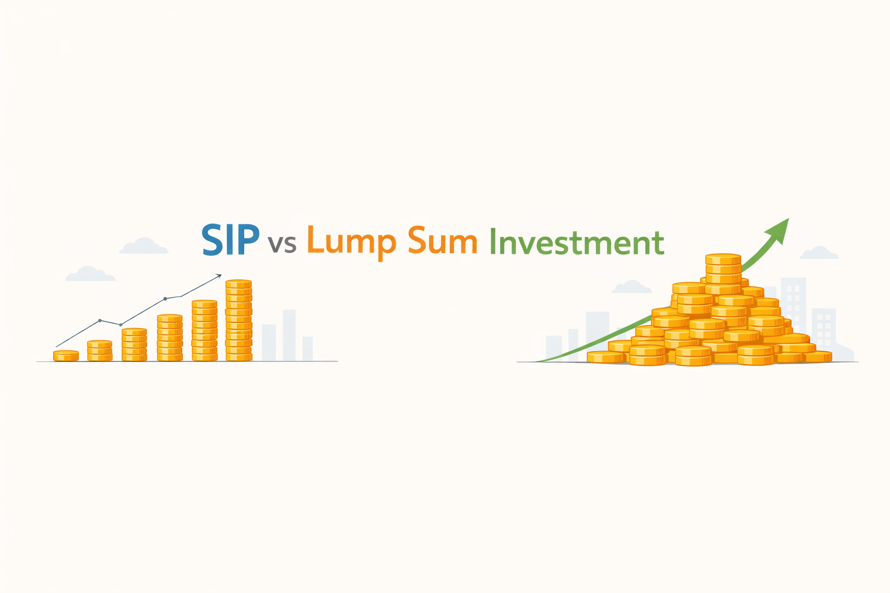
Every investor faces this question at some point: should I invest a fixed amount every month or put all my money in at once? The SIP vs lump sum debate has no single right answer – the best approach depends on your income pattern, market timing, risk tolerance, and investment horizon.
This guide breaks down both strategies with real numbers, historical context, and a practical framework to help you decide – or combine both intelligently.
The Core Difference
A Systematic Investment Plan (SIP) involves investing a fixed amount at regular intervals – typically monthly. A lump sum investment means deploying a large amount of capital at a single point in time.
Both strategies invest in the same instruments (equity mutual funds, index funds, direct stocks), but they differ fundamentally in how and when capital enters the market. This timing difference is what drives most of the performance variation between the two approaches.
How SIP Works
When you set up a monthly SIP, you buy units of a fund or shares of a stock at whatever price prevails on that date. Some months you buy at high prices; other months you buy at low prices. Over time, this averaging reduces your effective cost per unit – a mechanism called rupee cost averaging.
Example: You invest Rs.10,000/month in an index fund for 12 months.
| Month | NAV (Rs.) | Units Purchased |
|---|---|---|
| Jan | 100 | 100 |
| Feb | 90 | 111 |
| Mar | 80 | 125 |
| Apr | 95 | 105 |
| May | 105 | 95 |
| Jun | 115 | 87 |
Total invested: Rs.60,000. Total units: ~623. Average cost per unit: Rs.96.3 – lower than the simple average NAV of Rs.97.5. This is rupee cost averaging at work. You automatically buy more units when prices are low and fewer when prices are high.
“Start investing with confidence! Explore
0 demat account
and grow your wealth.”
How Lump Sum Works
With a lump sum, you invest the entire amount on a single day. If you invest Rs.12 lakh when the market is at a low point – say, after a correction – and the market subsequently rallies 15%, your entire Rs.12 lakh benefits from that full rally.
This is the core advantage of lump sum: when deployed at the right time, your maximum capital works for you from day one. There is no ‘waiting on the sidelines’ effect. The earlier money enters the market, the longer it compounds.
The risk is equally clear: if you invest Rs.12 lakh at a market peak and prices fall 20%, you have immediately lost Rs.2.4 lakh on paper. Emotional distress from this scenario causes many investors to exit at exactly the wrong time.
SIP vs Lump Sum: Historical Performance
Academic research and historical backtests consistently show that lump sum investing outperforms SIP approximately 65-70% of the time in equity markets. This makes mathematical sense: equity markets trend upward over the long term, so having all your money invested earlier gives you more time to compound.
However, this advantage assumes perfect timing and emotional resilience – two things most retail investors lack. For salaried professionals who receive monthly income, SIP is not just a strategy choice; it is the only practical option. You invest what you have when you have it.
The underperformance of SIP versus lump sum is also context-dependent. In highly volatile markets or sideways markets, SIP’s rupee cost averaging benefit is more pronounced. In strong bull markets with minimal drawdowns, lump sum wins decisively.
When SIP Is Better
- You receive a monthly salary and do not have a large investable corpus upfront
- Markets are near all-time highs and you are uncertain about near-term direction
- You want to remove the emotional burden of timing the market
- You are a first-time investor building the habit of regular saving
- The market is in a period of high volatility or uncertain macroeconomic conditions
- You want to invest across multiple market cycles to build a truly average-cost position
When Lump Sum Is Better
- The market has just experienced a significant correction (15%+ drawdown)
- You have received a windfall: bonus, inheritance, property sale proceeds, or maturity proceeds
- Your investment horizon is 10+ years, where timing effects are significantly diluted
- You have high emotional resilience and will not panic-sell during drawdowns
- Interest rates are high – deploying capital quickly avoids the opportunity cost of holding cash
Returns Comparison
Assuming 12% p.a. CAGR over 10 years (approximate long-term Nifty 50 return):
| Scenario | SIP Rs.10K/month | Lump Sum Rs.12L | Difference |
|---|---|---|---|
| 12% p.a. | 10 years | Rs.23.2 lakh | Rs.37.3 lakh | Lump sum wins by Rs.14.1L |
| 8% p.a. | 10 years | Rs.18.3 lakh | Rs.25.9 lakh | Lump sum wins by Rs.7.6L |
| Volatile: 12% avg, high variance | Rs.24.1 lakh* | Rs.35.8 lakh* | Gap narrows with volatility |
*Illustrative figures. Actual returns vary based on market conditions, fund selection, and entry/exit timing.
Key insight: The total capital deployed is the same (Rs.12L lump sum = Rs.10K/month x 10 years). The lump sum invests earlier, so it has more time compounding. However, in practice, most salaried investors build their Rs.12L gradually through monthly SIPs – so the comparison is largely theoretical.
The Hybrid Approach: Core SIP + Tactical Lump Sum
The most sophisticated approach combines both strategies. Run a monthly SIP as your default – this builds discipline and eliminates timing anxiety. Then, when the market corrects significantly (Nifty falls 15% or more from recent highs), deploy additional lump sum capital from your emergency fund surplus or liquid savings.
This strategy gives you the best of both worlds: the discipline and averaging of SIP, plus the opportunistic advantage of lump sum during market dislocations. Many successful long-term investors in India follow exactly this playbook.
On Lemonn, you can set up automatic monthly SIPs and also execute single buy orders when you spot market opportunities – zero commission on both.
Frequently Asked Questions
Q: Can I convert my SIP to lump sum if I receive a bonus?
Yes. You can continue your existing SIP and additionally invest a lump sum separately. They are independent investment actions.
Q: Which is better for Nifty 50 index funds?
Both work well for index funds. For long-term investors (10+ years), lump sum deployed during corrections and SIP for regular monthly amounts is the optimal combination.
Q: What is the minimum SIP amount on Lemonn?
Lemonn allows SIPs starting from Rs.500/month for most funds. There are no SIP setup charges or platform fees.
Q: Does SIP guarantee positive returns?
No. SIP reduces timing risk through averaging, but if the underlying asset falls over your entire investment period, you will still have losses. SIP works best for long-term (5+ year) investment horizons in quality assets.
Q: Is there a tax difference between SIP and lump sum?
Each SIP instalment is treated as a separate investment for capital gains calculation. A lump sum has a single purchase date. Both are taxed identically on actual gains (LTCG/STCG based on holding period).
Disclaimer
The stocks mentioned in this article are not recommendations. Please conduct your own research and due diligence before investing. Investment in securities market are subject to market risks, read all the related documents carefully before investing. Please read the Risk Disclosure documents carefully before investing in Equity Shares, Derivatives, Mutual fund, and/or other instruments traded on the Stock Exchanges. As investments are subject to market risks and price fluctuation risk, there is no assurance or guarantee that the investment objectives shall be achieved. Lemonn (Formerly known as NU Investors Technologies Pvt. Ltd) do not guarantee any assured returns on any investments. Past performance of securities/instruments is not indicative of their future performance.
Related Posts


Download Lemonn
Download my app for share market trading, ipo investment, trading account, and all your investment needs.



