
How Stock Buybacks Work, and Why They Matter
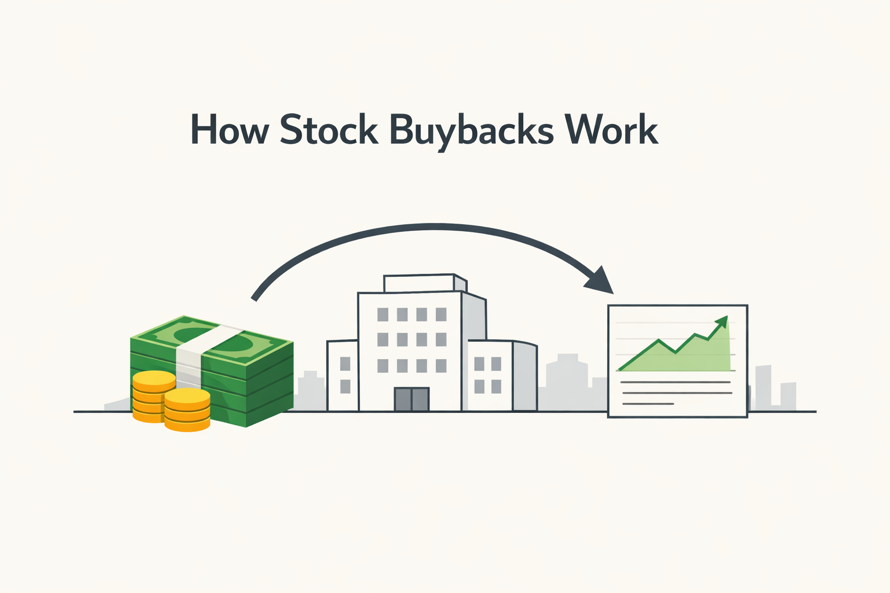
There are moments in the stock market when a company suddenly steps onto the other side of the trade. Instead of issuing shares. Instead of raising money. Instead of inviting new owners. It begins by buying its own stock.
That reversal always attracts attention.
Announcements appear after market hours. Exchange filings surface quietly. Within minutes, traders begin calculating implications. Supply. Demand. Ownership. Valuation. All shift, even before a single share gets repurchased.
These announcements involve stock buybacks. And while the mechanics sound simple, the meaning rarely is.
A buyback can signal confidence. It can signal excess cash. It can signal the absence of expansion opportunities. Sometimes it signals all three at once. Investors who understand buybacks often read them less as transactions and more as statements-statements made with capital.
To see why they matter, it helps to begin with the basics.
What is a stock buyback?
A stock buyback happens when a company purchases its own shares from the open market or directly from shareholders. It sounds counterintuitive at first. Companies usually issue shares to raise capital. Buybacks do the opposite. They absorb shares back into the company.
The immediate effect is mathematical. The number of outstanding shares declines.
Imagine a company with 1,000 million shares outstanding. If it buys back 50 million shares, only 950 million remain. Nothing operational changes overnight. Revenue remains the same. Employees remain the same. Factories remain exactly where they were. Yet ownership shifts subtly.
Each remaining share now represents a slightly larger slice of the same company.
This matters more than it appears. Earnings are spread across fewer shares. Earnings per share rise automatically. Ownership concentration increases without investors purchasing additional shares themselves.
Stock buybacks typically use surplus cash. Companies do not print new money for buybacks. They use existing reserves. Cash generated through operations. Cash accumulated over the years.
In India, buybacks have become especially common among cash-rich companies. Tata Consultancy Services, Infosys, and Wipro have all conducted repeated buybacks. Each announcement involved thousands of crores being moved from company reserves back into shareholders’ hands.
Buybacks do not change the business overnight.
They quietly change the structure of ownership.
Why companies use stock buybacks
Companies rarely announce stock buybacks impulsively. These decisions follow an internal financial evaluation. Cash position. Growth pipeline. Capital requirements. Market valuation.
One of the most common reasons involves surplus cash accumulation.
Some businesses generate cash faster than they can deploy it productively. Technology services companies illustrate this clearly. Their revenue flows steadily. Their expansion requires limited physical infrastructure. Cash builds up gradually. Idle cash earns little return.
Buybacks offer a direct outlet.
Instead of letting capital sit unused, companies recycle it back into equity.
Another reason involves valuation perception. Management teams monitor their own stock price closely. When they believe their shares trade below intrinsic value, buybacks allow them to acquire ownership at what they consider favorable prices.
This sends a message. Quiet, but powerful. It signals internal confidence.
Financial metrics also play a role. When outstanding shares decline, earnings per share rise-even if total profit remains unchanged. Investors watch these metrics carefully. Improved ratios often influence valuation models.
Buybacks also provide flexibility compared to dividends. Dividends create recurring expectations. Buybacks remain discretionary. Companies announce them when conditions feel right.
Sometimes buybacks stabilize stock prices during uncertain periods. When broader markets weaken, company demand supports shares indirectly.
The decision always reflects priorities. Expansion. Acquisition. Debt reduction. Or buybacks. Capital flows toward whichever path management considers most efficient.
Buybacks reveal that choice.
“Start investing with confidence! Explore
0 demat account
and grow your wealth.”
History of stock buybacks
Stock buybacks did not always operate freely. Earlier financial systems treated buybacks cautiously. Regulators feared manipulation. Companies influencing their own stock price raised serious concerns.
Gradually, regulatory frameworks evolved. Structured rules replaced outright restrictions.
In India, SEBI introduced buyback regulations during the late 1990s. These regulations defined eligibility, limits, disclosure requirements, and shareholder protections. Transparency became mandatory.
Initially, buybacks appeared occasionally. Manufacturing companies prioritized expansion. Infrastructure investment consumed capital.
Technology companies changed that pattern.
As India’s IT sector matured, companies like Infosys and Tata Consultancy Services began generating large free cash flows. Expansion requires human capital more than physical infrastructure. Cash accumulated steadily.
Buybacks became logical.
TCS alone has conducted multiple buyback programs, each exceeding ₹16,000 crore, across different years. Infosys followed with repeated buybacks as well. Wipro joined the pattern.
Buybacks became routine.
Globally, the trend accelerated after the 2008 financial crisis. Companies across industries accumulated cash and used buybacks to return capital efficiently.
Today, buybacks exist as a standard corporate action. Expected. Studied. Interpreted.
Never ignored.
How buybacks work
Stock buybacks follow strict regulatory procedures. Companies cannot purchase shares arbitrarily. Every step requires disclosure.
Two primary methods dominate Indian markets.
The first involves open market buybacks. The company purchases shares gradually through the stock exchange. No fixed price exists. Purchases occur over time. Weeks. Sometimes months. Prices fluctuate naturally.
This method offers flexibility. Companies buy more when prices appear favorable. Less when prices rise.
The second involves tender offers.
Here, the company announces a fixed buyback price. Usually above the current market price. Shareholders receive an invitation. Sell shares at the offered price. Participation remains voluntary.
Tender offers often attract strong interest. Premium pricing creates an immediate incentive.
SEBI regulations also impose limits. Buyback size cannot exceed specified percentages of paid-up capital and reserves. Funding must come from internal sources. Excessive borrowing remains restricted.
Once repurchased, shares are extinguished permanently. They disappear. Outstanding share count declines. Ownership redistributes silently. Supply tightens.
These changes ripple across financial metrics instantly. Earnings per share improve. Return on equity strengthens. Market perception adjusts.
The business continues exactly as before. But its structure shifts.
Buyback risks and misconceptions
Stock buybacks often appear positive at first glance. Yet interpretation requires caution. Context matters more than the announcement.
Common risks and misunderstandings include:
- Companies may announce buybacks because expansion opportunities remain limited, not because growth remains strong.
- Buybacks executed at elevated valuations may destroy shareholder value rather than create it.
- Cash used for buybacks becomes unavailable for future acquisitions, innovation, or expansion.
- Earnings per share may improve mathematically without any improvement in underlying profitability.
- Some buybacks attempt to support short-term stock sentiment rather than long-term strategic goals.
- Buybacks do not guarantee stock price appreciation. Market sentiment still dominates price movement.
- Excessive buybacks may weaken balance sheets if cash reserves decline too far.
Buybacks carry meaning. But meaning changes depending on timing, valuation, and financial health.
Investors who study context understand buybacks more clearly.
Tips for evaluating stock buybacks
Evaluating stock buybacks requires more than reading headlines. Investors often examine deeper indicators:
- Compare buyback value against total market capitalization. Larger programs create a stronger impact.
- Evaluate buyback price relative to market price. Premium pricing often signals confidence.
- Review cash reserves and free cash flow before the buyback announcement. Strong reserves support sustainability.
- Examine company debt levels. Healthy balance sheets matter more than buyback size alone.
- Observe frequency of buybacks. Consistent buybacks suggest stable cash generation.
- Consider industry maturity. Mature industries produce buybacks more frequently than fast-growing sectors.
- Watch management timing. Buybacks during corrections may signal perceived undervaluation.
Bottom line
Stock buybacks reshape ownership quietly. They reduce outstanding shares. They concentrate earnings. They redistribute capital.
In India, buybacks became common among companies with strong and predictable cash flows-especially technology firms, financial institutions, and mature businesses.
Buybacks can signal strength. They can signal surplus. They can signal strategic intent. But they never replace business fundamentals. Revenue growth still matters. Competitive strength still matters. Cash flow still matters.
Buybacks remain a financial decision layered on top of operational reality. Understanding stock buybacks allows investors to see beyond the announcement itself. To see intent. And sometimes, to see confidence expressed in its most direct form-capital buying itself.
FAQs:
Q. Are buybacks good for a stock?
Buybacks often support a stock because fewer shares remain in circulation. Ownership concentration rises. Earnings per share increase automatically. Markets frequently interpret buybacks as a signal that management sees long-term value in the company.
Q. How does a share buy back work?
A company uses its own cash to purchase shares from the stock exchange or directly from shareholders. Those shares get extinguished permanently. Outstanding share count falls. Each remaining shareholder owns a larger percentage of the same business.
Q. Why do CEOs buy their own stock?
Leadership teams approve buybacks when they believe the company generates surplus cash and the current valuation looks attractive internally. Buybacks also reflect capital allocation priorities. Management chooses ownership consolidation over expansion or cash retention.
Q. How to profit from stock buybacks?
Investors often watch for buyback announcements, tender offer premiums, and improving earnings per share. Reduced supply can influence valuation over time. Market reaction depends on timing, company fundamentals, and the scale of the buyback.
Disclaimer
The stocks mentioned in this article are not recommendations. Please conduct your own research and due diligence before investing. Investment in securities market are subject to market risks, read all the related documents carefully before investing. Please read the Risk Disclosure documents carefully before investing in Equity Shares, Derivatives, Mutual fund, and/or other instruments traded on the Stock Exchanges. As investments are subject to market risks and price fluctuation risk, there is no assurance or guarantee that the investment objectives shall be achieved. Lemonn (Formerly known as NU Investors Technologies Pvt. Ltd) do not guarantee any assured returns on any investments. Past performance of securities/instruments is not indicative of their future performance.
Related Posts

Download Lemonn
Download my app for share market trading, ipo investment, trading account, and all your investment needs.



