
Risks of Margin Trading Facility (MTF) in India
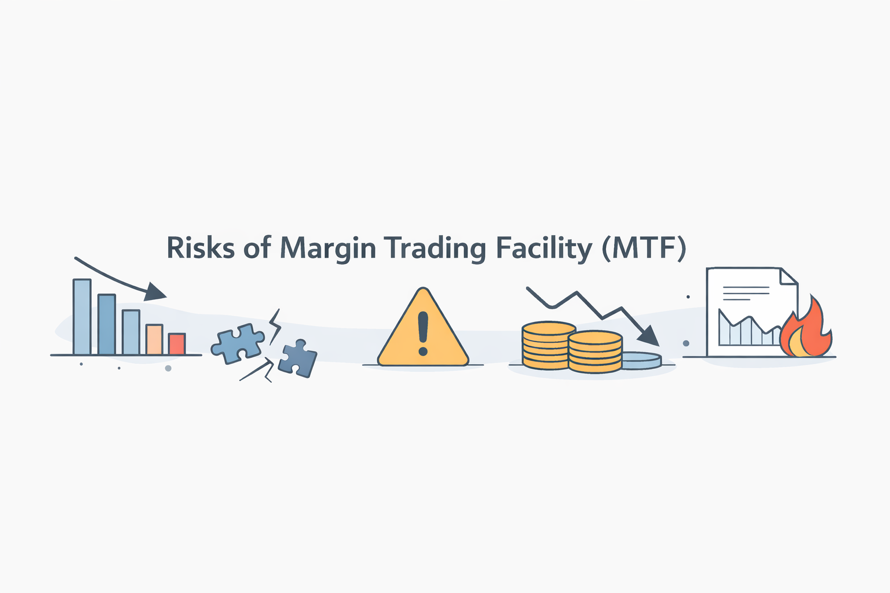
Margin Trading Facility is a powerful tool – but it is not without risk. Every rupee of leverage that amplifies your gains equally amplifies your losses. Before you use MTF, you need to understand exactly what can go wrong and how to protect yourself.
This article covers the five main risks of MTF, illustrates loss scenarios with real numbers, and provides a practical checklist for using MTF responsibly.
The Leverage Paradox: Bigger Gains, Bigger Losses
Leverage is a double-edged sword. When you use 4x MTF, a 10% rise in the stock price becomes a 40% gain on your own capital. But a 10% fall becomes a 40% loss on your own capital. And a 25% fall wipes out your entire own capital.
This asymmetry is the defining characteristic of leveraged trading. The market does not always move in your favour – and when it moves against you with leverage, losses can accumulate faster than most beginners expect.
The 5 Main Risks of MTF
“Start investing with confidence! Explore
0 demat account
and grow your wealth.”
1. Margin Call Risk
A margin call happens when the value of your pledged stocks falls below the required margin threshold. For example, if you need to maintain a 20% margin ratio and the stock falls 15%, your margin ratio drops below the threshold.
At this point, Lemonn (or any broker) will issue a margin call – a request to add more funds or sell some holdings to restore the margin ratio. If you do not respond in time, the broker may forcibly sell your holdings.
Margin calls are stressful and can force you to sell at the worst possible time – at the bottom of a correction – crystallising a loss that might have recovered if you had held.
2. Interest Cost Erosion
MTF interest at 12.99% per annum may seem small on a daily basis (about 0.03% per day). But over months, it compounds. If you hold an MTF position for 180 days on Rs.2 lakh borrowed, you pay approximately Rs.10,811 in interest.
If the stock has not moved significantly in that period, your interest cost eats into (or entirely cancels out) any modest gain. MTF works best when there is a clear catalyst and a defined exit plan – not as a ‘buy and forget’ strategy.
3. Forced Liquidation Risk
If a margin call goes unanswered, the broker has the legal right to sell your MTF holdings without your explicit consent. This is called forced liquidation.
Forced liquidation typically happens at market price during volatile sessions – which means you may get a worse price than if you had sold voluntarily. Additionally, if the sale proceeds are insufficient to cover the full borrowed amount, you are still liable for the shortfall.
4. Concentration Risk
Many retail investors use MTF to take large positions in a single stock they are ‘very confident’ about. This creates concentration risk – your entire leveraged capital is exposed to one company’s fortunes.
If that stock drops sharply due to a fraud disclosure, regulatory action, or poor results, your leveraged losses can be catastrophic. Diversifying your MTF exposure across multiple stocks or sectors reduces this risk.
5. Overconfidence and Overtrading
Easy access to leverage can create a false sense of control. Beginners who have a few early successes with MTF often increase their leverage aggressively – a classic overconfidence trap.
Overtrading with MTF means you are constantly paying interest on multiple positions, your portfolio becomes harder to monitor, and a single bad position can cascade into a series of margin calls. Discipline and position sizing are as important as stock selection.
MTF Loss Scenarios
The table below shows how leverage amplifies both gains and losses on an Rs.25,000 own capital investment with 4x MTF (total position: Rs.1,00,000):
| Scenario | Capital Deployed | Profit / Loss on Position | Return on Own Capital (Rs.25,000) |
|---|---|---|---|
| Stock rises 10% | Rs.1,00,000 | +Rs.10,000 gain | +40% gain on own capital |
| Stock rises 5% | Rs.1,00,000 | +Rs.5,000 gain (minus interest) | +20% gain (minus interest cost) |
| Stock flat (0%) | Rs.1,00,000 | Zero gain, interest cost applies | Negative return (interest erodes capital) |
| Stock falls 10% | Rs.1,00,000 | -Rs.10,000 loss | -40% loss on own capital |
| Stock falls 25% | Rs.1,00,000 | -Rs.25,000 loss | -100% loss: own capital completely wiped out |
| Stock falls 30% | Rs.1,00,000 | -Rs.30,000 loss | Own capital wiped + Rs.5,000 owed to broker |
The 25% and 30% scenarios are not hypothetical. Indian stocks routinely fall 20-40% during earnings disappointments, fraud disclosures, or broader market corrections. Always have a stop-loss.
How to Use MTF Responsibly
Follow this checklist before and during any MTF position:
- Never invest more than you can afford to lose entirely.
- Limit MTF to 20-30% of your total portfolio – do not leverage everything.
- Set a stop-loss before you enter, and honour it without exception.
- Choose only fundamentally strong, large-cap stocks for MTF – avoid small-caps and penny stocks.
- Always maintain a cash buffer of at least 10-15% extra above the minimum margin requirement.
- Have an exit plan: know your target price and your stop-loss price before entering the trade.
- Track interest accrual daily. Include it in your profit/loss calculation.
- Avoid taking new MTF positions when markets are highly volatile or near all-time highs without clear conviction.
- Review your MTF positions weekly. Markets change; your thesis should be re-evaluated regularly.
SEBI Safeguards Built Into MTF
SEBI has put several structural safeguards in place to protect retail investors using MTF:
- Minimum own margin requirement of 20%: You must fund at least 20% of the purchase value from your own pocket. This limits total leverage to 5x maximum.
- Eligible securities list: Only SEBI-approved Group 1 (high liquidity) stocks can be bought on MTF. Highly volatile penny stocks are excluded.
- Pledge mechanism: Stocks bought via MTF are pledged in your own demat account – not transferred to the broker. This prevents misuse of client securities.
- Daily mark-to-market: Your MTF exposure is re-evaluated daily based on current market prices. Margin shortfalls trigger immediate calls.
- Disclosure obligations: Brokers must clearly disclose interest rates, fees, and margin requirements before activating MTF for any client.
Frequently Asked Questions
Q1. Can I lose more money than I invested with MTF?
Yes. If a stock falls sharply enough, your losses can exceed your own capital. You would then owe the broker the additional amount. This is why stop-losses are essential.
Q2. How quickly can a margin call happen?
A margin call can happen within the same trading day if the stock falls sharply enough. Brokers typically send an SMS and app notification. You usually get until end of day or the next morning to respond.
Q3. What is the difference between a margin call and forced liquidation?
A margin call is a warning – you are asked to add funds. Forced liquidation is the action taken if you do not respond to the margin call – the broker sells your holdings automatically.
Q4. Is MTF suitable for long-term investors?
MTF is most suitable for medium-term positional trades (days to months). For long-term holding (years), the cumulative interest cost typically outweighs the benefit of leverage.
Q5. Does Lemonn send margin call alerts?
Yes. Lemonn sends real-time push notifications, SMS alerts, and email notifications when your MTF margin falls below the required threshold.
Disclaimer
The stocks mentioned in this article are not recommendations. Please conduct your own research and due diligence before investing. Investment in securities market are subject to market risks, read all the related documents carefully before investing. Please read the Risk Disclosure documents carefully before investing in Equity Shares, Derivatives, Mutual fund, and/or other instruments traded on the Stock Exchanges. As investments are subject to market risks and price fluctuation risk, there is no assurance or guarantee that the investment objectives shall be achieved. Lemonn (Formerly known as NU Investors Technologies Pvt. Ltd) do not guarantee any assured returns on any investments. Past performance of securities/instruments is not indicative of their future performance.
Related Posts



Download Lemonn
Download my app for share market trading, ipo investment, trading account, and all your investment needs.



