
Oil-Sensitive Stocks Fall as Brent Crude Tops $91/Barrel
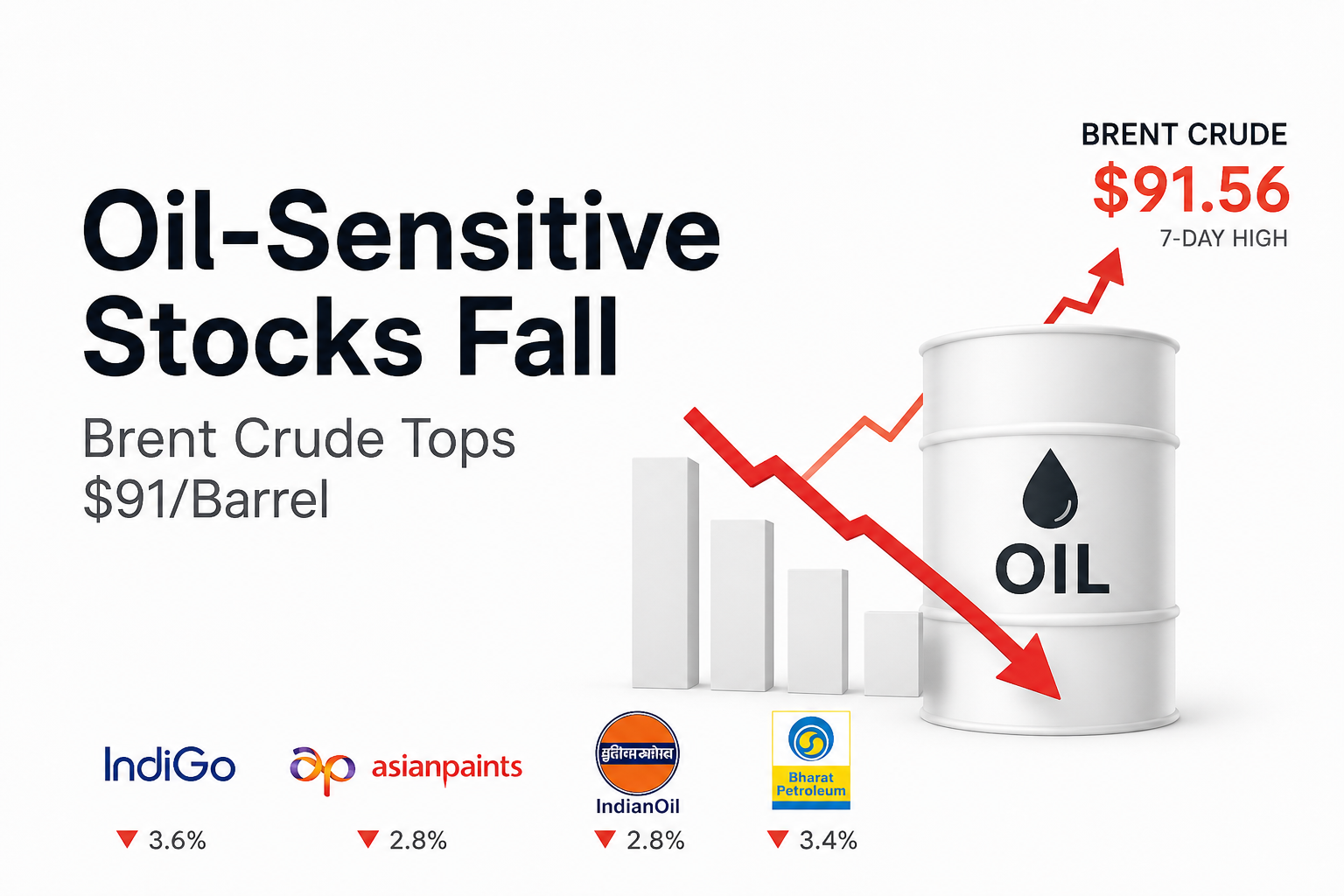
Oil-sensitive stocks including IndiGo, Asian Paints, Indian Oil and BPCL fell sharply on September 1 as Brent crude climbed to a seven-day high of $91.56 per barrel.
Higher crude prices tend to hurt airlines, paint manufacturers and oil marketing companies because they increase fuel or raw material costs. The latest spike followed renewed tensions between the US and Iran, which raised concerns about oil supplies from West Asia.
Why are oil-sensitive stocks falling today?
Brent crude rose above $91 per barrel on Tuesday, September 1, reaching an intraday high of $91.56. That was its highest level since August 25, 2026.
The rise in oil prices came after fresh military exchanges involving the US and Iran increased fears of further supply disruptions in the Middle East.
For India, which depends heavily on imported crude, sustained higher oil prices can affect companies through:
- Higher aviation turbine fuel costs for airlines
- More expensive crude purchases for oil marketing companies
- Higher prices for crude-derived inputs used by paint companies
- Costlier synthetic rubber and carbon black for tyre manufacturers
- Broader inflation and currency pressures
The Nifty Oil & Gas index fell around 0.8% in early trade to an intraday low of 11,013.55.
Which oil-sensitive stocks fell?
Several major crude-sensitive stocks were trading lower during the morning session.
| Company | Price reported | Intraday change |
|---|---|---|
| Aegis Logistics | ₹1,226 | -6.6% |
| IndiGo | ₹5,078 | -3.6% |
| BPCL | ₹318 | -3.4% |
| GAIL India | ₹173.45 | -3.0% |
| Petronet LNG | ₹293 | -2.9% |
| Asian Paints | ₹2,583 | -2.8% |
| Indian Oil | ₹136 | -2.8% |
| HPCL | ₹362 | -2.0% |
| Berger Paints | ₹495 | -1.1% |
Prices and returns above reflect intraday data reported on September 1 and can change during the trading session.
“Start investing with confidence! Explore
Lemonn
and grow your wealth.”
Why did IndiGo shares fall?
InterGlobe Aviation, which operates IndiGo, fell around 3.6% to ₹5,078.
Fuel is one of the biggest operating expenses for an airline. When crude oil prices rise, aviation turbine fuel can become more expensive, putting pressure on operating margins unless airlines are able to offset the increase through higher ticket prices or other cost controls.
That makes airline shares particularly sensitive to sudden increases in global oil prices.
Why are Asian Paints and other paint stocks under pressure?
Asian Paints fell about 2.8%, while Berger Paints declined around 1.1%.
Paint manufacturers use several petrochemical and crude-linked raw materials. When crude prices remain elevated, the cost of these inputs can increase.
Companies may respond by raising product prices, but passing the entire increase on to customers is not always possible. Investors therefore tend to watch crude prices closely when assessing paint-company margins.
Why did BPCL and Indian Oil shares decline?
Bharat Petroleum Corporation Ltd, or BPCL, fell around 3.4%, while Indian Oil Corporation declined about 2.8%. HPCL was also down roughly 2%.
These companies buy crude oil and refine it into products such as petrol and diesel.
When crude prices rise quickly, their input costs increase. Their profitability can come under pressure if retail fuel prices do not rise sufficiently to compensate for those higher costs.
This explains why oil marketing companies can sometimes fall even when global crude prices are rising.
Why are ONGC and Oil India different?
Higher crude prices do not affect every energy company in the same way.
Upstream oil producers such as ONGC and Oil India extract crude and natural gas. Higher commodity prices can increase the value of what they produce, subject to factors such as production volumes, government policies and taxes.
On September 1, upstream stocks including ONGC and Oil India were trading higher even as downstream and crude-consuming companies came under pressure.
This creates an important distinction for investors:
Crude consumers
Companies such as airlines, paint makers and oil marketing companies can face higher costs when crude rises.
Crude producers
Oil exploration and production companies can potentially benefit from higher realised crude prices.
Why has Brent crude crossed $91?
The latest rise was driven largely by geopolitical risk.
Fresh US-Iran hostilities revived concerns over disruptions to oil supplies and shipping routes in the Middle East. Brent futures were trading above $91 per barrel on September 1 as markets assessed the possibility of a prolonged disruption.
The Strait of Hormuz remains particularly important for global markets because a significant share of international oil supply normally passes through the region.
When traders believe those supplies could be disrupted, crude prices can jump even before an actual shortage develops.
How do higher crude oil prices affect the Indian stock market?
Rising crude prices can affect India beyond individual oil-sensitive stocks.
India imports much of the crude oil it consumes. A sustained increase in oil prices can therefore raise the country’s import bill.
That can potentially put pressure on:
- Inflation
- The Indian rupee
- Corporate input costs
- Current account balances
- Consumer spending
- Interest-rate expectations
Indian benchmark indices were subdued on September 1, with rising oil prices and geopolitical risks offsetting some optimism around domestic growth.
What should investors watch next?
For oil-sensitive stocks, the direction of crude prices will remain an important near-term trigger.
Investors can track three major factors.
1. US-Iran tensions
Any further escalation could increase fears of prolonged oil supply disruptions. Signs of de-escalation could have the opposite effect.
2. Brent crude prices
A brief spike above $90 may have a different impact from crude remaining at elevated levels for several weeks.
Sustained prices matter more for corporate margins because companies eventually have to absorb, hedge or pass on higher costs.
3. Retail fuel and product prices
For oil marketing companies, investors will watch whether changes in crude costs are reflected in domestic petrol and diesel pricing.
For airlines and paint companies, the ability to raise ticket prices or product prices will also influence how much higher crude ultimately affects earnings.
Are oil-sensitive stocks likely to remain volatile?
Oil-sensitive stocks can remain volatile while geopolitical uncertainty keeps crude prices elevated.
The size of the eventual earnings impact, however, depends on how long high crude prices persist. A short-lived commodity spike may have a limited financial effect, while a prolonged period above $90 per barrel could create more significant margin pressure for businesses that consume large amounts of oil or crude-linked raw materials.
Investors should therefore distinguish between an immediate market reaction and the longer-term effect on company fundamentals.
FAQs
Why did IndiGo shares fall when crude oil prices rose?
IndiGo uses aviation turbine fuel as a major operating input. Higher crude prices can eventually increase aviation fuel costs, potentially squeezing airline margins. This makes airline stocks sensitive to sharp movements in oil prices.
Why does crude oil affect Asian Paints?
Many raw materials used in paints and coatings are linked to petrochemicals and crude oil. Higher crude prices can therefore increase manufacturing costs for companies such as Asian Paints.
Why do BPCL and Indian Oil fall when oil prices rise?
BPCL and Indian Oil are downstream oil companies that purchase crude for refining. Rising crude increases their input costs. Margins can come under pressure if higher costs cannot be passed on quickly through fuel prices.
Which Indian stocks benefit from higher crude oil prices?
Upstream producers such as ONGC and Oil India can potentially benefit because they sell the crude oil and gas they produce. Their actual earnings also depend on production, taxation, government policy and realised prices.
What was the Brent crude oil price on September 1?
Brent crude touched a seven-day high of about $91.56 per barrel on September 1, 2026, its highest level since August 25.
Will crude oil above $90 hurt the Indian economy?
Persistently high crude prices can increase India’s import bill and inflation risks while creating pressure on the rupee and corporate input costs. The economic impact depends largely on how high prices rise and how long they remain elevated.
Key takeaways
- Brent crude climbed to a seven-day high of $91.56 per barrel on September 1.
- IndiGo fell around 3.6%, BPCL 3.4%, Asian Paints and Indian Oil about 2.8% each during the reported session.
- Airlines and paint makers face higher fuel or raw material costs when crude prices rise.
- Oil marketing companies can face margin pressure when crude costs rise faster than retail fuel prices.
- Upstream producers such as ONGC and Oil India can benefit from higher crude prices.
- Further movement in oil-sensitive stocks will depend heavily on crude prices and developments in US-Iran tensions.
Stock-market information is for educational purposes only and should not be treated as investment advice. Market prices can change rapidly during the trading session.
Disclaimer
The stocks mentioned in this article are not recommendations. Please conduct your own research and due diligence before investing. Investment in securities market are subject to market risks, read all the related documents carefully before investing. Please read the Risk Disclosure documents carefully before investing in Equity Shares, Derivatives, Mutual fund, and/or other instruments traded on the Stock Exchanges. As investments are subject to market risks and price fluctuation risk, there is no assurance or guarantee that the investment objectives shall be achieved. Lemonn do not guarantee any assured returns on any investments. Past performance of securities/instruments is not indicative of their future performance.
To read the RA disclaimer
Research Analyst - Gaurav Garg
Related Posts


Download Lemonn
Download my share market app for stock trading—trade stocks effortlessly in the market.



