
Best FMCG Stocks in India: 7 Top Picks to Research
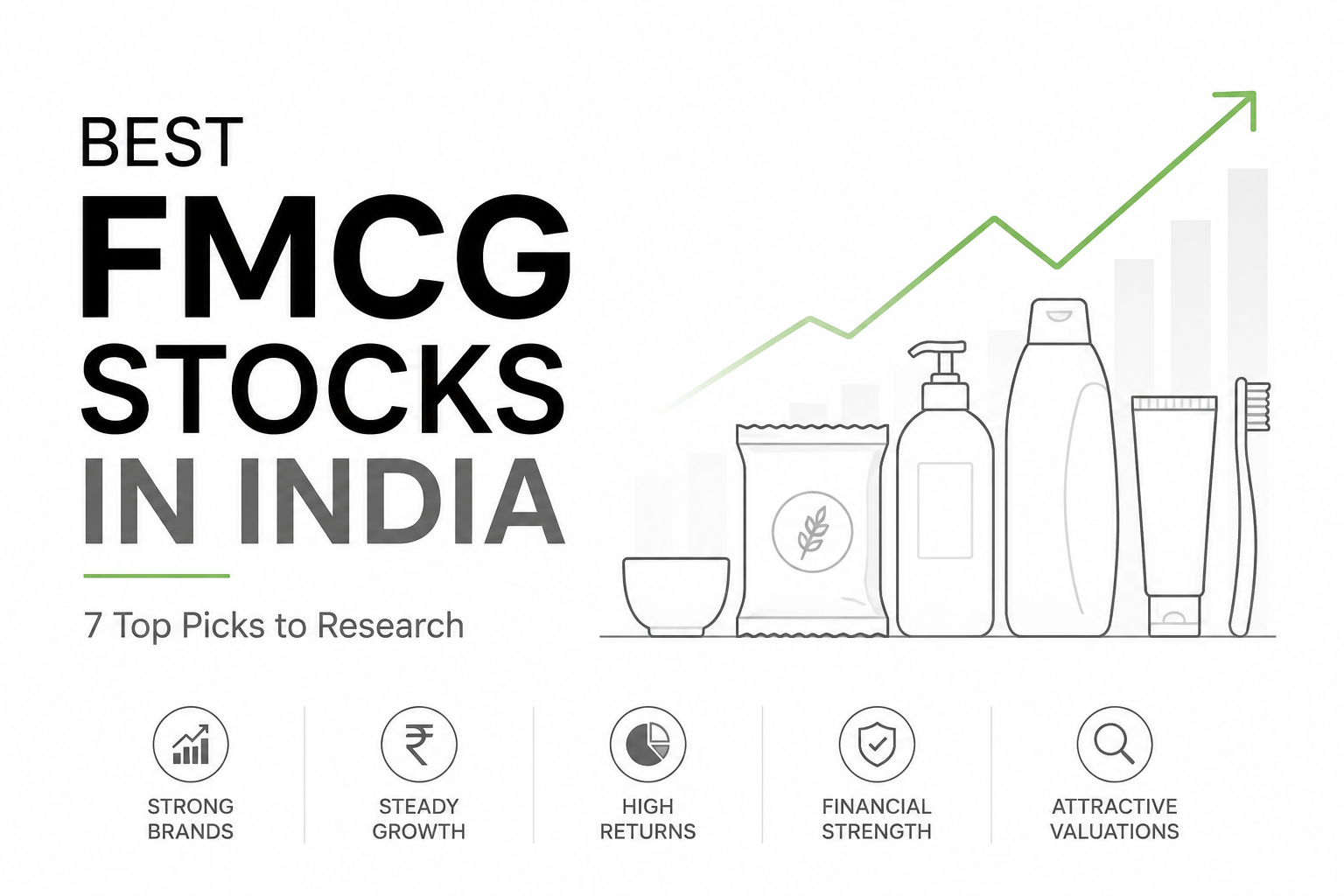
The best FMCG stocks in India to research include ITC, Hindustan Unilever, Marico, Britannia Industries, Dabur India, Nestlé India, and Godrej Consumer Products. Based on a combination of growth, profitability, capital efficiency, balance-sheet strength, cash generation, competitive position, and valuation, ITC, HUL, and Marico stand out in our current ranking.
That does not mean they are automatically the best stocks to buy today. FMCG companies often command high valuations, so the price investors pay can matter almost as much as the quality of the underlying business.
This analysis primarily uses audited FY2025-26 financial information, supplemented by Q1 FY2026-27 results and market valuation data available around September 2, 2026.
Best FMCG Stocks in India at a Glance
| Rank | FMCG stock | Research score* | Main strength | Key concern |
|---|---|---|---|---|
| 1 | ITC | 85/100 | Valuation, cash generation, ROCE | Cigarette regulation and tax risk |
| 2 | Hindustan Unilever | 82/100 | Brands, margins, distribution | Moderate growth, premium valuation |
| 3 | Marico | 80/100 | Growth and capital efficiency | Elevated valuation |
| 4 | Britannia Industries | 77/100 | ROE, ROCE, strong food brands | Commodity costs and valuation |
| 5 | Dabur India | 74/100 | Improving growth, rural exposure | Lower capital efficiency |
| 6 | Nestlé India | 72/100 | Exceptional brands and ROE | Very high valuation |
| 7 | Godrej Consumer Products | 69/100 | Emerging-market growth potential | Lower ROCE and higher debt |
*Scores are analytical assessments, not exchange or brokerage ratings. They incorporate quantitative financial metrics and qualitative judgments explained below. Close scores should not be interpreted as precise differences in investment quality.
One reason ITC ranks first is valuation. On September 2, 2026, ICICI Direct’s Nifty FMCG data showed ITC at about 16.9 times earnings, versus roughly 42.5 times for HUL, 47.9 times for Britannia, 57.5 times for Marico, and 75.1 times for Nestlé India.
What Is the FMCG Industry?
Fast-moving consumer goods, or FMCG, are everyday products purchased frequently and generally at relatively low prices.
The sector includes:
- Packaged foods and beverages
- Personal care products
- Household cleaning products
- Oral care
- Hair and skin care
- Health and wellness products
- Biscuits, snacks and staples
Companies such as HUL, Dabur and Godrej Consumer operate across several categories, while Britannia and Nestlé India have greater exposure to packaged foods.
ITC requires an additional qualification. It has a substantial FMCG business, but it is not a pure-play FMCG company because cigarettes, agri-business, paper and other operations also contribute to its financial performance.
“Start investing with confidence! Explore
Lemonn
and grow your wealth.”
What Is the Outlook for FMCG Stocks in India?
India’s long-term FMCG opportunity remains attractive, but the near-term environment is more complicated.
NielsenIQ reported that India’s FMCG industry recorded 7.8% year-on-year value growth in Q4 2025, while rural volume growth was 2.9% and urban growth was 2.3%. NIQ also highlighted the growing importance of modern trade and e-commerce.
Earlier, Q3 2025 FMCG value growth had been 12.9%, with volume increasing 5.4%. Rural consumption continued to outperform urban consumption during that period.
Key growth drivers
Several structural trends can support Indian FMCG companies over the longer term.
Rising rural consumption: Rural India represents a large market for packaged foods, personal care and household products.
Premiumisation: Higher-income consumers are gradually shifting toward premium beauty, health, nutrition and convenience products.
E-commerce and quick commerce: Online channels are becoming increasingly important, particularly in India’s large cities. NIQ reported e-commerce reaching an 18% share in the top eight metros during the OND 2025 quarter.
Distribution expansion: Companies with extensive rural distribution networks can reach markets that smaller brands may struggle to serve profitably.
Branded consumption: The shift from unorganised to branded products remains a long-term opportunity in several categories.
The sector is not free from pressure. As of September 2026, higher sugar, crude-linked packaging inputs and copra prices were creating potential margin pressure for several FMCG companies.
How We Selected the Best FMCG Stocks
Companies first need to pass basic eligibility checks. These include positive latest-year profit, positive operating cash flow, at least three years of financial history, adequate liquidity, reasonably manageable debt, consistent disclosure and no persistent revenue decline.
Eligible companies are then evaluated on this 100-point framework:
| Factor | Weight |
|---|---|
| Five-year revenue growth | 15% |
| Five-year profit growth | 15% |
| Latest annual profit growth | 10% |
| Operating-margin stability | 10% |
| ROE and ROCE | 15% |
| Debt and interest coverage | 10% |
| Operating and free cash flow | 10% |
| Market position and competitive advantage | 5% |
| Valuation versus peers | 10% |
| Total | 100% |
The scores should be treated as a research framework rather than mathematically exact forecasts. Accounting changes, acquisitions, disposals and exceptional items can distort historical comparisons.
HUL is one example. Its FY26 disclosures separate continuing and discontinued operations following changes to its ice cream business, so underlying continuing-business figures deserve more weight than headline reported profit comparisons.
1. ITC
Why does ITC rank first?
ITC combines high capital efficiency, strong cash generation, dominant consumer franchises and a substantially lower valuation than most large FMCG peers.
As of September 2, 2026, ICICI Direct reported:
- P/E: 16.91
- Debt-to-equity: 0.02
- ROCE: 38.31%
- ROE: 29.49%
These metrics give ITC a considerable advantage in the valuation and balance-sheet portions of our scoring framework.
Is ITC’s FMCG business growing?
Yes. ITC reported 15% year-on-year FMCG revenue growth in Q4 FY26. For FY26 overall, company gross revenue increased 10.1% and EBITDA rose 4.9%.
Momentum continued into Q1 FY27, when standalone FMCG segment revenue increased 12%, while segment PBIT increased 21%. Excluding staples, FMCG revenue grew 16%.
ITC has developed brands across packaged foods, biscuits, noodles, personal care and household categories.
What are the risks?
The biggest complication is that ITC cannot be analysed as a pure FMCG business.
Cigarettes remain economically important, creating exposure to taxation, regulation and illicit-market competition. Its paper and agri businesses introduce additional cyclicality.
This diversification helps explain why ITC’s P/E cannot be directly compared with Nestlé or HUL without adjustment.
Research score: 85/100
2. Hindustan Unilever
Hindustan Unilever is one of India’s strongest consumer businesses, backed by a large portfolio of household, personal-care, beauty and food brands.
Its scale and distribution network create significant competitive advantages.
How did HUL perform in FY26?
HUL reported FY26 turnover of ₹63,763 crore, with underlying sales growth of 5% and underlying volume growth of 4%.
Adjusted EBITDA was ₹15,054 crore, representing a 23.6% margin. Cash from operations reached ₹10,496 crore.
HUL’s historical turnover increased from ₹46,321 crore in FY21 to ₹63,763 crore in FY26, although reported figures have been restated for continuing operations where applicable.
HUL valuation
As of September 2, ICICI Direct’s sector data showed approximately:
| Metric | HUL |
|---|---|
| P/E | 42.51 |
| Debt/equity | 0.03 |
| ROCE | 25.43% |
| ROE | 31.07% |
The balance sheet remains a major strength.
The weakness is valuation combined with relatively modest growth. Paying more than 40 times earnings requires confidence that HUL can sustain earnings growth for many years.
Research score: 82/100
3. Marico
Marico moves into our top three because FY26 delivered unusually strong revenue growth while the business continued to produce high returns on capital.
Its major brands include Parachute and Saffola, while foods, premium personal care and digital-first brands provide additional growth avenues.
How fast is Marico growing?
FY26 revenue from operations reached ₹13,611 crore, up 26% year on year. Marico described this as its highest revenue growth in 14 years.
India underlying volume growth was 8%, its highest in seven years, while international constant-currency growth reached 20%.
Marico’s FY25 annual report had reported ROCE of 47.2%, return on net worth of 41.7%, debt-to-equity of only 0.09 and interest coverage of 37 times.
Those are excellent capital-efficiency and solvency indicators.
What’s the catch?
Valuation.
The September 2 sector snapshot put Marico at approximately 57.5 times earnings, compared with 42.5 times for HUL and 34.4 times for Dabur.
A high-quality business can still generate disappointing stock returns when purchased at an excessively optimistic valuation.
Research score: 80/100
4. Britannia Industries
Britannia has one of India’s strongest packaged-food franchises, particularly in biscuits and bakery products.
The business benefits from brand recognition, distribution and relatively high capital efficiency.
Britannia’s financial strengths
Current sector data showed Britannia with:
- ROCE of about 55.3%
- ROE of about 53.6%
- Debt-to-equity of 0.28
- P/E of approximately 47.9
The exceptionally high ROE and ROCE scores well in our profitability framework.
Britannia has also published audited FY26 results and Q1 FY27 financial information through its investor disclosures.
Risks to watch
Raw-material inflation is important for Britannia. Wheat, milk, sugar and packaging costs can materially affect margins.
Sugar and packaging-related input pressures were again a concern entering the September 2026 quarter.
At close to 48 times earnings, the stock also leaves less room for disappointing growth.
Research score: 77/100
5. Dabur India
Dabur offers a different FMCG proposition, with significant exposure to Ayurveda, healthcare, oral care, personal care, beverages and rural consumption.
Its growth trajectory has recently improved.
Is Dabur’s growth recovering?
FY26 revenue from operations increased from ₹12,563.1 crore to ₹13,192.6 crore. EPS rose from ₹10 to ₹10.7.
The acceleration became clearer in Q1 FY27.
Dabur reported:
- Consolidated revenue: ₹3,764 crore
- Revenue growth: 10.6%
- Net profit: ₹591 crore
- Net-profit growth: 15%
- India FMCG growth: 9.5%
- Underlying India volume growth: 5%
This is an encouraging combination of revenue, volume and profit growth.
Dabur valuation and profitability
As of September 2, Dabur traded at roughly 34.4 times earnings, with ROCE around 20.9%, ROE around 16.8% and debt-to-equity of 0.10.
Dabur therefore looks less expensive than HUL, Britannia, Marico and Nestlé on headline P/E.
Its disadvantage is lower capital efficiency.
Research score: 74/100
6. Nestlé India
Nestlé India is arguably one of the highest-quality businesses on this list.
Its brands, including Maggi and Nescafé, give it significant pricing power and consumer loyalty.
But investment quality and business quality are not always identical.
How profitable is Nestlé India?
Nestlé India’s FY26 revenue from operations reached approximately ₹23,155 crore, compared with ₹20,202 crore in FY25. Profit after tax increased from roughly ₹3,315 crore to ₹3,545 crore.
The company’s capital efficiency is exceptional.
September 2 sector data showed ROE of approximately 76.3% and ROCE of 56.5%.
Why isn’t Nestlé ranked higher?
Valuation is the major reason.
Nestlé India was trading at roughly 75 times earnings in the September 2 snapshot, the highest multiple among our shortlisted large FMCG companies.
Even exceptional companies can be risky investments when expectations embedded in the share price are extremely high.
The FY26 accounts also contain exceptional items, so investors should distinguish recurring operating performance from reported profit movements.
Research score: 72/100
7. Godrej Consumer Products
Godrej Consumer Products provides exposure to household insecticides, hair care, personal care and emerging markets outside India.
Its international footprint gives it greater growth opportunities, but also creates currency and execution risks.
How does GCPL compare?
September 2 sector data indicated approximately:
- P/E: 44.37
- Debt/equity: 0.34
- ROCE: 17.56%
- ROE: 15.10%
Compared with companies such as Marico, Britannia and ITC, those capital-efficiency numbers are less compelling.
GCPL therefore needs stronger earnings growth and successful execution across its markets to justify a mid-40s earnings multiple.
Research score: 69/100
Financial Comparison of the Best FMCG Stocks
The following snapshot helps show why valuation materially changes the ranking.
| Company | P/E | ROCE | ROE | Debt/equity |
|---|---|---|---|---|
| ITC | 16.91 | 38.31% | 29.49% | 0.02 |
| HUL | 42.51 | 25.43% | 31.07% | 0.03 |
| Marico | 57.53 | 40.47% | 44.30% | 0.14 |
| Britannia | 47.93 | 55.30% | 53.62% | 0.28 |
| Dabur | 34.37 | 20.85% | 16.82% | 0.10 |
| Nestlé India | 75.10 | 56.47% | 76.34% | 0.18 |
| Godrej Consumer | 44.37 | 17.56% | 15.10% | 0.34 |
Source: ICICI Direct Nifty FMCG constituent data, September 2, 2026. Market multiples change daily and should be checked again before making an investment decision.
Which FMCG stock looks cheapest?
ITC is the cheapest of these seven companies on headline P/E, by a substantial margin.
That discount is not entirely a free lunch. ITC has a different business mix, including cigarettes, agri and paper operations, so it deserves a different valuation framework from pure consumer-goods companies.
Among more conventional diversified FMCG companies, Dabur’s valuation looks comparatively moderate, particularly if its recent double-digit revenue and profit momentum continues.
Which FMCG company has the highest ROE?
Based on the September 2 comparison, Nestlé India has the highest ROE at about 76%, followed by Britannia and Marico.
High ROE alone should not determine a stock purchase. Capital structure, accounting treatment, brand economics and valuation all matter.
Best FMCG Stocks by Investor Priority
Different companies stand out depending on what an investor wants to research.
| Investor priority | Stock worth researching |
|---|---|
| Valuation | ITC |
| Large diversified FMCG franchise | HUL |
| Growth plus high ROCE | Marico |
| Packaged foods | Britannia |
| Rural and Ayurveda exposure | Dabur |
| Premium business quality | Nestlé India |
| Emerging-market consumer exposure | Godrej Consumer |
This distinction is useful because there is no universally “best” FMCG stock.
A conservative investor focused on valuation may reach a different conclusion from an investor willing to pay a large premium for long-term brand quality.
Major Risks of Investing in FMCG Stocks
1. Expensive valuations
Valuation is arguably the biggest sector-level risk.
Several large FMCG companies trade at 40 to 75 times earnings. At such valuations, even respectable earnings growth can disappoint investors if valuation multiples contract.
2. Commodity inflation
Sugar, copra, crude derivatives, milk, wheat, palm oil and packaging materials can influence margins.
Recent increases in sugar, crude-linked inputs and copra illustrate that this risk remains relevant.
3. Weak consumer demand
FMCG companies are considered relatively defensive, but they are not immune to consumer pressure.
Customers can reduce discretionary purchases, switch brands or move to smaller packages when household budgets are stretched.
4. Competition from smaller brands
Large distribution networks remain valuable, but digital commerce has made it easier for smaller brands to reach consumers.
NIQ has noted that smaller manufacturers have been gaining share and, in some periods, growing volumes faster than larger manufacturers.
5. Regulatory risks
Regulation varies considerably across the sector.
ITC has substantial tobacco-related regulatory and taxation exposure. Food companies face food-safety and labelling requirements, while consumer-health products can encounter additional advertising and regulatory scrutiny.
How Can Investors Approach FMCG Stocks?
Rather than buying whichever FMCG stock has recently performed best, investors can follow a more disciplined process.
- Start with business quality. Look for strong brands, distribution, pricing power and sustainable market share.
- Check volume growth. Price increases can temporarily make revenue growth look better than underlying demand.
- Compare operating margins over several years. Stable margins can indicate pricing power and cost discipline.
- Examine ROCE and cash flow. High accounting profits are less valuable if they require excessive capital or fail to convert into cash.
- Review debt. Most mature FMCG companies should be capable of operating with relatively modest leverage.
- Compare valuation with growth. A 60 times P/E stock needs a stronger growth outlook than a similar company trading at 30 times.
- Consider staggered investing. High-quality consumer companies frequently trade at premium valuations, making entry price important.
Which Is the Best FMCG Stock in India?
ITC ranks first in our current quantitative and qualitative framework, largely because it combines strong capital returns, low leverage and a much lower headline P/E than other large FMCG stocks.
HUL ranks second because of its brand portfolio, distribution, margins, cash generation and balance-sheet quality. Marico takes third place because of its stronger recent growth and high capital efficiency.
There are important qualifications.
ITC is not a pure FMCG company, while HUL and Marico trade at substantially higher earnings multiples. Nestlé India offers exceptional business economics but receives a lower overall score because its valuation embeds high expectations.
For investors, therefore, the better question is not simply “Which is India’s best FMCG company?” It is which high-quality FMCG business offers the most attractive combination of growth, financial strength and valuation at the price available today?
FAQs About the Best FMCG Stocks in India
Which are the top FMCG stocks in India?
Some of India’s major listed FMCG stocks include Hindustan Unilever, ITC, Nestlé India, Britannia Industries, Marico, Dabur India, Godrej Consumer Products, Tata Consumer Products and Colgate-Palmolive India. The best choice depends on growth, profitability, valuation and investor objectives.
Which FMCG stock is best based on valuation?
Among the seven stocks analysed here, ITC has the lowest headline P/E at roughly 16.9 times based on September 2, 2026 sector data. However, ITC’s cigarette, agri and paper businesses mean its valuation is not directly comparable with a pure FMCG company.
Is HUL a good FMCG stock for the long term?
HUL has strong brands, high margins, low debt and substantial cash generation. FY26 turnover reached ₹63,763 crore and cash from operations was ₹10,496 crore. Its key investment risk is the valuation investors must pay relative to its current growth rate.
Which FMCG stock has the highest ROE?
Nestlé India had the highest ROE among the seven shortlisted companies at approximately 76.3%, based on the September 2, 2026 comparison. Britannia and Marico also reported high capital-return metrics.
Which FMCG stock is growing fastest?
Recent growth depends on the measurement period. Marico reported exceptionally strong FY26 revenue growth of 26%, while Dabur’s Q1 FY27 revenue increased 10.6% and ITC’s standalone FMCG segment grew 12%.
Are FMCG stocks safe investments?
FMCG businesses are often relatively defensive because consumers continue buying everyday products during economic slowdowns. Their shares are not risk-free. High valuations, commodity inflation, competition, weak volume growth and regulatory changes can still produce significant losses.
Is now a good time to invest in FMCG stocks?
Sector valuations vary substantially, so a stock-by-stock approach may be more useful than treating all FMCG companies alike. The Nifty FMCG index was down about 17.8% over one year as of September 2, 2026, but several major FMCG companies still traded at expensive earnings multiples.
Key Takeaways
- ITC ranks first in our current framework because of valuation, capital efficiency, cash-generation characteristics and low leverage, although it is not a pure FMCG business.
- HUL ranks second for its brands, distribution, stable margins, strong cash flow and balance sheet.
- Marico ranks third, supported by 26% FY26 revenue growth and strong capital returns.
- Britannia offers excellent ROE and ROCE, but commodity costs and valuation need monitoring.
- Dabur’s growth has accelerated, making it an interesting recovery candidate at a lower P/E than several large peers.
- Nestlé India has outstanding business economics, but its roughly 75 times P/E creates substantial valuation risk.
- Investors should compare volume growth, margins, ROE, ROCE, cash flow, debt and valuation, rather than relying on brand reputation alone.
- Rankings are research tools, not predictions of future stock returns.
Investment-risk disclaimer: This analysis is for educational and informational purposes only. It is not personalized investment advice or a recommendation to buy, sell or hold any security. Financial ratios, market prices and valuations change over time. Investors should review the latest exchange filings, annual reports and valuations, and consider their risk tolerance and financial circumstances before investing.
Disclaimer
The stocks mentioned in this article are not recommendations. Please conduct your own research and due diligence before investing. Investment in securities market are subject to market risks, read all the related documents carefully before investing. Please read the Risk Disclosure documents carefully before investing in Equity Shares, Derivatives, Mutual fund, and/or other instruments traded on the Stock Exchanges. As investments are subject to market risks and price fluctuation risk, there is no assurance or guarantee that the investment objectives shall be achieved. Lemonn do not guarantee any assured returns on any investments. Past performance of securities/instruments is not indicative of their future performance.
To read the RA disclaimer
Research Analyst - Gaurav Garg
Related Posts

Download Lemonn
Download my share market app for stock trading—trade stocks effortlessly in the market.



