How Mutual Fund Expense Ratio Affects Your Returns Over Time
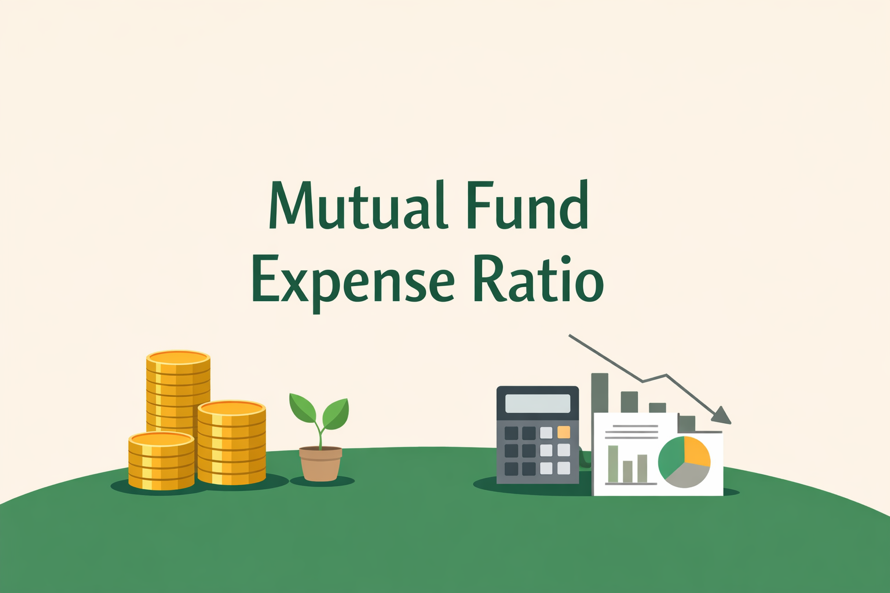
A mutual fund looks simple from the outside. You invest money, and the mutual fund managers manage it. You gain if the fund performs better and lose if it doesn’t, right?
But behind this seemingly simple operation, there is one major factor that almost every investor either doesn’t know or, if they do, doesn’t pay special attention to it. This powerful factor that shapes long-term wealth is the mutual fund expense ratio.
It might surprise you, but this ratio decides how much your gross return will be on your investment. It also explains how you are covering the fund’s operating costs. Mutual fund expense ratio is often insignificant when you look at it at first, mostly in a fraction. It has a very minor impact over a year.
But if you stay invested for the long term, you see how large the actual number becomes! And that’s why investors should be aware of it. This blog post will discuss this in detail.
What Is an Expense Ratio in Mutual Funds
The mutual fund expense ratio is the annual fee charged by a mutual fund to manage and operate the scheme. It is expressed as a percentage of the fund’s average assets under management.
If a fund carries an expense ratio of 1.5 percent, it means 1.5 percent of the fund’s assets are used annually to cover management and operating expenses. This cost gets deducted directly from the fund’s net asset value. Investors do not pay it separately. It reflects automatically in the NAV.
Every mutual fund in India discloses its expense ratio transparently. The Securities and Exchange Board of India regulates maximum permissible limits based on the fund size and structure. As assets increase, regulatory caps generally decline, encouraging cost efficiency at scale.
Investors often compare expense ratios when choosing between similar funds. A difference of 0.5 percent may appear minor. In reality, that difference compounds every year and shapes long-term wealth outcomes.
How a Fund House Calculates Expense Ratio
A fund house calculates the mutual fund expense ratio by dividing total annual operating expenses by the fund’s average assets under management.
The calculation formula works as follows:
Expense Ratio = Total Annual Operating Expenses ÷ Average AUM
Operating expenses include management fees, administrative costs, registrar charges, marketing expenses, and other operational components. These costs accumulate over the year. The fund house spreads them proportionately across the asset base.
In India, expense ratios differ between direct plans and regular plans. Direct plans exclude distributor commissions and typically carry lower expense ratios. Regular plans include distribution and commission expenses, resulting in higher cost structures.
Regulatory guidelines impose ceilings. Equity schemes have different caps compared to debt or hybrid schemes. As a fund’s AUM increases, the permitted expense percentage gradually reduces, encouraging economies of scale.
Fund houses disclose updated expense ratios monthly. Investors can verify these figures on the scheme fact sheets or the fund’s official website.
“Start investing with confidence! Explore the best
mutual funds
and grow your wealth.”
What the Expense Ratio Includes
The mutual fund expense ratio covers a range of operational components required to run the scheme efficiently.
First, it includes the fund management fee. This compensates the fund manager and investment team for research, portfolio construction, and monitoring.
Second, it includes administrative expenses. These cover back-office operations, compliance costs, record maintenance, accounting, and regulatory filings.
Third, it includes registrar and transfer agent fees. These support investor servicing, statement generation, and transaction processing.
Fourth, it may include distribution expenses in regular plans. These compensate intermediaries and distributors.
Fifth, marketing and advertising costs may form part of the operational structure.
Custodian charges, trustee fees, and audit expenses also contribute.
All these components combine into a single percentage figure. Investors do not see line-by-line deductions. The expense ratio integrates them into the NAV calculation.
Why Expense Ratios Differ
Not all mutual funds have identical cost structures. The mutual fund expense ratio varies for several reasons.
Active equity funds often carry higher expense ratios because they require intensive research, frequent portfolio monitoring, and dynamic allocation strategies. Analysts, research teams, and trading infrastructure add operational cost.
Passive index funds and exchange-traded funds typically carry lower expense ratios. They replicate benchmark indices and require limited active decision-making.
Small AUM funds often show higher expense ratios because fixed operating costs are spread across a smaller asset base. As AUM increases, cost efficiency improves.
Regular plans include distributor commissions, raising the expense ratio compared to direct plans.
The investment universe also matters. International funds, sectoral funds, and specialized thematic schemes may involve higher operational complexity.
Regulatory caps ensure reasonable cost ceilings. Yet within those limits, variation exists based on strategy, scale, and distribution model.
How Expense Ratios Affect Investments
The mutual fund expense ratio quietly and consistently influences your portfolio. It affects net returns every single year. The impact unfolds gradually, then accelerates through compounding.
Let us examine its effect from multiple angles.
Impact on Returns:
Every mutual fund generates gross returns before deducting expenses. The expense ratio reduces this gross return to arrive at the net return.
If a fund earns 12 percent gross and has an expense ratio of 2 percent, the investor receives approximately 10 percent net, subject to minor variations due to timing and cash flow.
Now consider another fund earning the same gross return but charging 1 percent. The net becomes approximately 11 percent.
A one percent annual difference compounds meaningfully over time. In 10 years, that gap will widen. In 20 years, it will become substantial.
The cost directly reduces investor earnings year after year.
Effect Over Time:
Compounding magnifies the impact of the mutual fund expense ratio. A seemingly small cost percentage subtracts growth each year, then compounds the reduced base in subsequent years.
Imagine investing ₹10 lakh for 20 years at 12 percent gross return.
With a 2 percent expense ratio, the net return becomes 10 percent.
With a 1 percent expense ratio, the net return becomes 11 percent.
Over two decades, that one percent difference can translate into lakhs of rupees in portfolio value.
The longer the holding period, the greater the cost impact becomes. Short-term investors may experience a limited effect. Long-term investors see amplified consequences.
Compounding works in both directions. Higher returns compound wealth. Higher costs compound reduction.
Balancing Cost and Performance:
Lower expense ratios generally support higher net returns. Yet cost alone does not determine fund selection.
An actively managed fund may justify a higher expense ratio if it consistently delivers high risk-adjusted performance. Superior asset allocation, disciplined stock selection, and consistent alpha generation can offset higher costs.
So, investors balance expense ratios with track record, fund manager stability, investment philosophy, and portfolio construction.
Cost awareness strengthens decision-making. Performance consistency sustains conviction.
The objective lies in evaluating whether the incremental cost generates proportional value.
Transparency for Investors:
The mutual fund expense ratio offers transparency. It gives investors a measurable, standardized way to compare cost structures.
Indian regulations mandate disclosure. Fund fact sheets clearly mention the expense ratio for direct and regular plans.
This transparency empowers investors. Instead of relying solely on marketing material or short-term returns, investors can assess cost efficiency objectively.
Informed investors integrate the expense ratio into broader portfolio analysis. They evaluate risk, returns, category positioning, and cost together rather than in isolation.
Key Takeaway
The mutual fund expense ratio represents more than a technical percentage. It shapes your net returns consistently, quietly, and powerfully.
It consists of management fees, administrative costs, and distribution expenses. It also includes operational charges. Now each mutual fund has a different mutual fund expense ratio based on the strategy, fund size, and even the fund type. But one thing is constant, it reduces your gross return annually, and just like your returns, it too compounds annually.
So, it’s very important that investors study the expense ratio of the funds they are planning to invest in. After all, you don’t want any surprises after 5 or 10 years, right?
FAQs:
What is an expense ratio in a mutual fund?
The expense ratio is the annual percentage a mutual fund charges to manage your money. It covers management fees, admin costs, and operational expenses. The fund deducts it directly from the NAV.
How does the expense ratio affect my returns?
It reduces your gross returns every year. Even a small percentage compounds over time and can create a meaningful gap in long-term wealth.
What is an expense ratio example?
If you invest ₹1,00,000 in a fund with a 2 percent expense ratio, about ₹2,000 annually goes toward expenses. Your net return reflects the balance after this deduction.
Why do expense ratios differ?
Active funds usually charge more due to research and portfolio management. Index funds charge less. Direct plans carry lower costs than regular plans.
How often is the expense ratio charged?
It is calculated annually but adjusted daily in the NAV. You do not pay it separately; it reflects automatically in your returns.
Disclaimer
The stocks mentioned in this article are not recommendations. Please conduct your own research and due diligence before investing. Investment in securities market are subject to market risks, read all the related documents carefully before investing. Please read the Risk Disclosure documents carefully before investing in Equity Shares, Derivatives, Mutual fund, and/or other instruments traded on the Stock Exchanges. As investments are subject to market risks and price fluctuation risk, there is no assurance or guarantee that the investment objectives shall be achieved. Lemonn (Formerly known as NU Investors Technologies Pvt. Ltd) do not guarantee any assured returns on any investments. Past performance of securities/instruments is not indicative of their future performance.
Related Posts


Download Lemonn
Download my mutual fund app - your mutual funds, stock, invest in ipo, mf, trade invest hub with demat account features.