Understanding Indexation Benefit in Mutual Fund
What Is Indexation in Mutual Funds?
Inflation is something that impacts the market in an extremely subtle way. You won’t see big headlines about markets crashing overnight due to inflation. But what it does is erode your good-looking on-paper gains on mutual fund investments substantially as time elapses. When you look at the purchasing power of your investment after some years, that’s when you’ll realize the extent of damage done by erosion.
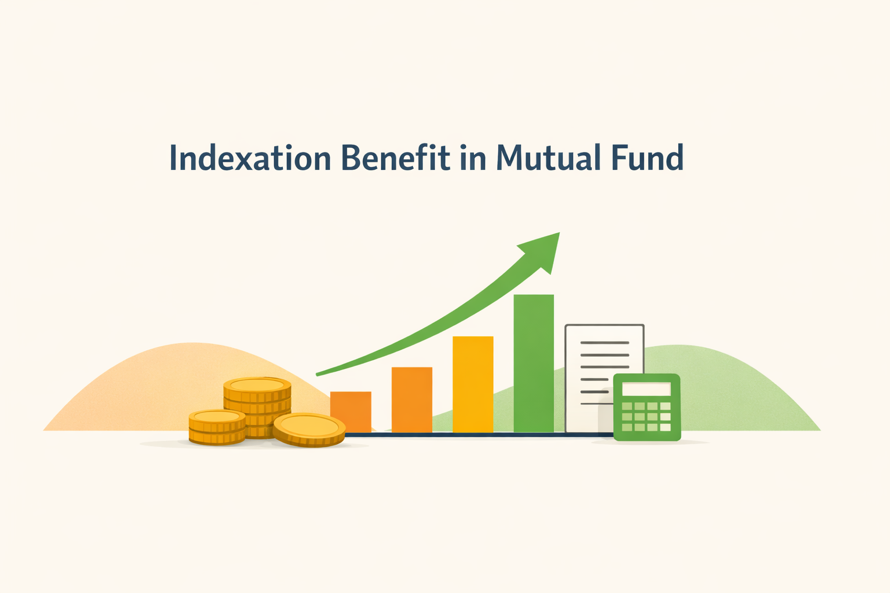
And that’s where the indexation benefit in mutual fund comes into play. The indexation benefit in mutual fund investing is the adjustment of the purchase cost of your investment to align with inflation. For this, it uses the Cost Inflation Index (CII) declared by the government.
What it does is, it does not calculate your capital gains from the original acquisition price. Instead, the tax framework historically allowed investors to inflate that cost proportionately. The higher the adjusted cost, the lower the taxable gain.
Under the earlier tax regime, debt-oriented mutual funds held beyond 36 months qualified for long-term capital gains (LTCG) taxation at 20% with indexation. That single phrase – “20% with indexation” – reshaped post-tax return calculations for long-term conservative investors.
Indexation does not enhance actual returns. It does not improve portfolio performance. It does something subtler but powerful: it ensures tax is levied closer to real economic gain rather than inflation-inflated gain. In a high-inflation environment, that difference becomes meaningful.
However, reforms beginning April 1, 2023 significantly altered how indexation applies to debt mutual funds. For many new investments, indexation is no longer available. Yet for legacy holdings, the mechanism still matters. Understanding it requires clarity about dates, fund classification, and evolving tax provisions.
Why Is Indexation Important in Mutual Fund Taxation?
Taxation without inflation adjustment creates a distortion. Suppose an investor earns 8% annually in a debt fund while inflation averages 6%. The nominal gain appears attractive. The real gain is modest. Without indexation, tax applies to the full nominal gain. With indexation, part of that nominal gain is neutralized.
Historically, indexation was important because it:
- Reduced the effective tax burden on long-term debt investments
- Enhanced post-tax yield
- Rewarded a longer holding duration
- Protected purchasing power
- Created tax efficiency compared to fixed deposits
Before April 1, 2023:
- Debt mutual funds held for more than 36 months
- Taxed at 20% LTCG with indexation
After April 1, 2023 (Finance Act 2023, Section 50AA):
- Debt mutual funds acquired on/after this date
- Gains taxed at slab rates
- No indexation benefit
- No LTCG differentiation
Then came July 23, 2024. A revised LTCG framework introduced a 12.5% tax rate without indexation for qualifying long-term assets. However, most newly purchased specified debt mutual funds remain taxed at slab rates, without indexation.
Today, indexation is relevant only for legacy investments. But still, it’s good to have an idea about the topic when you compare old holdings or historical returns.
“Start investing with confidence! Explore the best
mutual funds
and grow your wealth.”
How Indexation Works in Mutual Funds?
Indexation operates through the Cost Inflation Index (CII), a number published annually by the government.
Relevant updated CII values:
- FY 2019–20: 289
- FY 2024–25: 363
- FY 2025–26: 376
The formula:
Then:
Let us pause here.
The multiplier reflects inflation accumulation across years. If inflation rises steadily, CII rises steadily. If the holding period spans multiple years, the indexed cost increases proportionately.
The longer the holding period, the larger the inflation adjustment. That is why indexation historically rewarded patience.
However, post-2023 reforms removed this mechanism for most new debt mutual fund purchases. Therefore, eligibility hinges entirely on acquisition date and fund classification.
Indexation is not automatic. It is conditional.
How to Calculate Indexation in Mutual Funds
Let us work through a fully updated example using actual CII figures.
Assume:
Investment: ₹10,00,000
Purchase Year: FY 2019–20 (CII = 289)
Sale Year: FY 2024–25 (CII = 363)
Redemption Value: ₹14,00,000
Step 1: Calculate Indexed Cost
IndexedCost=10,00,000×363289IndexedCost≈10,00,000×1.256=₹12,56,000
Step 2: Calculate LTCG
LTCG=14,00,000-12,56,000=₹1,44,000
Without indexation, taxable gain = ₹4,00,000.
With indexation, taxable gain = ₹1,44,000.
That is not a minor adjustment. It fundamentally alters tax efficiency.
Let us visualize the difference:
| Particulars | Without Indexation | With Indexation |
|---|---|---|
| Purchase Cost | ₹10,00,000 | ₹10,00,000 |
| Indexed Cost | Not Applicable | ₹12,56,000 |
| Sale Value | ₹14,00,000 | ₹14,00,000 |
| Taxable Gain | ₹4,00,000 | ₹1,44,000 |
| Tax @20% | ₹80,000 | ₹28,800 |
The inflation adjustment reduces tax liability by more than ₹50,000 in this example. That differential compounds across portfolios.
Example of Indexation Benefit Calculation
Consider another scenario.
Investment: ₹5,00,000
Purchase CII: 280
Sale CII: 340
Sale Value: ₹7,00,000
Indexed Cost:
5,00,000×340/280 = ₹6,07,143
Taxable Gain:
7,00,000 – 6,07,143=₹92,857
Nominal gain was ₹2,00,000.
Inflation-adjusted taxable gain becomes ₹92,857.
Indexation almost halves the taxable base.
This is why debt funds historically attracted long-term investors seeking tax efficiency.
Which Mutual Funds are Eligible for Indexation Benefit?
Eligibility depends entirely on purchase date and fund composition.
Legacy Investments (Pre-April 1, 2023)
- Debt mutual funds with <35% equity exposure
- Held >36 months
- LTCG taxed at 20% with indexation
New Investments (On/After April 1, 2023)
- Specified debt mutual funds
- Gains taxed at slab rates
- No indexation
- No long-term classification
Post-July 23, 2024 Framework
- Certain long-term assets taxed at 12.5% without indexation
- Debt-heavy specified funds remain slab-taxed
As of January 2026
- No reintroduction of indexation for new debt funds
- Legacy holdings may still qualify
Therefore, investors must examine:
- Date of acquisition
- Equity exposure percentage
- Fund classification
- Transfer date
Indexation today is date-sensitive.
Indexation in SIPs
Systematic Investment Plans complicate indexation calculations because each installment is treated separately.
Each SIP installment:
- Has its own purchase date
- References its own CII
- Has its own indexed cost
When redeeming, gains must be calculated tranche by tranche. That means multiple indexed cost calculations for a single fund.
Historically, long-running SIPs spanning several years benefited meaningfully because earlier tranches enjoyed greater inflation adjustment.
However, for SIPs initiated after April 1, 2023, in specified debt funds, indexation no longer applies.
Tax treatment depends on the date of each installment.
Impact of Indexation on Long-Term Capital Gains (LTCG)
Indexation historically reduced taxable gains significantly.
It:
- Lowered effective tax rate
- Increased post-tax yield
- Rewarded long holding duration
- Reduced inflation distortion
- Enhanced debt fund competitiveness
Without indexation, nominal gains are fully taxable. With indexation, the inflation-adjusted cost absorbs part of the gain.
The difference is structural, not cosmetic.
Under the current framework, most new debt mutual fund investments do not receive this advantage. Therefore, post-tax comparisons must reflect slab-rate taxation.
How to Maximize Indexation Benefits
For investors holding legacy eligible debt funds:
- Hold investments beyond 36 months
- Plan redemptions across financial years
- Track CII updates annually
- Calculate tranche-wise for SIPs
- Avoid premature exits
Strategic timing amplifies indexation benefit in mutual fund portfolios.
For new investments, tax planning requires a different approach because slab taxation applies.
Conclusion
The indexation benefit in mutual fund investing once played a central role in long-term debt allocation strategy. By adjusting acquisition cost using the Cost Inflation Index, it reduced taxable capital gains and enhanced post-tax returns.
But the tax reforms introduced on April 1, 2023, eliminated the indexation benefit for most acquired specified debt mutual funds. The later updates introduced in July 2024 revised the entire LTCG framework without the need for indexation.
Indexation today remains relevant primarily for legacy holdings purchased before April 2023. Its mechanism continues to matter for accurate tax computation and historical portfolio evaluation.
Indexation adjusted for inflation. Reforms adjusted for revenue.
Understanding both dimensions allows investors to interpret past strategies and current realities with clarity.
FAQs:
Q. Can mutual funds be indexed?
Mutual funds themselves are not “indexed” in the tax sense. Indexation applies to the cost of acquisition when calculating capital gains, not to the fund’s NAV. Historically, certain debt mutual funds qualified for indexation on long-term gains. Under current rules, most new debt mutual fund investments do not receive indexation benefit.
Q. What is the 7-5-3-1 rule in mutual funds?
The 7-5-3-1 rule serves as a guide for SIP investors in mutual fund schemes. Seven points to the minimum duration of SIP investment, five is the category of equity investments like value, large-cap, global stocks, GARP, and multi/small-cap. The number 3 gives investors a heads-up on three emotional phases that prepare them for market gyrations: disappointment, irritation, and panic. And the numeric 1 urges investors to top up their SIP contributions once every year.
Q. What is meant by indexation benefits?
Indexation benefit refers to the adjustment of the purchase cost of an investment using the Cost Inflation Index. This is done to reduce the taxable gain on investments due to inflation.
Q. Is indexation benefit available for FY 2025-26?
If you have purchased debt mutual fund investments before April 1, 2023, you might still get the benefit of indexation. But for most new debt mutual funds, this benefit is not available. New investments are taxed under new and reduced tax slabs, rather than receiving indexation benefits.
Disclaimer
The stocks mentioned in this article are not recommendations. Please conduct your own research and due diligence before investing. Investment in securities market are subject to market risks, read all the related documents carefully before investing. Please read the Risk Disclosure documents carefully before investing in Equity Shares, Derivatives, Mutual fund, and/or other instruments traded on the Stock Exchanges. As investments are subject to market risks and price fluctuation risk, there is no assurance or guarantee that the investment objectives shall be achieved. Lemonn (Formerly known as NU Investors Technologies Pvt. Ltd) do not guarantee any assured returns on any investments. Past performance of securities/instruments is not indicative of their future performance.
Related Posts

Download Lemonn
Download my mutual fund app - your mutual funds, stock, invest in ipo, mf, trade invest hub with demat account features.