Nifty Bank Jumps Nearly 1% as ICICI Bank, Axis Bank and HDFC Bank Lead Gains
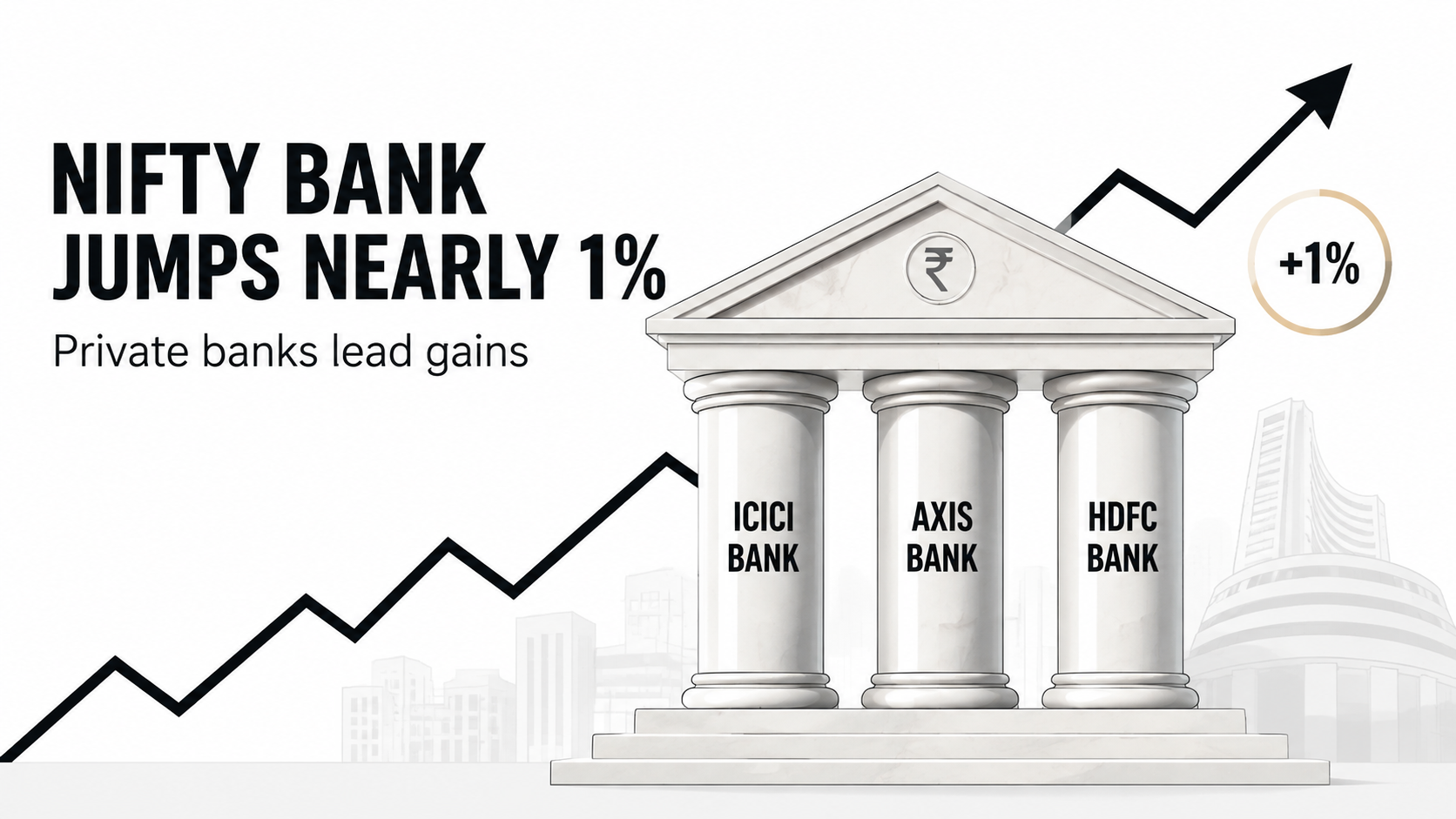
Banking stocks emerged as one of the strongest areas of the Indian stock market on September 3, 2026, with the Nifty Bank index gaining nearly 1% during morning trade.
ICICI Bank, Axis Bank, HDFC Bank and State Bank of India were among the major contributors as improving market sentiment and a sharp recovery in the Indian rupee encouraged buying in financial stocks.
At around 9:40 am, the Nifty Bank index was up 0.91% at 57,695. The rally extended beyond the benchmark banking index, with both private-sector and public-sector banking stocks recording gains.
How Much Did Nifty Bank Rise?
Nifty Bank climbed 0.91% during the morning session, putting it among the day’s stronger sectoral indices.
The Nifty Private Bank index performed even better, rising 1.17%.
The Nifty PSU Bank index gained 1.14%, indicating that buying was not restricted to a handful of heavyweight private banks.
This broad participation is important because a banking rally led by only one or two large stocks may be less convincing than a move involving several private and public-sector lenders.
Which Bank Stocks Led the Rally?
Large private-sector lenders were among the strongest contributors.
ICICI Bank rose around 1.59% to ₹1,449.20 during morning trade, while Axis Bank gained approximately 1.55% to ₹1,273.30.
HDFC Bank advanced about 1.28% to ₹709.80, while State Bank of India gained approximately 0.92% to ₹1,030.30.
All four featured among the leading Nifty 50 gainers during the early session.
Major banking gainers
| Bank | Approximate early gain |
|---|---|
| ICICI Bank | 1.59% |
| Axis Bank | 1.55% |
| HDFC Bank | 1.28% |
| SBI | 0.92% |
The move shows why heavyweight financial stocks can have a significant effect on both the banking index and the broader Nifty 50.
What Drove the Banking Stock Rally?
There was no single company-specific trigger affecting all banks.
Instead, the rally appeared to reflect a combination of stronger overall risk appetite, currency-market improvement and broad buying across financial stocks.
One important development was the sharp recovery in the rupee.
The Indian currency opened 67 paise stronger at ₹94.30 against the U.S. dollar, compared with ₹94.97 in the previous session.
The move followed the RBI’s disclosure that more than $127 billion had been mobilised through the FCNR(B) route.
Improved currency stability can help financial-market sentiment because a rapidly weakening rupee can increase concerns about imported inflation, foreign capital outflows and macroeconomic volatility.
Why Does the Rupee Matter for Bank Stocks?
Banks are not direct currency plays in the same way as export-oriented IT companies, but the rupee can influence the broader economic environment in which lenders operate.
A stable or strengthening currency may improve investor confidence.
It can also reduce pressure from imported inflation, particularly when oil and other commodities are priced in dollars.
Currency stability may give policymakers greater flexibility when managing liquidity and interest rates.
All these factors can indirectly affect the banking sector.
The large FCNR(B) inflows also increased expectations that the RBI would have more room to manage foreign exchange conditions. That helped improve risk sentiment across the market.
Why Do ICICI Bank and HDFC Bank Matter So Much?
Large private-sector banks carry significant weight in major equity indices.
This means even relatively modest price moves in these stocks can influence Nifty Bank and the broader market.
HDFC Bank and ICICI Bank are among India’s largest lenders by market value.
Their size, profitability and institutional ownership make them important indicators of investor sentiment toward the domestic financial sector.
Axis Bank also carries meaningful weight, while SBI is the country’s largest public-sector lender.
When all these stocks rise together, Nifty Bank can move quickly.
Was the Rally Limited to Large Banks?
No.
Several mid-sized banks also recorded strong gains.
Bank of Maharashtra jumped nearly 4%, while Punjab & Sind Bank gained around 3%.
Bandhan Bank rose about 2.32%, and Bank of India advanced around 2.04%.
The strength across large, mid-sized and PSU lenders indicated broader sector participation.
That does not necessarily mean every bank has the same earnings outlook.
Investors still need to evaluate individual lenders separately based on profitability, asset quality, deposit growth and valuations.
What Fundamentals Matter Most for Bank Stocks?
Short-term price movements can be driven by sentiment, but bank valuations ultimately depend on financial performance.
Credit growth
Banks generate income by lending to consumers and businesses.
Healthy loan growth can support earnings, provided credit quality remains stable.
Deposit growth
Banks need deposits and other funding sources to support lending.
If loan growth is much faster than deposit growth, banks may need to pay higher rates to attract funds.
Net interest margin
Net interest margin, or NIM, measures the difference between what a bank earns on interest-bearing assets and what it pays for funding.
Falling margins can hurt profitability even if overall lending grows.
Asset quality
Non-performing loans remain one of the most important indicators of banking health.
Lower bad-loan ratios generally reduce provisioning requirements.
Fee income
Banks also generate revenue from credit cards, payments, distribution, wealth management and transaction services.
Diversified income can help reduce reliance on lending spreads.
What Could Affect Nifty Bank Next?
Investors will monitor several macroeconomic and company-specific factors.
RBI policy
Changes in interest rates and banking-system liquidity can affect margins, borrowing demand and valuations.
Bond yields
Changes in yields influence banks’ treasury portfolios and funding conditions.
Foreign investment flows
Financial stocks are widely owned by foreign institutional investors.
Large foreign inflows or outflows can therefore have a strong impact on the sector.
Quarterly earnings
Investors will examine loan growth, margins, deposits, provisions and management commentary when banks report their next results.
Economic growth
Banks tend to benefit from stronger economic activity because businesses and consumers borrow more.
A slowdown can weaken credit demand and raise repayment risks.
How Should Investors Interpret a 1% Nifty Bank Rally?
A one-day rally can be useful as a sentiment indicator, but it should not be treated as proof of a long-term trend.
Bank stocks can move sharply because of macroeconomic news, foreign flows or technical factors.
Long-term investors should focus more heavily on:
- Return on assets
- Return on equity
- Deposit franchise
- Loan growth
- Asset quality
- Capital adequacy
- Valuation
- Management execution
A high-quality lender can still become expensive, while a cheap bank can remain cheap if its fundamentals do not improve.
What Levels Should Traders Watch?
Technical traders often watch recent highs and lows, moving averages and major psychological index levels.
However, Nifty Bank can be highly volatile, particularly around RBI decisions, global market events and major earnings announcements.
Derivative positions can magnify both gains and losses.
Retail traders should therefore avoid treating a single strong opening as confirmation of a guaranteed directional move.
FAQs
Why did Nifty Bank rise today?
Nifty Bank gained as major private and public-sector banks attracted buying amid improving risk sentiment and a stronger rupee.
Which banks led Nifty Bank gains?
ICICI Bank, Axis Bank, HDFC Bank and SBI were among the major large-cap gainers during the morning session.
How much did Nifty Bank rise?
The index was up about 0.91% at 57,695 around 9:40 am on September 3.
Did PSU banks also rise?
Yes. The Nifty PSU Bank index gained around 1.14%, while several individual public-sector banks recorded stronger gains.
What should bank investors monitor?
Key factors include credit growth, deposits, margins, asset quality, RBI policy, bond yields and valuations.
Key Takeaways
- Nifty Bank rose nearly 1% during morning trading.
- ICICI Bank, Axis Bank and HDFC Bank led large-cap gains.
- SBI also traded higher.
- Private and PSU banking indices participated in the rally.
- A stronger rupee helped improve broader market sentiment.
- Investors should focus on bank fundamentals rather than one-day price moves.
Disclaimer
The stocks mentioned in this article are not recommendations. Please conduct your own research and due diligence before investing. Investment in securities market are subject to market risks, read all the related documents carefully before investing. Please read the Risk Disclosure documents carefully before investing in Equity Shares, Derivatives, Mutual fund, and/or other instruments traded on the Stock Exchanges. As investments are subject to market risks and price fluctuation risk, there is no assurance or guarantee that the investment objectives shall be achieved. Lemonn (Formerly known as NU Investors Technologies Pvt. Ltd) do not guarantee any assured returns on any investments. Past performance of securities/instruments is not indicative of their future performance.