IPO vs FPO: Key Differences Every Retail Investor Should Know
 Written by Team Lemonn
 Reviewed by Gaurav Garg, SEBI-registered Research Analyst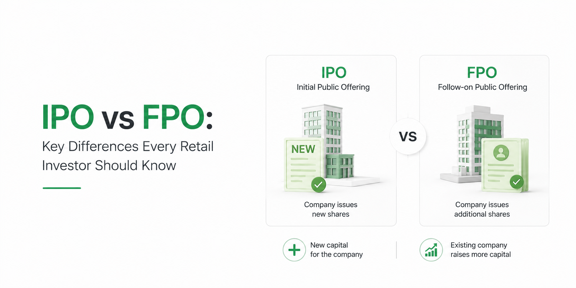
An IPO (Initial Public Offering) is a company’s first sale of shares to the public, while an FPO (Follow-on Public Offer) is a subsequent share sale by a company that is already listed. That one-line distinction, first-time versus repeat, drives almost every other difference between the two: pricing, risk, available data, and what each event signals about the company’s health.
For Indian Retail Individual Investors (RIIs), knowing which is which matters more than it might seem. IPOs get most of the attention and marketing buzz, but FPOs quietly offer something IPOs cannot: a track record. This guide breaks down both instruments so you can make an informed call the next time either lands in your demat account’s application list.
What Is an IPO (Initial Public Offering)?
An IPO is the process through which a private company offers its shares to the public for the first time and gets listed on a stock exchange such as the NSE or the BSE. It converts a privately held business into a publicly traded one, allowing anyone with a demat account to become a part-owner.
Companies typically use IPO proceeds to fund expansion, repay debt, or provide an exit route to early investors and founders. Since there is no trading history, investors must rely entirely on the Draft Red Herring Prospectus (DRHP) and Red Herring Prospectus (RHP) filed with the Securities and Exchange Board of India (SEBI) to evaluate the business.
Read More: What is an IPO? A Beginner’s Guide for Indian Investors
What Is an FPO (Follow-on Public Offer)?
An FPO, also called a follow-on public offer, is when a company that is already listed issues additional shares to raise more capital. Unlike an IPO, the company has an existing share price, published financial results, and a public trading history, all of which give investors far more data to work with.
FPOs are also governed by SEBI’s Issue of Capital and Disclosure Requirements (ICDR) Regulations, and the application process through ASBA (Application Supported by Blocked Amount) closely mirrors that of an IPO.
Read More: Understanding Follow-on Public Offer (FPO)
IPO vs FPO: Key Differences at a Glance
| Parameter | IPO | FPO |
| Company status | Private, going public for the first time | Already listed on a stock exchange |
| Purpose | Raise capital, enable listing, provide exit to early investors | Raise additional capital, reduce debt, broaden shareholder base |
| Available track record | None; based on projections and DRHP disclosures | Public financials, price history, and market performance |
| Pricing | Set via fixed price or book building, with limited market benchmarks | Often priced with reference to prevailing market price |
| Risk level | Generally higher, since valuation is largely untested | Generally lower, since real performance data exists |
| Listing gains potential | Can be high on strong demand, but unpredictable | Usually modest, as the stock is already fairly discovered |
| Regulatory framework | SEBI ICDR Regulations | SEBI ICDR Regulations |
| Retail investor allocation | Minimum 35% in book-built issues | Similar reservation norms apply |
IPO vs FPO: The Indian Perspective
In India, both IPOs and FPOs fall under SEBI’s ICDR framework, which mandates disclosure norms, pricing rules, and investor category reservations. In a public issue by a listed issuer, promoters must contribute at least 20% of the post-issue capital or 20% of the issue size.
At least 35% of the net offer must go to retail individual investors in a voluntary book-built issue, and this reservation applies to both IPOs and FPOs. Payment for both instruments is mandatorily routed through ASBA, so your application money stays blocked in your bank account, not debited upfront, until allotment is finalised.
One India-specific nuance: the price band for an FPO must be announced at least one working day before the offer opens, compared to a longer lead time for IPOs, since the market already has a reference price to work with.
What Does It Mean for the Company?
For a company, an IPO is a one-time transformational event. It changes ownership structure, invites public scrutiny, and imposes ongoing disclosure obligations under SEBI’s Listing Obligations and Disclosure Requirements (LODR).
An FPO is a routine capital-raising tool available to any listed company in good standing. Companies typically use FPO proceeds for expansion projects, acquisitions, research and development, working capital needs, or debt repayment. A poorly timed or poorly priced FPO can still dent investor confidence and depress the stock price.
What Does It Mean for Retail Individual Investors? Which Is Better?
Neither is universally “better.” The right choice depends on your risk appetite and what you are optimising for.
- IPOs suit investors comfortable with valuation uncertainty in exchange for a shot at strong listing-day gains, particularly in high-demand issues.
- FPOs suit investors who prefer buying into a business with visible financials and a real price history, often at a discount to the prevailing market price when the offer is priced attractively.
A practical rule of thumb: IPOs reward investors who do thorough prospectus research and can tolerate volatility; FPOs reward investors who already track the specific listed company and understand why it needs more capital.
Types of IPO
- Fixed Price Issue: The company sets a single, predetermined price at which shares are offered. Demand is known only after the issue closes.
- Book-Built Issue: The company announces a price band, and investors bid within that range. The final price is discovered based on demand, a method used in most large Indian IPOs today.
Types of FPO
- Dilutive FPO: The company issues fresh equity shares, increasing the total number of outstanding shares, which dilutes existing shareholders’ ownership percentage and typically reduces earnings per share (EPS). Proceeds go to the company.
- Non-Dilutive FPO: Existing shareholders, such as promoters or early investors, sell part of their holdings through an Offer for Sale (OFS) mechanism, so no new shares are created and there is no dilution. Proceeds go to the selling shareholders, not the company.
Why Do Companies Opt for an IPO?
- To raise growth capital without taking on additional debt
- To provide an exit or partial liquidity to founders, promoters, and early-stage investors
- To improve brand visibility, credibility, and access to future capital markets
- To create a liquid, market-determined valuation for the business
Why Do Companies Opt for an FPO?
- To fund expansion, acquisitions, or new projects without new borrowing
- To reduce existing debt and strengthen the balance sheet
- To broaden and diversify the shareholder base
- To meet SEBI’s minimum public shareholding requirements, especially for public sector undertakings
Risks Associated with Investing in an IPO
- Valuation uncertainty: Without a trading history, pricing relies heavily on projections and peer multiples, which can be optimistic.
- Listing volatility: Share prices can swing sharply on debut, in either direction.
- Limited operating history: Some IPO-bound companies have only a few years of audited financials.
- Allotment uncertainty: Popular issues are allotted by lottery for retail investors, so demand does not guarantee allotment.
Risks Associated with Investing in an FPO
- Dilution impact: A dilutive FPO increases share count, which can pressure EPS and the stock price.
- Signalling risk: A non-dilutive FPO where promoters sell a large stake can be read as a lack of confidence, even if unrelated.
- Pricing near the market price: Discounts are often smaller than the IPO-style gains investors expect.
- Underlying business risk: Existing business or sector risks carry directly into the FPO decision.
IPO vs FPO: Factors to Consider Before Investing
- Company fundamentals: Review revenue growth, profitability, debt levels, and promoter holding, using the RHP for IPOs and recent results for FPOs.
- Purpose of the issue: Funds raised for expansion or debt reduction are generally a healthier sign than funds used mainly to help investors exit.
- Pricing versus peers: Compare valuation multiples against listed industry peers.
- Type of offer: Check whether it is dilutive or non-dilutive (FPOs) or fixed price versus book-built (IPOs), since this affects likely returns.
- Investment horizon and market conditions: Short-term gain seekers and long-term investors should approach differently, and issues launched in weak markets often underperform.
Read More: IPO vs FPO: Key Differences
Should Retail Individual Investors Invest in an IPO?
RIIs can consider IPOs, but only after reading the RHP closely, understanding the business model, and being honest about their own risk tolerance, rather than applying purely because an issue is generating buzz. Diversifying IPO exposure across multiple issues, rather than concentrating capital in one, reduces single-company valuation risk.
Should Retail Individual Investors Invest in an FPO?
FPOs deserve a similar level of diligence, focused on why the specific company needs additional capital right now. An FPO from a fundamentally strong company using proceeds for expansion is a different proposition from one launched primarily to help a promoter reduce debt or exit part of their holding. Checking recent quarterly results and analyst commentary before applying is a reasonable first step.
Key Takeaways
- An IPO is a company’s first public share sale; an FPO is a share sale by a company that is already listed.
- FPOs offer more available data (price history, financials) than IPOs, generally making them somewhat lower risk.
- FPOs can be dilutive (new shares issued) or non-dilutive (existing shares sold via OFS).
- IPOs use fixed-price or book-building methods; both IPOs and FPOs fall under SEBI’s ICDR Regulations.
- Neither is inherently better for RIIs; the right choice depends on individual risk appetite, research depth, and investment horizon.
Frequently Asked Questions (FAQs)
Q: What is the main difference between IPO and FPO?
A: An IPO is a company’s first-ever public share offering, while an FPO (Follow-on Public Offer) is an additional share offering by a company that is already listed on a stock exchange.
Q: What does FPO mean in the stock market?
A: FPO stands for Follow-on Public Offer, the process by which an already-listed company issues more shares to raise additional capital from the public.
Q: Is an FPO safer than an IPO?
A: FPOs generally carry lower valuation uncertainty since the company has a trading history and public financials, but they are not risk-free and depend on fundamentals and pricing.
Q: Can retail investors apply for both IPOs and FPOs?
A: Yes, through the demat account using ASBA, subject to applicable retail reservation and investment limits.
Q: Is a rights issue the same as an FPO?
A: No. A rights issue offers additional shares only to existing shareholders in proportion to their current holdings, while an FPO is open to the general public.
Disclaimer
The stocks mentioned in this article are not recommendations. Please conduct your own research and due diligence before investing. Investment in securities market are subject to market risks, read all the related documents carefully before investing. Please read the Risk Disclosure documents carefully before investing in Equity Shares, Derivatives, Mutual fund, and/or other instruments traded on the Stock Exchanges. As investments are subject to market risks and price fluctuation risk, there is no assurance or guarantee that the investment objectives shall be achieved. Lemonn (Formerly known as NU Investors Technologies Pvt. Ltd) do not guarantee any assured returns on any investments. Past performance of securities/instruments is not indicative of their future performance.