IPO Allotment Process Explained: How Shares Are Allotted and How to Check Your Status
 Written by Team Lemonn
 Reviewed by Gaurav Garg, SEBI-registered Research Analyst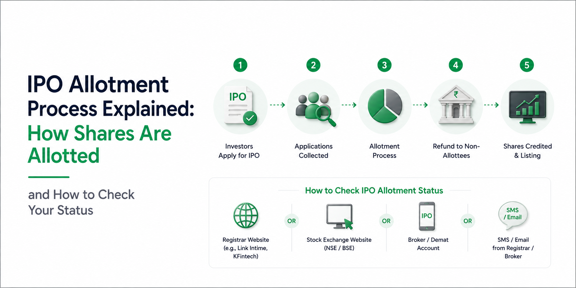
If you have applied for an IPO and are waiting anxiously to see whether you got shares, you are not alone. Every IPO season, lakhs of Indian retail investors apply, but far fewer actually receive an allotment. Understanding the IPO allotment process helps you set realistic expectations, decode your allotment chances, and know exactly where to check your IPO allotment status once the issue closes.
In this guide, we break down how IPO allotment works step by step, how allotment differs for retail, HNI, and institutional investors, and how to check whether you got shares this time around.
What Is IPO Allotment?
IPO allotment is the process by which a company, along with the stock exchange and the Registrar to the Issue (RTA), decides how many shares (if any) each applicant gets after an IPO closes for subscription. If the IPO is undersubscribed or fully subscribed, every valid applicant gets the shares they applied for. If it is oversubscribed, which is common for popular IPOs, only some applicants get shares, and the rest are refunded.
Who Decides IPO Allotment: The Key Players
- Registrar to the Issue (RTA): Usually KFin Technologies (KFintech) or MUFG Intime. The RTA validates every application, removes duplicates and invalid bids, and finalises allotment.
- Stock Exchanges (BSE/NSE): Share bid data with the registrar and help conduct the computerised lottery where required.
- SEBI: Sets the rules under the ICDR Regulations, 2018, that govern how shares must be divided among investor categories.
Investor Categories and Reservation Quotas
SEBI mandates a minimum reservation for each investor category in a mainboard IPO. This is what largely decides your chances of allotment.
| Investor Category | Investment Size | Typical Reservation |
| Retail Individual Investors (RIIs) | Up to ₹2 lakh | Minimum 35% of the net offer |
| Non-Institutional Investors (NIIs/HNIs) | Above ₹2 lakh | Minimum 15% of the net offer |
| Qualified Institutional Buyers (QIBs) | Mutual funds, banks, FIIs, insurers | Maximum 50% of the net offer |
A minimum of 35% of shares must be reserved for retail investors, a minimum of 15% for Non-Institutional Investors, and a maximum of 50% can be allocated to Qualified Institutional Buyers. Some issuers use a fixed-price structure where the retail and non-retail splits can differ, so it is always worth checking the specific IPO’s prospectus.
Step-by-Step: How the IPO Allotment Process Works
- Subscription window closes. The IPO typically stays open for 3 working days, after which banks stop accepting fresh ASBA (Applications Supported by Blocked Amount) bids.
- Exchanges forward bid data to the registrar. The stock exchanges, such as NSE or BSE, forward all application-related data to the IPO registrars, such as KFintech or MUFG Intime.
- Registrar validates applications. The registrar filters out duplicate PANs, technical errors, and invalid demat accounts, keeping only valid bids for the allotment process. Remember, SEBI allows only one application per PAN per IPO; a second application under the same PAN gets rejected automatically.
- Basis of Allotment (BoA) is finalised. Applications are grouped by category (retail, NII, QIB), and shares are distributed as per SEBI rules, either in full, proportionately, or via lottery.
- Shares credited, refunds processed. Successful applicants receive shares in their demat account, while blocked funds of unsuccessful or partially successful applicants are released. Under the current T+3 timeline, this entire cycle from issue closure to listing is compressed into just 3 working days, so allotment, refunds, and listing all move faster than in earlier years.
How Shares Are Actually Allotted: The Three Scenarios
Scenario 1: Fully subscribed or undersubscribed. If applications received are equal to or less than the shares on offer, every applicant gets the full number of shares they applied for.
Scenario 2: Oversubscribed, but each applicant can still get at least one lot. Shares are allotted on a proportionate (pro-rata) basis. Each applicant gets a share of the shares applied for, roughly in proportion to the overall demand, and where a full lot cannot be given to everyone, a lottery decides the last few lots.
Scenario 3: Heavily oversubscribed retail category. When the number of retail applicants is higher than the number of lots available, SEBI mandates a computerised lottery, also called a draw of lots. Every valid retail application gets an equal chance of receiving exactly one lot, so applying for more lots in a heavily oversubscribed IPO does not improve your odds compared to someone who applied for just one lot.
This is a common misconception among first-time investors: bidding for 5 lots does not give you 5 tickets in the retail lottery. You still get just one entry, for one lot.
Notably, SEBI has also removed proportional allocation for the Non-Institutional Investor category on mainboard and SME IPOs; NII allotment is now conducted through a draw of lots for the minimum NII lot size as well.
IPO Allotment Explained With an Example
Suppose an IPO reserves 1,00,000 shares for retail investors, with a lot size of 100 shares (₹15,000 approximately per lot). If the retail portion receives applications for 30,00,000 shares, the retail category is subscribed 30 times.
- Total retail lots available: 1,00,000 ÷ 100 = 1,000 lots
- Total retail applicants (assuming 1 lot each): 30,000 applicants
- Your chance of getting one lot: 1,000 ÷ 30,000 = roughly 1 in 30
This is exactly how an “oversubscribed IPO allotment process” works: the computer runs a random lottery among all valid applicants, and roughly 1 out of every 30 applicants walks away with a single lot. Applying under multiple family members’ PANs (each with their own demat account) genuinely increases your household’s overall odds, since each PAN gets an independent lottery entry, unlike applying for more lots under one PAN.
How to Check Your IPO Allotment Status
Allotment is usually announced within 1 to 2 working days after the IPO closes. You can check your status through any of these:
| Method | What You Need |
| Registrar’s website (KFintech or MUFG Intime) | PAN, application number, or DP/Client ID |
| BSE website (Status of Issue Application page) | Application number and PAN |
| NSE website (IPO section) | PAN or application number, one-time login |
| Your broker’s app (Order Book/IPO section) | Login credentials; status shows as Allotted/Not Allotted |
| Bank account | Check if the blocked ASBA amount has been debited (allotted) or released (not allotted) |
The registrar also publishes a detailed Basis of Allotment (BoA) document on its website, which shows the subscription figures and allotment ratio for every investor category. This is the most authoritative source if you want to understand exactly why you did or did not receive shares.
Read More: How To Check IPO Allotment Status In India: 2026 Guide
What Happens If You Are Not Allotted Shares?
If your application is not successful, or only partially successful, the blocked ASBA amount is released back to your bank account. SEBI mandates that this unblocking be completed by the close of the working day following the finalisation of the Basis of Allotment. You continue to earn interest on this money throughout, since ASBA only blocks funds rather than debiting them, so there is no real financial loss beyond the missed opportunity.
Tips to Improve Your IPO Allotment Chances
- Apply through multiple eligible family member accounts (spouse, parents, adult children), each with its own PAN and demat account, since each is a separate lottery entry.
- Apply at the cut-off price, not at a lower price within the band, so your bid isn’t rejected during price-based cuts.
- Avoid applying on the last day to sidestep technical glitches or payment failures.
- Apply for exactly one lot in the retail category in a hot IPO, since applying for more lots doesn’t raise your odds under the lottery system.
- Double-check PAN, DP ID, and bank details to avoid technical rejection, which disqualifies you regardless of subscription levels.
Read More: How IPO Allotment Works and How to Increase Your Chances
Key Takeaways
- Allotment is either full, proportionate, or via lottery, depending on the subscription level.
- Retail investors get a minimum 35% reservation, and allotment beyond one lot follows a fair, computerised draw of lots.
- The entire process, from issue closure to demat credit, is now completed within the T+3 timeline.
- You can check your status on the registrar’s website, BSE, NSE, or your broker’s app using your PAN.
- Unsuccessful applications are refunded (technically, unblocked) automatically within a day of the Basis of Allotment.
Frequently Asked Questions (FAQs)
Q: How long does IPO allotment take?
A: Allotment is usually finalised within 1 to 2 working days of the IPO closing, with listing following on T+3.
Q: Does applying for more lots increase my allotment chances in a retail category?
A: No. If the retail category is oversubscribed, each application gets one lottery entry regardless of how many lots you applied for.
Q: Can I check IPO allotment status without an application number?
A: Yes, most registrar and exchange websites allow you to check status using just your PAN.
Q: What happens to my money if I don’t get an allotment?
A: Since IPO applications use ASBA, your funds are only blocked, not debited. The block is released automatically if you are not allotted shares.
Q: Is the allotment process different for NII and HNI investors?
A: Yes. NII allotment now also uses a draw of lots for the minimum NII lot size instead of pure proportionate allocation, a change SEBI introduced to make the process fairer.
Disclaimer
The stocks mentioned in this article are not recommendations. Please conduct your own research and due diligence before investing. Investment in securities market are subject to market risks, read all the related documents carefully before investing. Please read the Risk Disclosure documents carefully before investing in Equity Shares, Derivatives, Mutual fund, and/or other instruments traded on the Stock Exchanges. As investments are subject to market risks and price fluctuation risk, there is no assurance or guarantee that the investment objectives shall be achieved. Lemonn (Formerly known as NU Investors Technologies Pvt. Ltd) do not guarantee any assured returns on any investments. Past performance of securities/instruments is not indicative of their future performance.