What is the Book Building Process in an IPO?
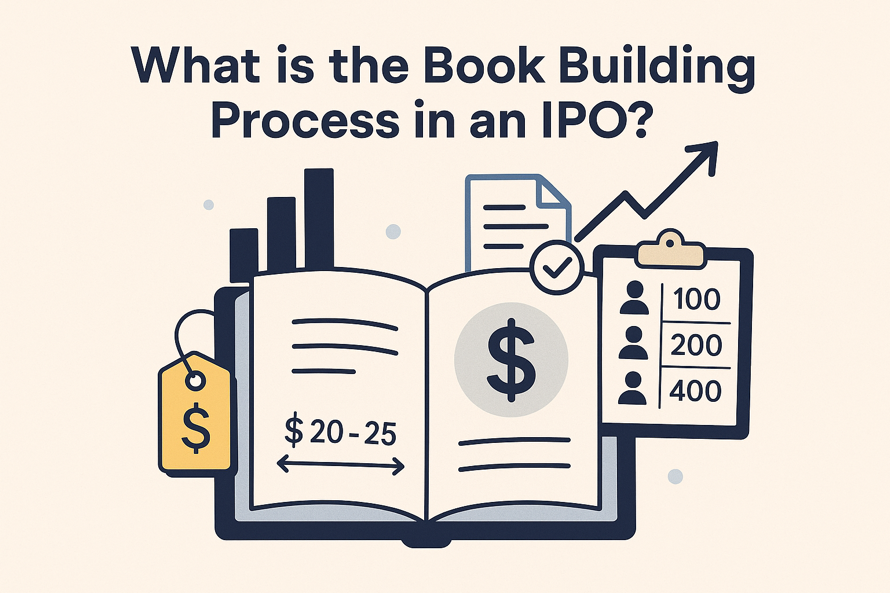
Definition of Book Building in IPO
The Book Building Process in IPO refers to a method where the issuing company, together with its underwriters or merchant bankers, invites bids from investors within a defined price range (price band). Based on these bids, the final issue price (cut-off price) is determined.
In simpler terms, it builds a “book” of demand by collecting information from investors who specify how many shares they want and at what price within the band. That demand input guides the determination of final pricing.
Because it links investor interest with pricing, this process aligns the company’s offering with market realities rather than just guessing a fixed price.
Difference Between Fixed Price Issue and Book Building Issue
Here are the key differences:
Fixed Price Issue
The issuer sets a specific price per share in advance. Investors apply at that price. The full demand is unknown until the issue closes.
Book Building Issue
A price band is announced. Investors bid within that range. After bids close, the final price is fixed based on aggregated demand.
Comparison in table form:
| Feature | Fixed Price Issue | Book Building Issue |
|---|---|---|
| Price determination | Predetermined | Demand-based |
| Demand visibility | Low until close | Higher during bidding |
| Investor participation | Simpler for retail | More flexible for all categories |
| Risk of mispricing | Higher | Reduced by market input |
Because of these advantages, many modern IPOs favour the Book Building Process in IPO over fixed price methods.
Step-by-Step Book Building Process in IPO
Appointment of Merchant Bankers and Underwriters
First, the company planning the IPO appoints one or more merchant bankers (also called book-runners or underwriters). They manage the process of the book building, advise on structure, and handle regulatory filings.
Price Band Announcement
Next, the company and the book-runners decide a price band—a lower and upper limit of share price (for example ₹100-₹120 per share). Investors will bid only within that band.
The price band gives clarity to investors about the expected range and allows the issuer to gauge likely demand at different price levels.
Bidding by Investors (Retail, HNI, QIB)
During the bidding period, the book is “open” and investors from different categories (Retail Individual Investors (RII), High Net Worth Individuals (HNI), Qualified Institutional Buyers (QIB)) place their bids specifying quantity and price within the band.
Investors may revise bids until the closing time. The accumulated bids form the “book” which reflects demand across price levels and investor categories.
Book Closure and Demand Analysis
Once the bidding period ends, the book-runners review the bids. They see how many shares are bid at each price point, how many investors participated, and from which category.
Based on this demand analysis, the final issue price (also called the cut-off price) is determined at a level where most shares can be sold and investor interest is robust.
Finalization of Issue Price (Cut-Off Price)
The book-runners, in consultation with the issuer, fix the final cut-off price. All successful bidders at or above that price will be allotted shares at the same final price. Bids below the cut-off may be rejected.
For example, if the price band was ₹50-₹70 and demand at ₹65 is highest, then ₹65 may become the cut-off price.
Share Allotment and Listing
After price finalization, shares are allotted to the successful bidders based on allocation rules and investor category quotas. The shares are then listed on the stock exchange and start trading. The listing price and performance often depend on how demand and pricing align. This completes the Book Building Process in IPO, enabling companies to price their offering based on real investor feedback.
Types of Book Building
100% Book Building Process
In a 100% book building issue, all shares of the IPO are offered through the book building route (i.e., all bids are collected and the final price is determined by demand). This method maximizes price discovery and is fully demand-driven.
Partial Book Building Process
In a partial book building issue, a portion of the shares is offered through book building (bidding process), and the remaining shares are offered at a fixed price. For example, 75% may be via book building and 25% fixed price.
This offers a hybrid approach: some price flexibility with some certainty.
Advantages of the Book Building Process
Efficient Price Discovery
The Book Building Process in IPO allows the company to discover a price that reflects real investor demand rather than guessing. The price band and bids provide live data on what investors are willing to pay.
Transparency in IPO Allotment
Because the process shows demand across price levels and categories, it offers more transparency than a fixed-price method. Investors can see subscription levels and the book built during the process. Also, regulatory frameworks often require disclosure of subscription ratios, which enhances trust.
Wider Participation from Different Investor Categories
The method allows participation by institutional investors, HNIs, and retail investors. Each category bids, creating a broad demand base and equitable allocation. It enables both large and small investors to participate meaningfully.
Thanks to these benefits, many companies and regulators favour the book-building route.
Limitations of the Book Building Process
Risk of Overvaluation or Undersubscription
Although book building improves price discovery, it does not eliminate risk. If investor demand is over-hyped, the final price may end too high, and the listing may disappoint. If demand is weak, the issue may be undersubscribed.
Complex Process for Retail Investors
The bidding process, price band, and cut-off price mechanisms can be more complex for individual retail investors compared to a fixed-price issue, where they simply apply at a known price. Retail investors need to understand how to bid, how the cut-off price works, and how allocation works, which may pose challenges for some.
Dependence on Market Sentiment
Because the final price is determined by investor demand, the process heavily depends on market sentiment, macro-economics, and investor mood. These factors can shift rapidly, injecting uncertainty into the book from the outset.
Example of Book Building in Recent IPOs
Oversubscribed IPOs and High Listing Gains
When a company uses the Book Building Process in an IPO and demand significantly exceeds supply, you often see oversubscription and strong listing gains. For example, when many IPOs in India hit hundreds of times the subscription, the cut-off price climbed accordingly.
These cases show how strong demand in the book-building phase influences pricing and aftermarket momentum.
Cases Where IPOs Underperformed Despite High Demand
There have also been situations where, although the book was heavily subscribed, the final pricing turned out high, and the listing day performance was weak. This shows that while book building offers better pricing mechanics, it cannot guarantee upside post-listing or eliminate all risk.
Detailed case studies (with IPO names and numbers) can illustrate these twin outcomes clearly.
Conclusion – Why Book Building is Crucial in IPOs
The Book Building Process in IPO has become the dominant pricing mechanism because it aligns issuer ambition with investor demand. It helps companies set a better price, gives investors more transparent participation, and widens the base of bidders.
While risks remain—such as market swings, valuation errors, and retail complexity—the advantages outweigh the limitations for many issuers and markets. For anyone tracking IPOs, understanding this process offers insight into how new issues are priced, how demand builds, and how listing outcomes may unfold.
FAQs
Q1: What is the difference between a fixed price issue and a book building issue?
A fixed price issue has a predetermined per-share price set by the issuer, while a book building issue uses a price band and investor bids to decide the final issue price.
Q2: How is the cut-off price decided in a book-built IPO?
The cut-off price is the final per-share price determined after the bidding period ends, based on aggregated demand at each bid price within the band. The issuer and book-runner analyse bids and select the price at which the shares can be allotted effectively.
Q3: Who can participate in the book-building process?
Different categories participate: Qualified Institutional Buyers (QIBs), High Net Worth Individuals (HNIs), and Retail Individual Investors (RIIs). All these submit bids during the book building phase in many markets, such as India.
Q4: What is the role of merchant bankers in book building?
Merchant bankers (underwriters, book-runners) advise the issuer, set the price band, conduct roadshows, collect bids, build the book, analyze demand, and assist in final pricing and allocation. They act as intermediaries between the issuer and the investor community.
Q5: Why do most IPOs in India follow the book building process?
Book building offers market-driven pricing, better transparency, broader investor participation, and regulatory support (via Securities and Exchange Board of India – SEBI). These factors make it a preferred route for Indian IPOs over fixed price issues.
Disclaimer
The stocks mentioned in this article are not recommendations. Please conduct your own research and due diligence before investing. Investment in securities market are subject to market risks, read all the related documents carefully before investing. Please read the Risk Disclosure documents carefully before investing in Equity Shares, Derivatives, Mutual fund, and/or other instruments traded on the Stock Exchanges. As investments are subject to market risks and price fluctuation risk, there is no assurance or guarantee that the investment objectives shall be achieved. Lemonn (Formerly known as NU Investors Technologies Pvt. Ltd) do not guarantee any assured returns on any investments. Past performance of securities/instruments is not indicative of their future performance.