What Are Anchor Investors? Meaning, Process & Comparison
 Written by Kumar Ashutosh
 Reviewed by Gaurav Garg, SEBI-registered Research Analyst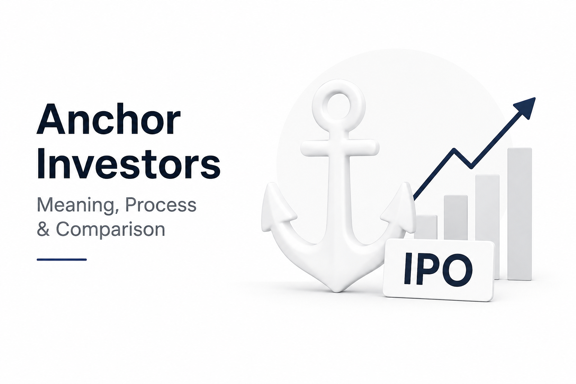
Anchor investors are institutional investors who invest in an Initial Public Offering (IPO) before it opens for public subscription. Their participation helps build confidence in the IPO by signaling that experienced investors believe in the company’s prospects.
For companies launching an IPO, anchor investors can improve market sentiment and generate early demand. For retail investors, understanding the role of anchor investors can provide useful context, though their participation alone should never be the only reason to invest.
What Are Anchor Investors?
An anchor investor is a Qualified Institutional Buyer (QIB) who receives shares in an IPO one working day before the issue opens to the public.
In India, the anchor investor mechanism is governed by the Securities and Exchange Board of India (SEBI). The objective is to attract credible institutional investors who can improve confidence in the IPO.
Anchor investors typically include:
- Mutual funds
- Insurance companies
- Pension funds
- Sovereign wealth funds
- Foreign Portfolio Investors (FPIs)
- Banks and financial institutions
- Alternative Investment Funds (AIFs)
These investors usually invest significant amounts and conduct detailed due diligence before participating.
Why Are They Called Anchor Investors?
The term “anchor” reflects their role in stabilizing demand during an IPO.
Just as an anchor keeps a ship steady, anchor investors help establish confidence before public investors begin bidding. Their participation often attracts attention from institutional and retail investors, although it does not guarantee the IPO’s success.
How Does the Anchor Investor Process Work?
The anchor investor allocation follows a structured process regulated by SEBI.
Step 1: Company Announces the IPO
The company files its offer documents and announces the IPO schedule.
Step 2: Anchor Book Opens
One working day before the IPO opens, eligible institutional investors submit bids.
Step 3: Price Discovery
Anchor investors receive shares at the IPO price determined through the book-building process.
Step 4: Share Allocation
Shares are allotted to selected anchor investors before the public subscription begins.
Step 5: Public IPO Opens
After anchor allocation is completed, the IPO becomes available to institutional, retail, and non-institutional investors.
Step 6: Lock-in Period
Under current SEBI regulations:
- 50% of the allotted shares are locked in for 90 days
- The remaining 50% are locked in for 180 days
The lock-in period discourages immediate selling after listing and promotes market stability.
How Much of an IPO Can Anchor Investors Receive?
SEBI permits a portion of the Qualified Institutional Buyer (QIB) allocation to be reserved for anchor investors.
The exact allocation depends on the size and structure of the IPO, but it forms part of the QIB quota rather than creating an additional allocation.
Who Can Become an Anchor Investor?
Only eligible institutional investors classified as Qualified Institutional Buyers can participate.
These include:
| Eligible Anchor Investors | Examples |
|---|---|
| Mutual Funds | SBI Mutual Fund, HDFC Mutual Fund |
| Insurance Companies | LIC, ICICI Prudential Life |
| Foreign Portfolio Investors | Global investment funds |
| Pension Funds | Domestic and international pension funds |
| Banks | Scheduled commercial banks |
| Alternative Investment Funds | Category I and II AIFs |
Retail investors and High Net Worth Individuals (HNIs) cannot participate as anchor investors.
Benefits of Anchor Investors
Builds Market Confidence
Institutional participation often signals that experienced investors have evaluated the company’s fundamentals.
Improves IPO Visibility
Large institutional names can generate interest among market participants and financial media.
Supports Demand
Early commitments may encourage wider participation from other investor categories.
Enhances Price Discovery
Institutional bids help establish fair market pricing during book building.
Demonstrates Institutional Interest
Strong participation may indicate that professional investors see long-term potential in the business.
Limitations of Anchor Investors
Despite their importance, anchor investors are not a guarantee of success.
No Assurance of Listing Gains
Many IPOs with strong anchor participation have listed below their issue price.
Investment Horizons Differ
Institutional investors often have different objectives and risk tolerance than retail investors.
Lock-in Expiry Can Affect Prices
When the lock-in period ends, some anchor investors may choose to sell, potentially increasing market volatility.
Retail Investors May Misinterpret Signals
Strong anchor participation should complement, not replace, independent research.
Anchor Investors vs Retail Investors
| Feature | Anchor Investors | Retail Investors |
|---|---|---|
| Investor Type | Qualified Institutional Buyers | Individual investors |
| Investment Size | Large institutional investments | Smaller individual investments |
| Allocation Timing | Before IPO opens | During IPO subscription |
| Eligibility | Institutions only | Resident individuals meeting eligibility criteria |
| Lock-in Period | 90 days for 50%, 180 days for remaining 50% | No mandatory IPO lock-in for allotted shares |
| Research Capability | Dedicated investment teams | Individual research and analysis |
Do Anchor Investors Guarantee IPO Success?
No.
While strong anchor participation is often viewed positively, IPO performance depends on several factors, including:
- Company fundamentals
- Financial performance
- Industry outlook
- IPO valuation
- Market conditions
- Investor sentiment after listing
Several IPOs with notable anchor participation have delivered weak listing performance, while others with modest institutional participation have performed well.
Should Retail Investors Follow Anchor Investors?
Anchor investor participation can be one useful indicator, but it should not be the only basis for an investment decision.
Before investing in an IPO, consider:
- Revenue and profit growth
- Business model
- Competitive position
- Valuation compared to peers
- Risk factors in the Red Herring Prospectus (RHP)
- Industry growth prospects
- Corporate governance and promoter track record
A balanced evaluation provides a stronger investment framework than relying solely on institutional participation.
Summary
Anchor investors are Qualified Institutional Buyers who invest in an IPO before it opens to the public. Their participation can improve confidence, aid price discovery, and support demand during the offering.
However, retail investors should avoid treating anchor investment as a guarantee of listing gains or long-term performance. Combining anchor participation with fundamental research, valuation analysis, and an understanding of market conditions leads to more informed investment decisions.
Frequently Asked Questions (FAQs)
Q. What is an anchor investor in an IPO?
An anchor investor is a Qualified Institutional Buyer that receives shares in an IPO before the issue opens for public subscription under SEBI’s anchor investor framework.
Q. Can retail investors become anchor investors?
No. Only eligible Qualified Institutional Buyers, such as mutual funds, insurance companies, banks, FPIs, and pension funds, can participate as anchor investors.
Q. Do anchor investors receive shares at a discount?
No. Anchor investors are allotted shares at the IPO price determined through the book-building process.
Q. Are anchor investors required to hold their shares?
Yes. Under current SEBI regulations, 50% of the allotted shares are locked in for 90 days, while the remaining 50% are locked in for 180 days.
Q. Does strong anchor participation guarantee listing gains?
No. Anchor participation may indicate institutional confidence, but IPO performance depends on factors such as valuation, company fundamentals, market conditions, and investor sentiment.
Q. Where can I check anchor investor details?
Companies disclose anchor investor allocations through stock exchange filings before the IPO opens. These details are also available in the IPO documents and on the websites of the NSE and BSE.
Key Takeaways
- Anchor investors are Qualified Institutional Buyers who invest before an IPO opens.
- Their participation helps improve market confidence and supports price discovery.
- Only institutional investors can become anchor investors.
- SEBI requires a lock-in period of 90 days for half the allocation and 180 days for the remaining half.
- Strong anchor participation is a positive indicator but should never replace thorough fundamental analysis before investing.
Disclaimer
The stocks mentioned in this article are not recommendations. Please conduct your own research and due diligence before investing. Investment in securities market are subject to market risks, read all the related documents carefully before investing. Please read the Risk Disclosure documents carefully before investing in Equity Shares, Derivatives, Mutual fund, and/or other instruments traded on the Stock Exchanges. As investments are subject to market risks and price fluctuation risk, there is no assurance or guarantee that the investment objectives shall be achieved. Lemonn (Formerly known as NU Investors Technologies Pvt. Ltd) do not guarantee any assured returns on any investments. Past performance of securities/instruments is not indicative of their future performance.