What Is an After Market Order (AMO)?
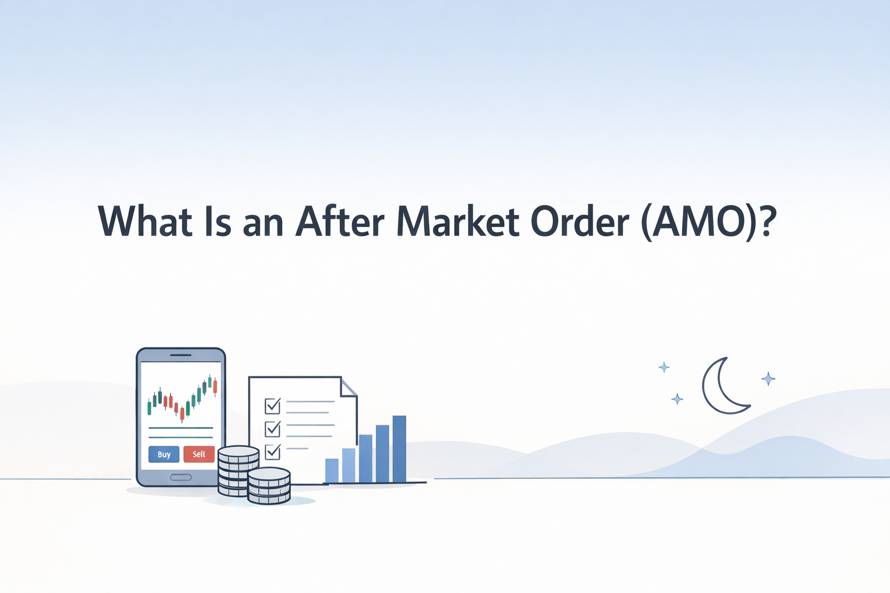
An After Market Order (AMO) is a stock market order you place after trading hours. The order is queued and automatically sent to the exchange when the market opens the next trading day. AMOs are useful if you can’t trade during market hours or if you want to react quickly to news released after the market closes.
How Does an After Market Order Work?
Stock markets operate during fixed hours (for example, 9:15 AM to 3:30 PM in India). Once the market closes, you normally can’t place standard buy or sell orders for immediate execution.
That’s where an After Market Order comes in.
Here’s how it works:
- You place the order after the market closes.
- Your broker holds the order in their system.
- When the market opens the next day, the order is sent to the exchange.
- The order gets executed based on market conditions and order type (market or limit).
In simple terms, an AMO lets you schedule your trade for the next session.
Types of After Market Orders
AMOs can be placed as different order types:
“Start investing with confidence! Explore
0 demat account
and grow your wealth.”
1. Market Order (AMO Market)
- Executes at the best available price at market open.
- Higher execution certainty.
- Price may differ from what you expected due to overnight gaps.
2. Limit Order (AMO Limit)
- Executes only at your specified price or better.
- More price control.
- May not get executed if the price isn’t reached.
Most traders prefer limit AMOs to avoid unexpected price jumps.
Why Do Traders Use AMOs?
Here are the most common reasons:
1. Convenience
If you work during trading hours, AMOs let you place trades in the evening without rushing.
2. Reacting to News
Major news-earnings results, government policies, global market movements-often comes out after market hours. AMOs help you act early.
3. Planning Ahead
You can analyze charts calmly after hours and place well-thought-out trades without emotional pressure.
What Happens at Market Open?
When the market opens, there’s usually higher volatility. Prices may:
- Gap up (open much higher than the previous close)
- Gap down (open much lower)
- Move sharply in the first few minutes
If you placed a market AMO, it executes at the opening price.
If you placed a limit AMO, it executes only if your price condition is met.
This opening volatility is the biggest factor to consider before placing an AMO.
Benefits of After Market Orders
Here are the main advantages:
- Flexibility to trade outside market hours
- Time to research and plan
- Ability to react to overnight global developments
- No need to monitor markets live
For long-term investors, AMOs are often a convenient tool.
Risks of Using AMOs
AMOs are useful, but they’re not risk-free.
1. Price Gaps
Stock prices can change significantly overnight due to global events.
Example: If a stock closes at $100 and you place a market AMO to buy, it might open at $108 the next day.
2. High Volatility at Open
The first few minutes of trading can be unpredictable.
3. Non-Execution (Limit Orders)
If you set a strict limit price, your order might not execute at all. Understanding these risks helps you use AMOs wisely.
AMO vs Regular Order: What’s the Difference?
| Feature | After Market Order (AMO) | Regular Order |
|---|---|---|
| When Placed | After market hours | During market hours |
| Execution Time | Next market session | Immediate (if conditions met) |
| Best For | Planned trades | Real-time trading |
| Risk Level | Subject to opening volatility | Depends on timing |
If you want immediate control, use regular orders. If you want convenience and planning flexibility, AMOs are helpful.
When Should You Use an AMO?
An AMO makes sense when:
- You cannot trade during market hours
- You want to act on after-hours earnings results
- You are a long-term investor planning entry levels
- You prefer calm decision-making over fast execution
Avoid AMOs if you’re a short-term trader who needs precise entry timing.
Key Takeaways
- An After Market Order (AMO) is placed after trading hours.
- It gets executed when the market opens the next day.
- Market AMOs prioritize execution; limit AMOs prioritize price control.
- Opening volatility and price gaps are the main risks.
- AMOs are ideal for planned, non-urgent trades.
Frequently Asked Questions (FAQs)
Q. Is an AMO guaranteed to execute?
No. Market AMOs usually execute at open, but limit AMOs may not execute if the price isn’t reached.
Q. Is there extra charge for placing an AMO?
Most brokers do not charge extra, but always check your broker’s fee structure.
Q. Can beginners use AMOs?
Yes. AMOs are beginner-friendly, especially for long-term investors. Just be cautious about market orders due to price gaps.
Final Thoughts
An After Market Order (AMO) is a simple but powerful tool for investors who want flexibility. It allows you to place trades outside regular market hours and have them executed the next day. Used wisely-especially with limit prices-AMOs can help you trade more calmly and strategically. Before placing one, always consider overnight news, global market trends, and your risk tolerance. Smart planning makes AMOs a helpful part of your trading toolkit.
Disclaimer
The stocks mentioned in this article are not recommendations. Please conduct your own research and due diligence before investing. Investment in securities market are subject to market risks, read all the related documents carefully before investing. Please read the Risk Disclosure documents carefully before investing in Equity Shares, Derivatives, Mutual fund, and/or other instruments traded on the Stock Exchanges. As investments are subject to market risks and price fluctuation risk, there is no assurance or guarantee that the investment objectives shall be achieved. Lemonn (Formerly known as NU Investors Technologies Pvt. Ltd) do not guarantee any assured returns on any investments. Past performance of securities/instruments is not indicative of their future performance.
Related Posts


Download Lemonn
Download my app for share market trading, ipo investment, trading account, and all your investment needs.