Union Budget 2026-27: Key Highlights and What They Mean for You
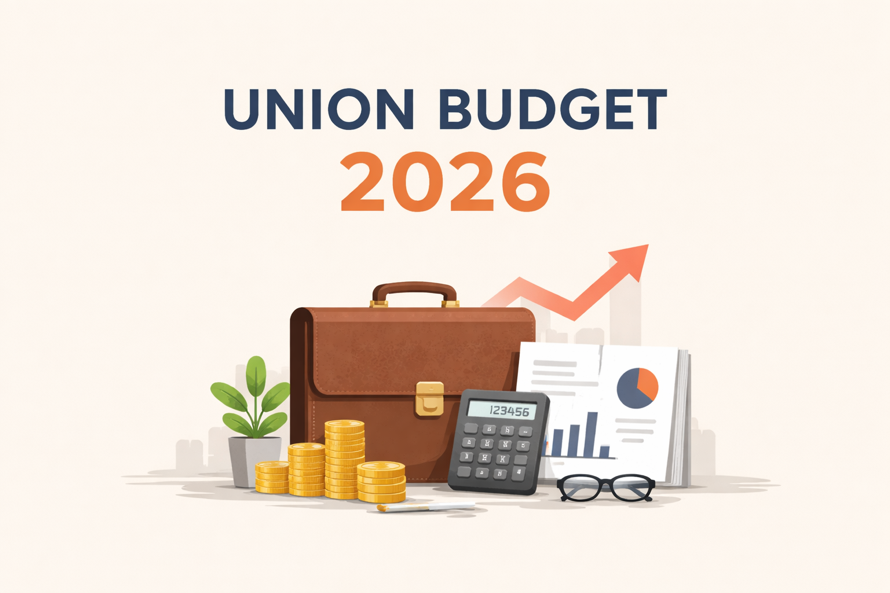
India’s Union Budget 2026-27 lays the groundwork for long-term growth with a sharp focus on infrastructure, manufacturing, and inclusive development. Instead of big giveaways, this budget focuses on building capacity, boosting productivity, and simplifying tax rules – all while staying on a responsible fiscal path.
Here’s a breakdown of what matters most.
Income Tax Overhaul: A Simpler System from 2026
The Income Tax Act 2025 will take full effect from April 1, 2026, replacing the old 1961 law. It’s more than a revision-it’s a complete rewrite.
Key changes:
- The confusing “Assessment Year” is gone. Income will now be taxed in the same year it’s earned (called the Tax Year).
- Fewer sections: The law has been trimmed from 700+ to 536 sections, making it easier to follow.
- No change in tax slabs or rates for FY 2026-27 – but more flexibility in deadlines and revisions.
Relief measures:
- Extended deadline for filing revised returns (till March 31 of the following year)
- Reduced TCS on remittances for education and health (from 5% to 2%)
- Tax exemptions for interest on accident claims, disability pensions, and small investors.
Personal Income Tax Update:
- Tax slabs and rates remain the same under both the new regime and the old regime for FY 2026-27.
- The government has chosen stability during the transition to the new Income Tax Act 2025, which takes effect from April 1, 2026.
However, several tax-related relief measures and structural changes were announced:
“Start investing with confidence! Explore
0 demat account
and grow your wealth.”
Key Tax Changes (Non-Slab):
| Change | Details |
|---|---|
| New “Tax Year” System | Replaces the old “Assessment Year” model; income is now taxed in the same year it is earned. |
| TCS Rate Reduction | TCS on foreign remittances for education and medical expenses reduced from 5% to 2%. |
| Revised Return Window Extended | You can now revise your ITR until March 31 of the succeeding tax year, with a small fee. |
| Exemptions Introduced | Tax-free interest on Motor Accident Claims; TDS removed. Disability pensions for armed forces are exempt. |
| Sovereign Gold Bonds (SGB) | Capital gains exemption only for original subscribers who hold till maturity. |
| Capital Gains on Buybacks | Now taxed as capital gains in shareholder hands instead of dividend income. |
So while slabs stayed untouched, the overall filing experience and compliance system is being modernized and made simpler.
Big Push on Infrastructure: ₹12.2 Lakh Crore Capex
Infrastructure continues to be the heart of India’s growth strategy.
Seven New High-Speed Rail Corridors Announced:
- Mumbai–Pune
- Pune–Hyderabad
- Hyderabad–Bengaluru
- Chennai–Bengaluru
- Hyderabad–Chennai
- Delhi–Varanasi
- Varanasi–Siliguri
These corridors will connect key tech, industrial, and cultural hubs, forming a “High-Speed Quadrilateral” in South India.
National Waterways & Coastal Shipping
- 20 new National Waterways will be developed
- Goal: Double inland shipping’s share in transport from 6% to 12% by 2047.
Manufacturing for the Future
India is shifting from low-end assembly to high-tech leadership.
Key missions:
- Biopharma SHAKTI: ₹10,000 crore over 5 years to boost biologics and biosimilars like cancer and diabetes drugs.
- Indian Semiconductor Mission 2.0: Focus on chip design and materials, not just fabs.
- Electronics Manufacturing: ₹40,000 crore to scale up domestic production of electronic components.
- Rare Earth Corridors: In Odisha, Kerala, Andhra, and Tamil Nadu to support green energy and defense sectors.
Rural India: A New Employment Model
The well-known MGNREGA scheme has evolved into VB-G RAM G (Viksit Bharat–Guarantee for Rozgar and Ajeevika Mission).
What’s new:
- 125 days of guaranteed rural employment (up from 100)
- Adjusted calendar to avoid peak farming seasons
- Bigger state role in implementation
- ₹95,692 crore allocated for the year.
Tech support also expands with Bharat-VISTAAR, a multilingual AI assistant for farmers.
MSMEs Get a Boost
India’s small businesses – key to jobs and innovation – get new support:
- SME Growth Fund: ₹10,000 crore to help small firms grow
- TReDS mandatory for government purchases, speeding up payments
- “Corporate Mitras”: Trained professionals to help MSMEs handle compliance affordably
- Courier export limits removed, aiding small e-commerce players.
Education, Creativity & the Youth Economy
The budget lays the foundation for a future-ready workforce:
- ₹1.39 lakh crore for education
- 5 university townships near industrial zones
- Indian Institute of Creative Technologies in Mumbai
- 15,000 schools and 500 colleges to get animation/VFX/gaming labs.
Women’s Empowerment: “She MARTS” & More
Women are at the center of several new schemes:
- “She MARTS”: Community-run retail outlets by women entrepreneurs
- A girls’ hostel in every district to support female STEM education
- Gender Budget allocation at an all-time high: ₹4.49 lakh crore.
Green Energy and Sustainability
Big steps toward India’s net-zero 2070 goal:
- Small Modular Nuclear Reactors: ₹20,000 crore R&D fund
- Carbon Capture: ₹20,000 crore to support clean industry
- Rooftop Solar: Up to 300 units/month free for 1 crore homes
- Green Hydrogen Mission: Aim to produce 5 million metric tons annually by 2030.
Defense Modernization: ₹7.84 Lakh Crore Allocation
Defense sees a record allocation:
- Capital outlay: ₹2.19 lakh crore for aircraft, ships, and R&D
- 75% of modernization spend to go to domestic industry
- Support for startups via iDEX, with ₹449 crore to fund new-age tech like AI and drones.
Fiscal Discipline and Growth Outlook
- Fiscal deficit target: 4.3% of GDP (down from 4.4%)
- Nominal GDP projected at ₹393 trillion with 10% growth
- Capital expenditure: ₹12.2 lakh crore
- Total budget size: ₹53.5 lakh crore.
India is staying on track to lower debt, build investor trust, and maintain macroeconomic stability even in a globally uncertain environment.
Final Thoughts
Union Budget 2026-27 doesn’t just look at this year – it’s planning for the next two decades. From tax simplification and MSME growth to futuristic transport and green energy, this budget sets the stage for India’s transition to a developed economy by 2047.
FAQs: Union Budget 2026-27
Q: Are there any changes in income tax rates?
No, the income tax slabs remain unchanged for FY 2026-27.
Q: What is the new “Tax Year” system?
From April 1, 2026, taxes will be filed for the same year income is earned – no more assessment year confusion.
Q: Which sectors saw the biggest investments?
infrastructure, manufacturing (biotech, semiconductors), defense, education, and green energy.
Q: What is VB-G RAM G?
It’s the new rural job guarantee scheme replacing MGNREGA, offering 125 days of employment per year.
Key Takeaways
- Major simplification of income tax law
- Record capex spend to fuel infrastructure and jobs
- Big bets on tech, green energy, and women-led businesses
- Steady economic growth with fiscal restraint
Disclaimer
The stocks mentioned in this article are not recommendations. Please conduct your own research and due diligence before investing. Investment in securities market are subject to market risks, read all the related documents carefully before investing. Please read the Risk Disclosure documents carefully before investing in Equity Shares, Derivatives, Mutual fund, and/or other instruments traded on the Stock Exchanges. As investments are subject to market risks and price fluctuation risk, there is no assurance or guarantee that the investment objectives shall be achieved. Lemonn (Formerly known as NU Investors Technologies Pvt. Ltd) do not guarantee any assured returns on any investments. Past performance of securities/instruments is not indicative of their future performance.
Related Posts

Download Lemonn
Download my app for share market trading, ipo investment, trading account, and all your investment needs.