Tracking Error in Index Funds: What It Is and Why It Matters for Your Returns
What is Tracking Error?
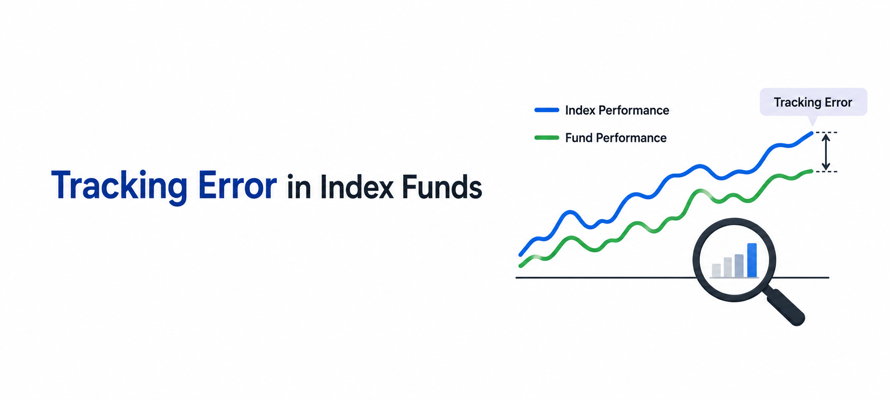
Tracking error measures the deviation between an index fund’s returns and its benchmark index returns over a period. It is expressed as the standard deviation of the daily/monthly differences. A perfectly replicating fund would have zero tracking error, but in practice, costs and operational factors create a gap.
What Causes Tracking Error?
- Expense ratio: The fund’s management cost directly reduces returns vs the benchmark
- Cash drag: Funds hold some cash for redemptions, which doesn’t earn market returns
- Replication method: Some funds use sampling (not full replication), creating gaps
- Dividend timing: Index counts dividends at ex-date; fund receives and reinvests later
- Transaction costs: Each rebalancing trade incurs brokerage and market impact costs
| Tracking Error Level | Interpretation | Action |
|---|---|---|
| < 0.05% annual | Excellent: tight replication | Preferred choice |
| 0.05%–0.15% annual | Good: minor deviations | Acceptable for most |
| 0.15%–0.30% annual | Moderate: review causes | Consider alternatives |
| > 0.30% annual | High: significant drag | Avoid or investigate |
“Start investing with confidence! Explore
0 demat account
and grow your wealth.”
Tracking Difference vs Tracking Error
Tracking difference is the cumulative return gap over a full year (fund return minus index return). Tracking error is the volatility of the daily gaps. Both matter: you want low tracking difference (fund doesn’t consistently lag) AND low tracking error (consistent performance). A fund could have zero tracking error but consistently underperform by the expense ratio.
How to Find Tracking Error Data
- Check the fund’s factsheet; most AMCs publish monthly factsheets
- SEBI mandates disclosure of tracking error in scheme information documents
- Use AMFI’s website to download fund performance data for manual calculation
- Platforms like MFCentral and Value Research publish tracking error metrics
Tracking Error Comparison: Top Nifty 50 Funds
| Fund | 1Y Tracking Error | 1Y Tracking Difference | TER |
|---|---|---|---|
| SBI ETF Nifty 50 | ~0.02% | ~0.07% | 0.07% |
| HDFC Nifty 50 Index Fund | ~0.03% | ~0.22% | 0.20% |
| UTI Nifty 50 Index Fund | ~0.04% | ~0.24% | 0.20% |
| Nippon India ETF BeES | ~0.02% | ~0.04% | 0.04% |
Practical Takeaways
- For ETFs: Prioritise tracking error – consistent replication is critical
- For index funds: Prioritise tracking difference – total return gap matters more
- Expense ratio is the primary driver – choose lowest TER in your preferred category
- Large AUM generally means better replication due to lower cash drag percentage
Disclaimer
The stocks mentioned in this article are not recommendations. Please conduct your own research and due diligence before investing. Investment in securities market are subject to market risks, read all the related documents carefully before investing. Please read the Risk Disclosure documents carefully before investing in Equity Shares, Derivatives, Mutual fund, and/or other instruments traded on the Stock Exchanges. As investments are subject to market risks and price fluctuation risk, there is no assurance or guarantee that the investment objectives shall be achieved. Lemonn (Formerly known as NU Investors Technologies Pvt. Ltd) do not guarantee any assured returns on any investments. Past performance of securities/instruments is not indicative of their future performance.
Related Posts


Download Lemonn
Download my app for share market trading, ipo investment, trading account, and all your investment needs.