SIP vs Lump Sum in Index Funds: When to Use Each Strategy
The Eternal Debate: SIP or Lump Sum?
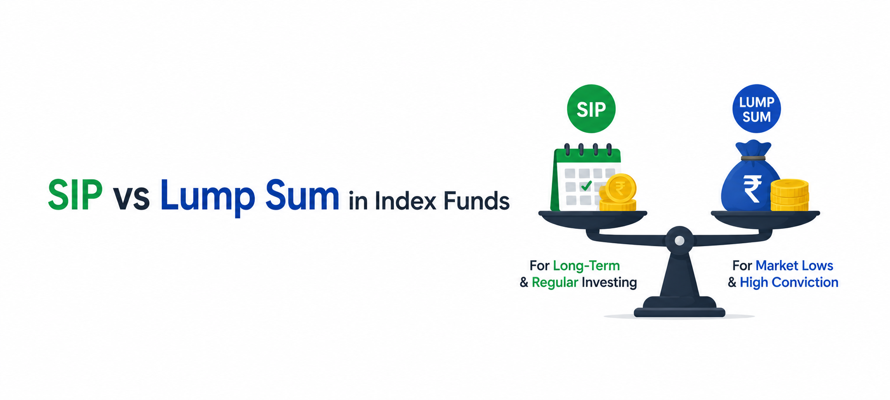
SIP (Systematic Investment Plan) and lump sum are two fundamental approaches to investing in index funds. The mathematically optimal choice depends on market conditions, but behaviorally, SIP wins for most investors because it removes emotion from the timing decision.
How SIP Works in Index Funds
A fixed amount (e.g., ₹10,000) is invested monthly on a predetermined date. In months when the NAV is low (market dip), you buy more units. In months when NAV is high, you buy fewer units. Over time, this reduces your average purchase price below the simple average: the ‘rupee cost averaging’ effect.
“Start investing with confidence! Explore
0 demat account
and grow your wealth.”
How Lump Sum Works
You invest the entire amount at once. If markets rise from your entry point, lump sum outperforms SIP because your entire capital was deployed from day one. If markets fall after entry, SIP outperforms because you continue buying at lower prices.
| Scenario | Better Approach | Why |
|---|---|---|
| Markets continuously rising after investment | Lump Sum | Full capital compounding from start |
| Markets volatile, flat long-term | SIP | Averaging reduces cost |
| Markets falling then recovering | SIP | Buy more units at lower prices |
| Large windfall received (bonus, inheritance) | Lump Sum + STPs | Deploy systematically over 6–12 months |
| Regular monthly savings | SIP | Natural fit for salary income |
Research Finding: Lump Sum vs SIP Historical Analysis
Studies on US markets (S&P 500) show lump sum investing outperforms monthly DCA about 2/3 of the time over 10-year periods, because markets rise more often than they fall. The same is likely true for Nifty 50 historically. However, the emotional and behavioral benefits of SIP are significant, investors who SIP are far less likely to panic-sell during corrections.
Systematic Transfer Plan (STP): The Best of Both Worlds
If you have a lump sum to invest but are worried about timing, use an STP; park the amount in a liquid or overnight fund first, then transfer a fixed amount monthly into your index fund. You get the safety of gradual deployment with the efficiency of having funds already in the system.
| Approach | Risk of Bad Timing | Return Potential | Behavioral Ease |
|---|---|---|---|
| SIP | Low | Good | Excellent |
| Lump Sum | High | Highest (if timed well) | Poor for most investors |
| STP (Liquid to Index) | Low | Good | Good |
Practical Recommendation for Indian Investors
- Salaried investors: Monthly SIP in index funds is the default, no overthinking needed
- Received large amount (bonus/maturity): Park in liquid fund, STP over 6–12 months into index fund
- Market has corrected > 15% from recent high: Lump sum into index fund is historically rewarding
- Market at all-time highs: Prefer SIP over lump sum to reduce timing risk
Disclaimer
The stocks mentioned in this article are not recommendations. Please conduct your own research and due diligence before investing. Investment in securities market are subject to market risks, read all the related documents carefully before investing. Please read the Risk Disclosure documents carefully before investing in Equity Shares, Derivatives, Mutual fund, and/or other instruments traded on the Stock Exchanges. As investments are subject to market risks and price fluctuation risk, there is no assurance or guarantee that the investment objectives shall be achieved. Lemonn (Formerly known as NU Investors Technologies Pvt. Ltd) do not guarantee any assured returns on any investments. Past performance of securities/instruments is not indicative of their future performance.
Related Posts



Download Lemonn
Download my app for share market trading, ipo investment, trading account, and all your investment needs.