
SIP vs Intraday Trading: Which Is Better for Indian Investors?
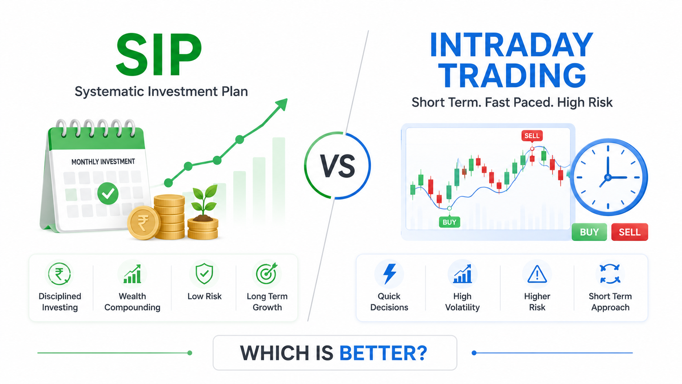
Many new investors enter the financial markets with the same question:
Should I invest through SIPs or try intraday trading?
While both can help grow wealth, they serve very different purposes. One focuses on long-term investing and compounding, while the other aims to generate short-term profits from daily market movements.
Investors searching for what is best SIP investment in India are often trying to understand whether systematic investing is a better choice than active trading.
The truth is that SIPs and intraday trading are not direct competitors. They are different financial tools designed for different goals, risk levels, and investor profiles.
In this guide, we’ll compare SIPs and intraday trading across returns, risk, taxation, time commitment, capital requirements, and suitability. We’ll also discuss a balanced approach that combines both strategies.
SIP vs Intraday Trading: Quick Overview
Before diving deeper, let’s understand the basics.
What Is a SIP?
A Systematic Investment Plan (SIP) allows investors to invest a fixed amount regularly into mutual funds.
Example:
- ₹5,000 invested every month
- Equity mutual fund
- Long-term wealth creation
SIPs are designed to help investors build wealth gradually through compounding and rupee-cost averaging.
“Start investing with confidence! Explore
0 demat account
and grow your wealth.”
What Is Intraday Trading?
Intraday trading involves buying and selling stocks within the same trading day.
Example:
- Buy shares at 10:00 AM
- Sell them at 2:00 PM
- Profit from short-term price movements
Intraday traders seek daily opportunities rather than long-term growth.
SIP vs Intraday Trading: Key Differences
| Feature | SIP | Intraday Trading |
|---|---|---|
| Goal | Wealth creation | Short-term profits |
| Time Horizon | Years | Minutes to hours |
| Risk Level | Moderate | High |
| Skill Requirement | Low | High |
| Daily Monitoring | Minimal | Extensive |
| Capital Requirement | Low | Flexible |
| Emotional Stress | Low | High |
| Suitable For | Most investors | Experienced traders |
The differences become even clearer when we compare individual factors.
Returns: SIP vs Intraday Trading
Returns are usually the first factor investors consider.
SIP Returns
Historically, diversified equity mutual funds in India have delivered approximately:
- 10% to 15% annualized returns over long periods
Some funds may outperform, while others may underperform.
The key advantage is compounding.
Example
₹10,000 monthly SIP
12% annual return
20 years
Potential corpus: More than ₹90 lakh
Compounding becomes increasingly powerful over time.
Intraday Trading Returns
Intraday trading has no fixed return expectation.
Returns depend on:
- Market conditions
- Skill level
- Risk management
- Capital deployed
While some traders generate substantial profits, many struggle to remain consistently profitable.
Reality Check
A large percentage of active retail traders fail to outperform the broader market over extended periods.
This is why intraday trading should be approached as a skill-based activity rather than a guaranteed income source.
Winner: SIP
For most investors, SIPs provide a more predictable path to long-term wealth creation.
Risk Comparison
Understanding risk is more important than chasing returns.
SIP Risk
SIPs are exposed to:
- Market volatility
- Economic cycles
- Fund performance
However:
- Investments are diversified
- Risk is spread across multiple stocks
- Long-term horizons reduce volatility impact
Intraday Trading Risk
Intraday trading carries significantly higher risk.
Potential challenges include:
- Rapid price movements
- Leverage-related losses
- Emotional decision-making
- Market volatility
A single poor trading decision can result in substantial losses.
Winner: SIP
For risk management, SIPs are generally the safer option.
Time Commitment
This is one of the biggest differences between the two approaches.
SIP Investing
Once a SIP is established:
- Investments occur automatically
- Minimal monitoring is required
- Monthly reviews are often sufficient
Many investors spend less than one hour per month managing their SIP portfolio.
Intraday Trading
Intraday trading requires:
- Market monitoring
- Technical analysis
- Trade execution
- Risk management
Active traders may spend:
- 3 to 8 hours daily
depending on their strategy.
Winner: SIP
SIPs are far more suitable for busy professionals.
Skill Requirements
SIP Investing
Successful SIP investing primarily requires:
- Financial discipline
- Patience
- Basic fund selection knowledge
Investors do not need advanced market expertise.
Intraday Trading
Intraday traders must understand:
- Technical analysis
- Price action
- Risk management
- Trading psychology
- Market structure
The learning curve is significantly steeper.
Winner: SIP
SIPs are more beginner-friendly.
Taxation: SIP vs Intraday Trading
Tax treatment differs substantially.
SIP Taxation
For equity mutual funds:
Short-Term Capital Gains (STCG)
Applicable when units are sold within one year.
Long-Term Capital Gains (LTCG)
Applicable after one year.
Tax rules are subject to change and should always be verified using the latest government guidelines.
Intraday Trading Taxation
Intraday profits are generally treated as:
Speculative Business Income
This means:
- Profits are added to taxable income
- Taxation depends on the investor’s slab rate
- Additional record-keeping may be required
Winner: SIP
SIP taxation is generally simpler for most investors.
Emotional Stress and Psychology
This factor is often overlooked.
SIP Investors
Most SIP investors focus on:
- Long-term goals
- Regular contributions
- Portfolio growth
Daily market fluctuations have limited impact on their decisions.
Intraday Traders
Traders frequently experience:
- Fear
- Greed
- Stress
- Decision fatigue
Managing emotions becomes a critical skill.
Many traders fail because of psychology rather than strategy.
Winner: SIP
SIPs create less emotional pressure.
Which Generates More Wealth Over Time?
For most investors, wealth creation depends on:
- Consistency
- Time in the market
- Compounding
SIPs excel in all three areas.
Example
Investor A:
Invests ₹10,000 monthly through SIPs for 20 years.
Investor B:
Attempts active trading with inconsistent results.
In many cases, Investor A achieves better long-term outcomes despite making fewer decisions.
What Is the Best SIP Investment in India?
There is no single “best” SIP for everyone.
The ideal SIP depends on:
- Risk tolerance
- Investment horizon
- Financial goals
Popular categories include:
Large-Cap Funds
Suitable for conservative investors.
Flexi-Cap Funds
Offer flexibility across market segments.
Index Funds
Track benchmark indices with lower costs.
Mid-Cap Funds
Higher growth potential with higher risk.
ELSS Funds
Provide tax benefits under applicable tax provisions.
The best SIP is the one aligned with your goals and risk profile.
Who Should Choose SIP Investing?
SIPs are often suitable for:
- Salaried professionals
- First-time investors
- Retirement planners
- Long-term wealth builders
- Passive investors
If your goal is financial freedom over the next 10–20 years, SIPs are often an excellent starting point.
Who Should Consider Intraday Trading?
Intraday trading may suit:
- Experienced market participants
- Active traders
- Individuals willing to learn technical analysis
- Investors with higher risk tolerance
Trading should generally be viewed as an advanced activity rather than a beginner investment strategy.
A Balanced Approach: 70% SIP, 30% Trading
Many investors don’t need to choose one or the other.
A hybrid approach can offer the best of both worlds.
Suggested Allocation
70% SIP Investments
Purpose:
- Long-term wealth creation
- Retirement planning
- Financial goals
30% Trading Capital
Purpose:
- Active market participation
- Skill development
- Additional return opportunities
This structure helps ensure that long-term wealth creation remains the priority while still allowing participation in trading.
Sample Portfolio Allocation
| Investment Type | Allocation |
|---|---|
| Equity Mutual Fund SIPs | 50% |
| Index Fund SIPs | 20% |
| Intraday Trading Capital | 20% |
| Emergency Fund | 10% |
The exact allocation should depend on individual financial goals and risk tolerance.
Common Mistakes Investors Make
Using SIP Money for Trading
Long-term investment capital should generally remain separate from trading capital.
Chasing Quick Profits
Many beginners underestimate the difficulty of consistent trading.
Ignoring Risk Management
Risk control is essential for both investing and trading.
Expecting Instant Results
Both SIPs and trading require patience and discipline.
Key Takeaways
- SIPs and intraday trading serve different purposes.
- SIPs focus on long-term wealth creation through compounding.
- Intraday trading seeks short-term profits from daily price movements.
- SIPs generally involve lower risk and less time commitment.
- Trading requires greater skill, discipline, and emotional control.
- Most investors are better suited to SIP investing.
- A 70% SIP and 30% trading allocation can provide balance for interested market participants.
Frequently Asked Questions
Q. Which is better: SIP or intraday trading?
For most investors, SIPs are generally better for long-term wealth creation because they involve lower risk and benefit from compounding.
Q. Can I do both SIP and intraday trading?
Yes. Many investors maintain SIP investments for long-term goals while allocating a smaller portion of capital to trading.
Q. Is intraday trading riskier than SIP investing?
Yes. Intraday trading typically involves significantly higher risk and volatility.
Q. What is the best SIP investment in India?
The best SIP depends on your goals, risk tolerance, and investment horizon. Index funds, flexi-cap funds, and large-cap funds are popular choices.
Q. How much money should I allocate to trading?
Many investors limit trading capital to a small portion of their overall portfolio and keep the majority invested for long-term growth.
Conclusion
The debate between SIPs and intraday trading isn’t about finding a single winner. It’s about understanding which approach aligns with your financial goals, risk tolerance, and lifestyle.
For most people, SIPs remain one of the most effective ways to build long-term wealth. They require less time, lower expertise, and benefit from the power of compounding. Intraday trading, while potentially rewarding, demands significant skill, discipline, and risk management.
If you’re just starting your investment journey, prioritizing SIPs is often the wiser choice. Once you’ve built a solid investment foundation, you can consider allocating a smaller portion of your portfolio to trading activities.
In the long run, successful wealth creation is usually driven not by frequent trading but by consistent investing, patience, and disciplined financial planning.
Disclaimer
The stocks mentioned in this article are not recommendations. Please conduct your own research and due diligence before investing. Investment in securities market are subject to market risks, read all the related documents carefully before investing. Please read the Risk Disclosure documents carefully before investing in Equity Shares, Derivatives, Mutual fund, and/or other instruments traded on the Stock Exchanges. As investments are subject to market risks and price fluctuation risk, there is no assurance or guarantee that the investment objectives shall be achieved. Lemonn (Formerly known as NU Investors Technologies Pvt. Ltd) do not guarantee any assured returns on any investments. Past performance of securities/instruments is not indicative of their future performance.
Related Posts

Download Lemonn
Download my app for share market trading, ipo investment, trading account, and all your investment needs.



