RSI Trading Strategy for Nifty and Bank Nifty: Practical 2026 Playbook
Why RSI Works Well on Indian Index Derivatives
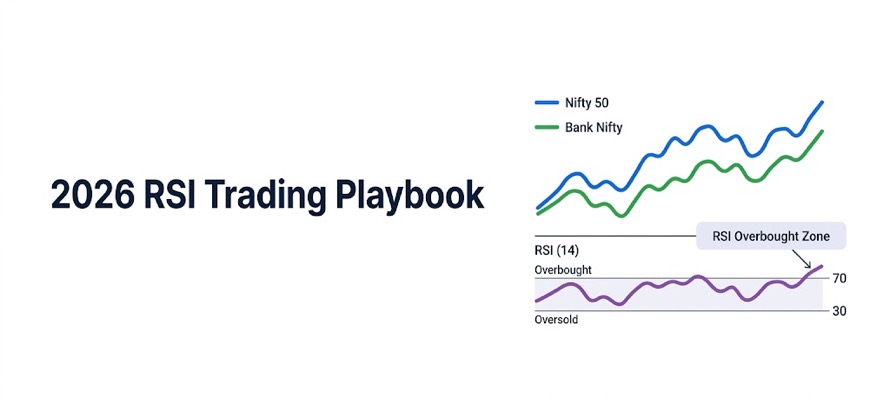
Nifty and Bank Nifty are among the most liquid derivatives globally. Their high liquidity means price discovery is efficient and technical indicators have more predictive value than on illiquid small-cap stocks. RSI on daily charts of Nifty has historically provided good entry signals for swing traders.
RSI Basics Recap
RSI is calculated from average gain vs average loss over 14 periods (default). Formula: RSI = 100 – [100/(1 + RS)] where RS = Average Gain / Average Loss. Standard overbought level: 70. Standard oversold level: 30.
“Start investing with confidence! Explore
0 demat account
and grow your wealth.”
Strategy 1: RSI Oversold Bounce
When Nifty daily RSI falls below 30, it signals that selling has been exhausted. This is a potential buying zone for swing traders looking for a bounce. Wait for RSI to start turning up from below 30 before entering (don’t catch a falling knife, wait for confirmation).
| Step | Action | Notes |
|---|---|---|
| 1 | RSI(14) on daily Nifty chart falls below 30 | Oversold condition confirmed |
| 2 | Wait for RSI to cross back above 30 | Momentum reversal signal |
| 3 | Check: Is price near support zone? | Confluence improves reliability |
| 4 | Enter long position (Nifty futures or call options) | After RSI turns up from sub-30 |
| 5 | Stop loss: below the recent swing low | Defined risk |
| 6 | Target: RSI reaching 60–70 zone (previous resistance) | Exit before overbought |
Strategy 2: RSI Divergence
Divergence occurs when price makes a new high (or low) but RSI does not confirm it. Bearish divergence: price makes higher high, RSI makes lower high: selling signal. Bullish divergence: price makes lower low, RSI makes higher low: buying signal. Divergences are more powerful on daily and weekly charts.
Strategy 3: RSI Trend-Following (40-80 Zone)
In strong uptrends, RSI oscillates between 40 and 80, rarely touching oversold below 30. Instead of waiting for 30, use 40 as the buy zone. When RSI dips to 40–50 in an uptrend, it is a higher-probability entry than waiting for 30 (which may never come in a bull market).
| Market Condition | RSI Buy Zone | RSI Sell Zone | Strategy |
|---|---|---|---|
| Strong uptrend (Nifty > 200 SMA) | 40–50 | 70–80 | Buy dips, trend-follow |
| Downtrend (Nifty < 200 SMA) | 20–30 | 60–70 | Sell bounces |
| Range-bound market | 30 | 70 | Classic oversold/overbought |
Risk Management for RSI Strategies
- Never enter on RSI signal alone, combine with price structure (support/resistance)
- Position size: Risk no more than 1–2% of account on any single trade
- Stop loss is non-negotiable; define it before entry, not after
- Avoid RSI signals in the first and last 30 minutes of trading (high noise period)
Disclaimer
The stocks mentioned in this article are not recommendations. Please conduct your own research and due diligence before investing. Investment in securities market are subject to market risks, read all the related documents carefully before investing. Please read the Risk Disclosure documents carefully before investing in Equity Shares, Derivatives, Mutual fund, and/or other instruments traded on the Stock Exchanges. As investments are subject to market risks and price fluctuation risk, there is no assurance or guarantee that the investment objectives shall be achieved. Lemonn (Formerly known as NU Investors Technologies Pvt. Ltd) do not guarantee any assured returns on any investments. Past performance of securities/instruments is not indicative of their future performance.
Related Posts



Download Lemonn
Download my app for share market trading, ipo investment, trading account, and all your investment needs.