Understanding Registrar and Transfer Agents (RTA) And Their Role in Investing
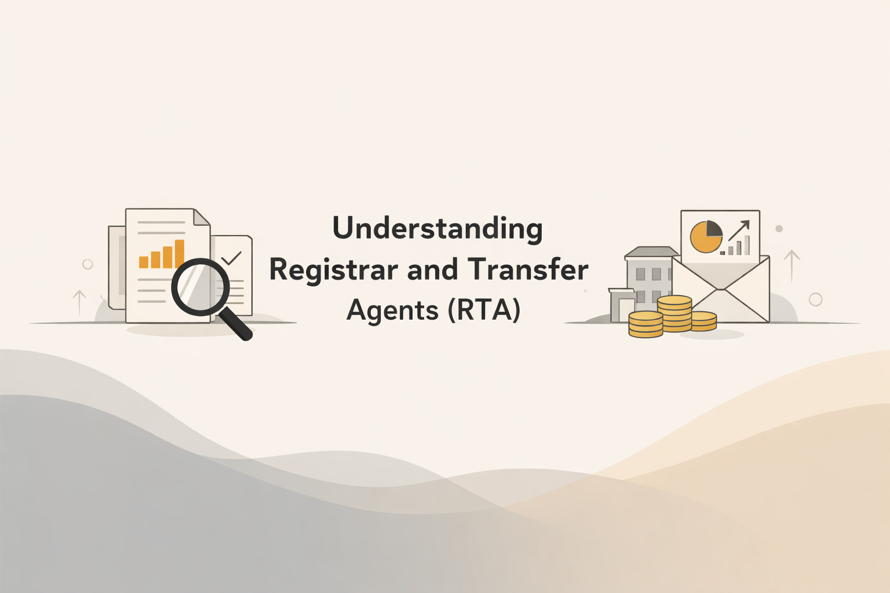
Registrar and Transfer Agents
Most investors think about returns. Performance charts. NAV movement. Alpha generation. Very few think about infrastructure. Yet, every investment ecosystem rests on an invisible administrative engine. That engine is powered by Registrar and Transfer Agents.
When an investor submits a mutual fund purchase request, units appear in the folio. When a redemption is placed, money arrives in the bank account. Statements reflect transactions accurately. Nominee changes get updated. SIPs continue uninterrupted. All of this looks effortless from the outside.
Behind the scenes, a structured operational framework processes each instruction. Data validation. Compliance checks. Cut-off time verification. Unit reconciliation. Regulatory reporting. These functions are executed systematically by Registrar and Transfer Agents.
An RTA functions as the recordkeeper and transaction processor for investment products. While asset management companies focus on portfolio construction, research, and asset allocation, RTAs manage the administrative layer. They maintain investor records. They process transactions. They generate statements. They ensure regulatory alignment.
In large markets, millions of investors transact daily across thousands of schemes. Every transaction must be accurately reflected in the system. Errors can lead to financial discrepancies, compliance violations, and investor disputes. The RTA reduces this operational risk by serving as a centralized service infrastructure.
In India, CAMS and KFin Technologies dominate the mutual fund RTA space. Globally, similar structures exist under transfer agency services for collective investment schemes. Regardless of geography, the function remains consistent: maintain ownership integrity and process investment transactions accurately.
They operate quietly. They operate continuously. And without them, the investment ecosystem would slow to a crawl.
The Role of Registrar and Transfer Agent
The role of Registrar and Transfer Agents extends far beyond clerical recordkeeping. They operate as transaction control centers within the investment chain.
Every purchase request submitted through a distributor, online platform, or AMC portal ultimately routes through RTA systems. The RTA validates investor details, checks KYC compliance, verifies bank mandates, applies cut-off rules, and allocates units at the correct NAV. Timing precision matters. Even minor discrepancies can create financial implications.
Redemptions undergo similar scrutiny. Bank details must match registered mandates. Units must be verified against available balance. Exit load rules must be applied accurately. Funds must transfer within regulatory timelines.
Beyond transaction processing, RTAs maintain master investor databases. This includes PAN records, FATCA declarations, nominee data, contact details, and transaction history. Regulatory frameworks demand traceability. Audit trails must remain intact. Every update must be documented.
They also generate consolidated account statements. Investors holding multiple schemes under one RTA receive integrated reporting. This reduces fragmentation and enhances transparency.
Investor servicing forms another layer of responsibility. Call centers, grievance redressal systems, email support, and online request tracking typically operate under RTA infrastructure. Investors may interact with RTAs more frequently than with the AMC itself.
Operational stability builds investor confidence. When systems function smoothly, trust deepens. When delays occur, confidence weakens quickly. The RTA safeguards this operational trust.
“Start investing with confidence! Explore
0 demat account
and grow your wealth.”
Services to AMC
Asset management companies focus on performance. Portfolio construction. Research models. Risk management frameworks. But performance cannot scale without administrative precision. That precision comes from Registrar and Transfer Agents.
RTAs deliver structured services to AMCs, including:
- End-to-end transaction processing across all schemes
- Daily reconciliation of subscriptions and redemptions
- Unit allocation and NAV-based computation
- Distributor commission calculation and payout tracking
- Corporate action execution, such as dividends and bonus units
- Investor reporting and data analytics dashboards
- Regulatory filing support and audit documentation
These functions may appear operational, yet they carry strategic weight. Accurate reconciliation ensures fund accounting integrity. Commission tracking supports distribution relationships. Analytics dashboards provide insight into investor behavior patterns, SIP trends, and redemption cycles.
RTAs also manage scheme-level corporate actions. When dividends are declared, payout instructions must align with unit holdings. When scheme mergers occur, unit conversions must be calculated precisely. These processes demand scale and system automation.
Outsourcing to an RTA allows AMCs to concentrate on investment decisions while maintaining administrative reliability. The separation of portfolio management and operational execution creates efficiency within the ecosystem.
Services to Mutual Fund Investors
From the investor’s standpoint, Registrar and Transfer Agents function as service gateways. The AMC brand may remain front-facing, yet the operational interface frequently runs through RTA platforms.
Investor-level services include transaction execution, data updates, and reporting support. When an investor changes bank details, registers a nominee, modifies an SIP, or requests a capital gain statement, the request flows into RTA systems for validation and processing.
Digital platforms operated by RTAs provide centralized access. Investors can log in, review portfolio holdings, download account statements, check transaction status, and submit service requests. This centralization simplifies administration for those holding multiple schemes.
RTAs also facilitate the transmission of units in the event of an investor’s death. Documentation must be verified. Legal heirs must be validated. Units must be transferred systematically. These processes require accuracy and sensitivity.
Tax reporting represents another critical service. Capital gain statements for financial year-end filing are generated through RTA systems. Investors rely on this accuracy for compliance.
Operational efficiency may appear invisible, yet its absence becomes immediately noticeable. Smooth processing enhances experience. Structured servicing strengthens investor loyalty.
Services to AIF Investors
Registrar and Transfer Agents extend their operational expertise beyond mutual funds into Alternative Investment Fund structures. AIFs involve more sophisticated investment mechanics. Capital commitments replace simple subscriptions. Drawdowns occur in stages. Distributions may follow complex waterfall structures.
Administrative precision becomes even more critical.
In AIF structures, RTAs assist with maintaining investor registers, tracking committed capital versus drawn capital, processing capital calls, and reconciling distribution payouts. Each capital movement must align with investor agreements and regulatory requirements.
AIF investments often involve high-net-worth individuals and institutions. Reporting expectations are detailed. Communication must be accurate. Confidentiality remains paramount.
RTAs generate investor statements reflecting capital deployment, returns generated, and outstanding commitments. Compliance filings must match regulatory templates. Audit support becomes essential.
Without structured transfer agency support, AIF administration would become fragmented and error-prone. The RTA provides consistency within complexity.
What is AIF?
An Alternative Investment Fund is a privately pooled investment vehicle that collects capital from sophisticated investors and deploys it according to a defined strategy. Unlike mutual funds designed for broad retail participation, AIFs typically involve higher minimum investment thresholds and longer investment horizons.
AIFs may invest in private equity, venture capital, hedge strategies, infrastructure assets, distressed credit, or structured opportunities. Regulatory authorities classify AIFs into categories based on strategy focus and risk profile.
Capital in an AIF is usually committed upfront but deployed in phases. Managers issue capital calls as opportunities arise. Investors contribute according to commitment schedules. Returns are distributed periodically or upon exit events.
This staggered structure increases administrative complexity. Tracking each investor’s commitment balance, drawdown schedule, and distribution share requires systematic recordkeeping. Registrar and Transfer Agents provide this operational structure.
What is PMS?
Portfolio Management Services represent a customized investment structure. They do not pool funds like mutual funds and AIFs do. Instead, they are managed by professionals so they can deliver better results.
Investors hold securities directly in their demat accounts. The portfolio manager executes trades under a discretionary or non-discretionary mandate. Minimum investment thresholds are significantly higher than those for mutual funds.
Because securities are held individually, reporting requirements differ. Transaction reconciliation, performance computation, documentation management, and audit support remain essential.
RTAs may assist PMS providers by supporting investor reporting systems, transaction documentation workflows, and regulatory compliance data management. Even though PMS structures differ operationally, administrative reliability remains central.
FAQs:
Q. What is the difference between a registrar and a transfer agent?
A registrar maintains the official record of security holders. A transfer agent executes ownership changes, processes transfers, and updates records. In practice, both roles are usually combined under one entity called an RTA.
Q. What is an RTA agent?
An RTA agent is a Registrar and Transfer Agent. Its goal is to manage investor records, process transactions, and folio maintenance. It also plays a crucial role in ensuring compliance by mutual funds, AIFs, and other investment products.
Q. What is the role of a register and transfer agent?
A register and transfer agent focuses on ownership data and processes unit purchases. It also manages investor details and generates statements. It acts more like a backbone of the investment ecosystem.
Disclaimer
The stocks mentioned in this article are not recommendations. Please conduct your own research and due diligence before investing. Investment in securities market are subject to market risks, read all the related documents carefully before investing. Please read the Risk Disclosure documents carefully before investing in Equity Shares, Derivatives, Mutual fund, and/or other instruments traded on the Stock Exchanges. As investments are subject to market risks and price fluctuation risk, there is no assurance or guarantee that the investment objectives shall be achieved. Lemonn (Formerly known as NU Investors Technologies Pvt. Ltd) do not guarantee any assured returns on any investments. Past performance of securities/instruments is not indicative of their future performance.
Related Posts
Download Lemonn
Download my app for share market trading, ipo investment, trading account, and all your investment needs.