The Psychology of Panic Selling in stock market: Why Investors Sell at the Bottom and How to Stop
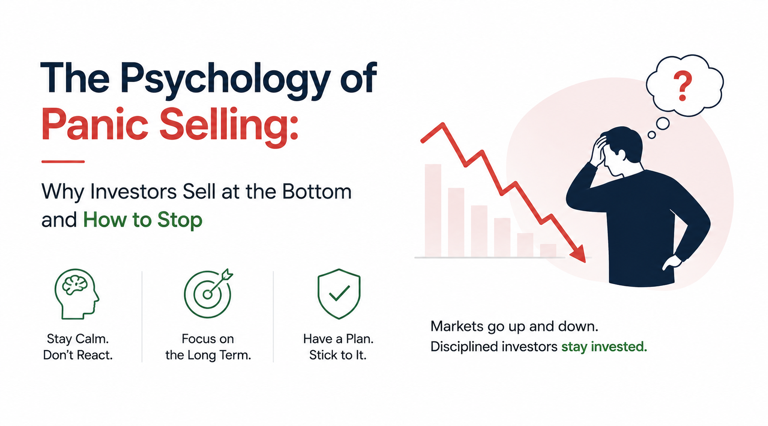
Why Market Crashes Trigger Panic Selling
During market corrections of 20–30%, retail investors face an overwhelming urge to sell. This is not irrationality — it is a hardwired survival response. The human brain processes financial loss in the same neural regions that process physical pain. A ₹1 lakh portfolio loss feels as threatening as a physical danger.
Loss Aversion: The Core Bias
Nobel Prize-winning research by Kahneman and Tversky proved that the pain of a loss is psychologically 2–2.5 times more intense than the pleasure of an equal gain. This means losing ₹1 lakh feels as bad as gaining ₹2–2.5 lakh feels good. This asymmetry explains why investors sell positions at a loss far more readily than they should.
| Investor Action | Rational Explanation | Behavioral Explanation |
|---|---|---|
| Selling during crash | Lock in loss, avoid further pain | Loss aversion triggers fight-or-flight |
| Holding after recovery | Waiting for breakeven | Anchoring to purchase price |
| Buying after big rally | Momentum following | Fear of missing out (FOMO) |
| Not buying the dip | Afraid to catch falling knife | Loss aversion + recency bias |
“Start investing with confidence! Explore
0 demat account
and grow your wealth.”
The Nifty 50 Crash Data: What Happened After Every Crash
| Crash Event | Nifty Fall | Recovery Time | Return if Held (5Y after bottom) |
|---|---|---|---|
| 2008 Global Financial Crisis | -60% | 3 years | +220% |
| 2011 European Debt Crisis | -28% | 1.5 years | +85% |
| 2020 COVID Crash | -38% | 6 months | +130% |
| 2022 Rate Hike Selloff | -17% | 8 months | +55% |
Proven Strategies to Prevent Panic Selling
1. Pre-commit to a written Investment Policy Statement
Write down: your investment horizon, expected market behaviour, and your commitment to not selling during corrections exceeding X%. Review this document during market crashes. The act of having written it creates a commitment contract with yourself.
2. Set Up Automatic SIP — Remove Human Decision
Automated SIP means you don’t have to make a ‘buy’ decision during market crashes. The system buys automatically. This sidesteps the emotional paralysis that prevents buying low.
3. Avoid Checking Portfolio Daily
Research shows investors who check their portfolio daily are 40% more likely to panic sell than those who check monthly. Switch to monthly reviews of your Lemonn portfolio during volatile periods.
When It Is Right to Sell
- Fundamental thesis has changed: management fraud discovered, business model broken
- Position exceeds 10% of portfolio (rebalancing, not fear)
- Genuine liquidity need: medical emergency, not ‘the market looks scary’
Disclaimer
The stocks mentioned in this article are not recommendations. Please conduct your own research and due diligence before investing. Investment in securities market are subject to market risks, read all the related documents carefully before investing. Please read the Risk Disclosure documents carefully before investing in Equity Shares, Derivatives, Mutual fund, and/or other instruments traded on the Stock Exchanges. As investments are subject to market risks and price fluctuation risk, there is no assurance or guarantee that the investment objectives shall be achieved. Lemonn (Formerly known as NU Investors Technologies Pvt. Ltd) do not guarantee any assured returns on any investments. Past performance of securities/instruments is not indicative of their future performance.
Related Posts



Download Lemonn
Download my app for share market trading, ipo investment, trading account, and all your investment needs.