Understanding Promoter Holding and Its Impact on Stock Performance
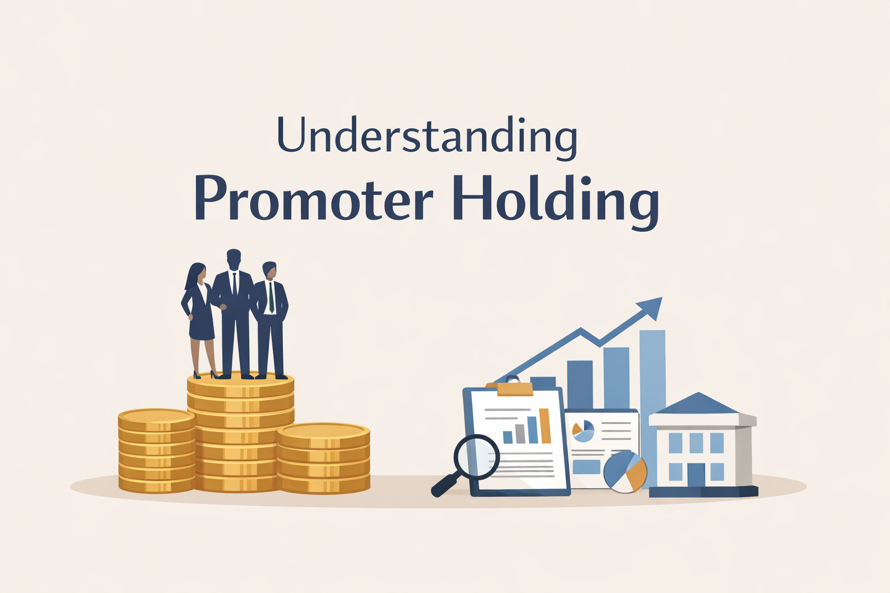
Ask any seasoned Indian investor what they check before buying a stock. Earnings come up. Debt levels are mentioned. Valuation multiples show up quickly. But somewhere in that conversation, almost instinctively, one variable is always there, promoter holding.
It sits quietly inside quarterly filings. It rarely gets headlines. Yet when it moves sharply, markets react faster than they react to revenue growth.
That tells you something.
Promoter holding is not just a percentage. It is a signal. Sometimes it signals conviction. Sometimes it signals caution. Sometimes it signals nothing at all, and that is where investors get it wrong.
A high promoter stake can indicate strong alignment. It can also mean low liquidity. A falling stake can reflect diversification. It can also reflect stress. The number alone does not decide the story. The context does.
If you understand how promoter holding works in Indian markets, under SEBI disclosure rules, minimum public shareholding norms, and governance standards, you stop reacting emotionally. You start interpreting strategically.
Let’s go layer by layer.
Promoter Holding and Its Importance to Investors
In India, every listed company must disclose its shareholding patterns on a quarterly basis. These filings break down ownership into promoters, institutions, foreign investors, and public shareholders. Investors often scroll straight to one column: promoter holding percentage.
Why does this number matter so much?
Because ownership concentration influences control, accountability, and long-term thinking. When promoters own a large chunk of equity, their wealth rises and falls with the company’s fortunes. That alignment reduces short-term temptation.
But importance goes deeper than alignment. Promoter holding influences structure.
Here’s why investors track it closely:
- It indicates how much control promoters retain over board decisions
- It affects free float and trading liquidity
- It signals promoter conviction when the stake increases
- It raises caution when the stake declines sharply
- It shapes institutional participation comfort
- It helps assess governance stability
Now consider liquidity. If promoters hold 70 percent, only 30 percent remains available for public trading. Lower free float can amplify volatility. A relatively small demand surge can push the price sharply upward. A sudden selling wave can pull it down just as quickly.
Institutions often prefer sufficient free float for smoother entry and exit. Excessively concentrated ownership can limit large-scale capital participation.
At the same time, very low promoter holding may weaken strategic stability. If promoters hold only 15 percent, external pressures may influence decisions more easily.
That balance, not too low, not excessively high, often creates comfort. This explains how promoter holding influences more than just optics. It shapes the entire trading ecosystem around the stock.
Promoter of a Company
A promoter in India is not simply a founder. SEBI defines promoters based on control and influence. A person or group qualifies as a promoter if they control management decisions or shape policy direction.
Promoters may sit on the board. They may guide acquisitions. They may define capital allocation priorities. Their role extends beyond ownership. That is why their stake matters.
If promoters increase their stake during market weakness, investors read that as a sign of conviction. If they gradually reduce their stake over time and communicate transparently, markets may interpret this as portfolio diversification.
However, if promoters aggressively promote without a clear rationale, investors question their intent. Promoters must disclose share sales, acquisitions, pledges, and reclassifications. These disclosures create transparency, but interpretation still requires judgment.
Ownership without integrity means little. Ownership with disciplined governance builds trust. Understanding who the promoter is and how they behave gives meaning to promoter holding numbers.
“Start investing with confidence! Explore
0 demat account
and grow your wealth.”
Promoter Holding
At its simplest, promoter holding equals the percentage of total outstanding shares owned by promoters.
If a company has 100 million shares and promoters own 60 million, promoter holding equals 60 percent. But that percentage influences several structural dimensions.
First, it determines voting power. Above 50 percent, promoters control special resolutions. Between 25 and 50 percent, they still retain significant influence. Below 25 percent, control weakens.
Second, it influences free float. Higher promoter holding reduces tradable supply. Lower free float increases price sensitivity. Third, it affects takeover vulnerability. Companies with strong promoter ownership resist hostile acquisitions easily.
SEBI mandates a minimum 25 percent public shareholding for most listed companies. Therefore, promoter holding is typically capped at 75 percent, unless an exemption applies. Changes in promoter holding often drive short-term price movement. A small increase may trigger optimism. A small decrease may spark speculation.
But single-quarter data rarely tells the whole story. Multi-quarter trends reveal more. When analyzing promoter holding, investors should always zoom out before drawing conclusions.
High Promoter Stake & Low Promoter Stake
High promoter stake often reassures investors. It signals that founders remain invested in long-term outcomes. It aligns incentives naturally.
However, very high concentrations can create liquidity constraints. Thin free float magnifies volatility. Institutions sometimes avoid stocks with free-float limits that constrain position sizing.
On the other hand, a lower promoter stake does not necessarily imply weakness. Many professionally managed Indian companies operate with dispersed ownership structures and strong institutional presence.
Market interpretation depends on:
- Industry maturity
- Governance standards
- Financial performance
- Institutional participation
Remember, context is more important than percentage.
Should I buy stocks of companies with a higher promoter holding percentage?
Higher promoter holding can indicate alignment, but it is not a substitute for financial analysis. Investors must evaluate profitability, debt levels, competitive positioning, and management credibility.
High promoter stake in a stagnating company does not guarantee returns. On the other hand, a moderate promoter stake in a fast-growing business may deliver superior performance. Use promoter holding as a filter, not as the sole deciding factor.
Increasing and Decreasing Trends in Promoter Holdings
Trend analysis adds depth.
When promoter holding increases gradually through open-market purchases, investors often interpret that as strong conviction. Promoters buying during corrections strengthen investor confidence.
When stake declines steadily, investors ask why. Compliance adjustments and institutional placements may explain reductions. Sudden, unexplained declines create anxiety.
Trend tells the story. Single data points create noise.
Monitoring how promoter holding evolves over several quarters provides far better insight than reacting instantly.
Some Exceptions to the Rule
Exceptions exist.
Government-owned enterprises often maintain high promoter holding, yet performance depends on operational efficiency rather than ownership concentration.
Large IT firms may operate successfully with a moderate promoter stake and strong professional management.
Private equity exits can temporarily reduce promoter or strategic ownership without affecting business fundamentals.
Ownership structure alone never defines performance. Execution always does.
Takeaway
Promoter holding acts as a governance lens. It reveals control structure, alignment, and liquidity dynamics. It influences perception quickly because investors associate ownership with accountability.
Yet, promoter stake must be interpreted with balance. A high stake may signal commitment. Low stake may improve liquidity. Increase stake may build confidence. Falling stake may demand context.
Combine promoter holding analysis with earnings strength and capital discipline. Numbers inform. Context clarifies.
Conclusion
In Indian markets, promoter holding remains one of the most closely watched ownership metrics. It shapes how investors assess alignment, control, and long-term intent.
But promoter ownership does not guarantee performance. Strong earnings, disciplined capital allocation, and governance standards ultimately drive returns.
Ownership structure influences narrative. Business execution determines outcome. Investors who understand this distinction avoid overreacting to quarterly percentage changes. They evaluate trend, intent, and fundamentals together.
That balanced approach turns promoter data from headline noise into strategic insight.
FAQs:
Q. How does promoter holding affect stock price?
Promoter holding shapes perception first, price next. When promoters increase stake, markets often read conviction and prices may firm up. When promoters reduce stake sharply, sentiment cools quickly. High ownership also shrinks free float, which can exaggerate both rallies and corrections.
Q. Is it good if promoter holding is high?
High promoter holding often signals strong alignment. Promoters with substantial skin in the game usually think long term. That builds comfort. However, extremely high concentration may restrict liquidity. Investors should balance ownership strength with governance quality and earnings consistency.
Q. Is 75% promoter holding good?
Seventy-five percent sits at the regulatory ceiling for most Indian companies. Such promoter holding ensures decisive control. It also leaves a limited public float. Reduced liquidity can intensify price swings during heavy buying or selling.
Q. What if promoter holding is more than 70%?
When promoter holding crosses 70 percent, control remains tight and concentrated. This can signal commitment and stability. At the same time, fewer shares circulate in the market. Limited supply may create sharper volatility when sentiment shifts.
Disclaimer
The stocks mentioned in this article are not recommendations. Please conduct your own research and due diligence before investing. Investment in securities market are subject to market risks, read all the related documents carefully before investing. Please read the Risk Disclosure documents carefully before investing in Equity Shares, Derivatives, Mutual fund, and/or other instruments traded on the Stock Exchanges. As investments are subject to market risks and price fluctuation risk, there is no assurance or guarantee that the investment objectives shall be achieved. Lemonn (Formerly known as NU Investors Technologies Pvt. Ltd) do not guarantee any assured returns on any investments. Past performance of securities/instruments is not indicative of their future performance.
Related Posts


Download Lemonn
Download my app for share market trading, ipo investment, trading account, and all your investment needs.