Understanding inflation and its impact on investments
Introduction
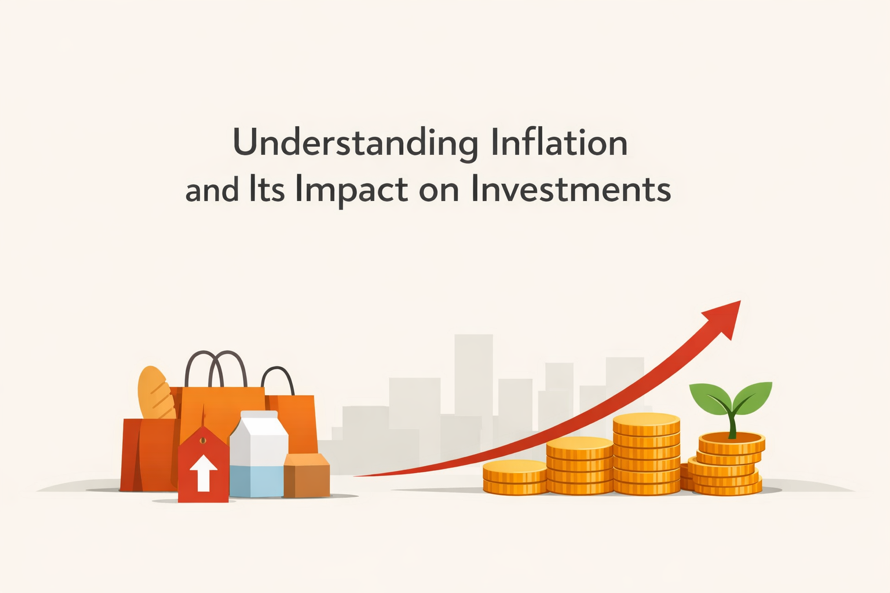
₹10 lakh in 2010 could run a household for years. Today, that same amount disappears much faster. The number stays the same. Its power does not. This gap defines inflation, and understanding inflation explains why many people feel financially stable on paper yet pressured in daily life. Salaries rise. Savings grow. Still, expenses move faster than expected. School fees double within a decade. Healthcare costs climb sharply. Rent increases quietly every few years. Inflation turns time into a financial variable. Money loses strength when it stays idle. Investments that grow alongside the economy help preserve that strength. Investors who grasp this early stop thinking only about saving. They start thinking about keeping their money relevant in the future, when prices look very different from today.
Inflation And Its Impact On Investments
Inflation shows itself in numbers people already know. ₹50 a litre petrol price from years ago now feels distant. A restaurant bill that once stayed under ₹1,000 will be hard to find now. These changes reflect a steady upward movement in prices. Understanding inflation means recognizing that this increase never stops completely. It slows. It accelerates. It pauses briefly. But it always moves over time.
India measures inflation through the Consumer Price Index, which tracks the prices of everyday essentials. Food prices often drive the biggest swings. A tomato shortage can double prices within weeks. Fuel price increases ripple across transport, delivery, and manufacturing. Soon, everything from groceries to online orders reflects that shift. Inflation spreads quietly, yet widely.
Cash struggles in this environment. Interest from savings accounts or fixed deposits adds predictability, but inflation eats into that improvement. ₹5 lakh saved today may look reassuring. Ten years later, its reach shrinks. It covers fewer months of expenses. This reality changes how investors approach financial planning.
Businesses adjust faster. Companies increase prices to protect margins. Their revenues rise alongside inflation. Equity markets often reflect this adjustment over time. Investors holding equity mutual funds indirectly participate in that growth. Gold responds differently. It attracts attention when inflation rises or the currency weakens. Its value often adjusts when the purchasing power of money declines.
Property follows its own path. Land becomes scarce in expanding cities. Construction materials cost more over time. Nevertheless, housing demand continues to rise. These factors gradually push property values upward.
Currency strength is closely linked to inflation levels. Higher domestic inflation often weakens the rupee. Imported goods become expensive. Investors holding foreign assets sometimes benefit when converting those investments back into rupees.
Understanding inflation changes how investors evaluate financial progress. A rising account balance alone means very little. What matters is how much future stability that balance can actually provide.
“Start investing with confidence! Explore
0 demat account
and grow your wealth.”
Key Benefits of Understanding Inflation And Its Impact On Investments
Understanding inflation helps investors evaluate returns more realistically. A fixed deposit offering 6 percent may appear attractive initially. However, inflation at similar levels limits actual financial improvement. Investors who recognize this difference make more informed decisions.
Long-term planning becomes clearer. Retirement planning requires projecting future expenses accurately. Medical costs, daily living expenses, and housing costs increase steadily. Investors who consider inflation build portfolios capable of supporting these future needs.
Investment selection improves significantly. Equity markets reflect business growth, which often moves alongside inflation. Commodities such as gold and oil respond directly to price increases. Property values often reflect urban growth and rising construction costs. Investors distribute funds across these assets thoughtfully.
Interest rate changes also become easier to understand. When inflation rises, interest rates usually follow. Loan EMIs increase. Deposit returns may improve. Investors who understand inflation adjust investment timing accordingly.
Inflation awareness strengthens discipline. Many investors panic when markets fluctuate. Understanding inflation helps investors recognize long-term patterns rather than react to short-term movements.
Tax efficiency also improves. Long-term investments often receive favorable tax treatment. Investors who combine inflation awareness with tax planning preserve more wealth.
Most importantly, understanding inflation helps maintain purchasing power. Investors begin focusing on financial capability instead of simply growing account balances.
Step-by-Step Guide
Step 1: Getting started
Start by observing personal expenses. Compare grocery bills from last year. Notice fuel price changes. These everyday observations provide a practical understanding of inflation.
Check official inflation data occasionally. RBI announcements and financial news provide simple updates. This helps connect personal experience with national trends.
Set financial goals based on future cost estimates. Education expenses, retirement living costs, and healthcare requirements increase steadily over time.
Step 2: Required documents
Prepare essential identification documents. PAN card, Aadhaar card, and bank account remain necessary for investment access.
Open a demat account for stock and bond investments. Register with mutual fund platforms for systematic investment plans.
Link your bank account to investment accounts. This allows smooth fund transfers and regular investing.
Step 3: How to execute or invest
Select investments capable of growing alongside inflation. Equity mutual funds provide exposure to business expansion. Government schemes provide stability. Gold offers balance during inflation cycles.
Invest regularly. Monthly investing builds discipline and reduces dependence on market timing.
Diversify investments. Spread funds across equity, fixed income, and physical assets.
Avoid keeping excessive idle cash. Idle cash gradually loses purchasing strength.
Step 4: Monitoring and exit strategy
Review investment performance periodically. Compare returns with inflation trends.
Adjust allocation if certain investments lag behind inflation over extended periods.
Withdraw investments gradually when financial goals approach.
Plan exits carefully to maintain tax efficiency and preserve returns.
Risks and Challenges
Inflation introduces several financial risks that investors must understand clearly.
• Rising interest rates may reduce bond prices and fixed income investment value.
• Stock markets may experience sudden volatility during inflation shifts.
• Currency depreciation may reduce purchasing strength.
• Fixed deposits may deliver returns close to inflation levels.
• Government policy changes may influence interest rates and investment performance.
• Certain sectors may struggle when production costs rise sharply.
• Real estate markets may experience uneven growth across locations.
• Commodity prices may fluctuate significantly.
• Emotional reactions may lead investors toward impulsive decisions.
• Inflation uncertainty may complicate long-term planning.
Expert Tips for Indians
Indian investors operate in a rapidly growing economy, influenced by both global and domestic factors.
• Follow RBI inflation announcements regularly.
• Maintain consistent exposure to equity mutual funds.
• Invest in Public Provident Fund and government savings schemes.
• Maintain partial allocation in gold.
• Invest regularly through SIPs.
• Review investment portfolio annually.
• Consider property investments carefully based on location growth.
• Focus on long-term financial goals.
• Avoid excessive idle savings.
• Maintain diversified investment approach
Conclusion
Inflation influences financial life throughout. Prices increase gradually. Purchasing strength changes slowly. Investors who ignore inflation often realize its impact only after several years. Understanding inflation provides clarity. It explains why certain investments perform better over time and why idle money gradually loses value.
India’s economy continues to expand, and inflation remains part of that growth process. Equity markets reflect corporate expansion. Gold responds to shifts in currency and the economy. Government schemes provide stability. Property reflects urban expansion.
Investors who understand inflation begin thinking beyond short-term returns. They plan based on future costs. They build diversified portfolios. They review investments regularly. This awareness strengthens financial security and ensures long-term wealth maintains its true value.
FAQs:
What is understanding inflation and its impact on investments?
It means you are getting an idea of how the rising prices or money’s reducing power will impact your investment value. It makes you aware of how and where you should invest to keep your investment valuable.
How does understanding inflation and its impact on investments work in India?
In India, inflation impacts routine life. It impacts food, housing, fuel, and other routine products. So when you understand inflation, you understand how the government’s policy shifts will impact certain investments. When you know this, you can make your own decisions much better.
What are the benefits of understanding inflation and its impact on investments?
The best part is that understanding inflation helps you plan better. You know exactly the actual worth of your investment after getting an idea about inflation.
Are there any risks involved in understanding inflation and its impact on investments?
A lot! First, inflation brings uncertainty. Equity prices, interest rates, and currency’s value changes drastically with inflation. So inflation has to be dealt with accordingly.
Who should consider understanding inflation and its impact on investments?
Anyone who is earning or investing must understand inflation. Without that, it’s almost impossible to plan for the future properly.
How can I get started with understanding inflation and its impact on investments?
The best way is to learn about inflation trends. Then, based on that understanding, diversify your investments to build a cushion, even when inflation beats estimates.
Disclaimer
The stocks mentioned in this article are not recommendations. Please conduct your own research and due diligence before investing. Investment in securities market are subject to market risks, read all the related documents carefully before investing. Please read the Risk Disclosure documents carefully before investing in Equity Shares, Derivatives, Mutual fund, and/or other instruments traded on the Stock Exchanges. As investments are subject to market risks and price fluctuation risk, there is no assurance or guarantee that the investment objectives shall be achieved. Lemonn (Formerly known as NU Investors Technologies Pvt. Ltd) do not guarantee any assured returns on any investments. Past performance of securities/instruments is not indicative of their future performance.
Related Posts
Download Lemonn
Download my app for share market trading, ipo investment, trading account, and all your investment needs.