
India GDP Base Year Change: History, Data and Impact
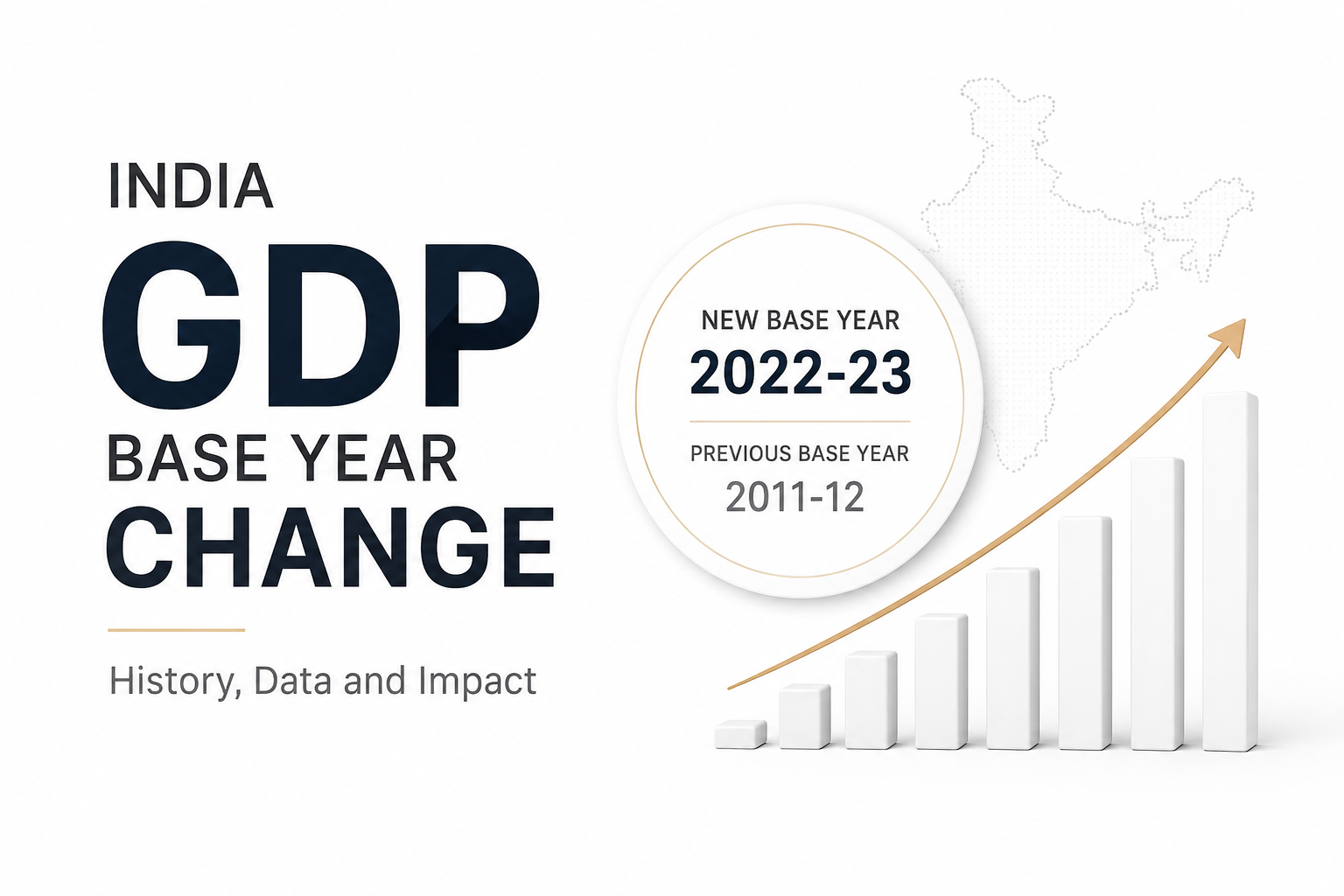
India has changed the GDP base year from 2011-12 to 2022-23, with the new GDP series released on February 27, 2026. The change does not mean India suddenly became richer or poorer. Instead, it updates the way economic activity is measured so GDP better reflects the structure of today’s economy.
The Ministry of Statistics and Programme Implementation (MoSPI) is responsible for the exercise through India’s official statistical system. No private company calculates India’s official GDP, although financial and operational data from lakhs of companies, government databases, surveys and other sources feed into the calculation.
The revision matters because changing the base year can alter historical GDP estimates, sector growth rates and important ratios such as debt-to-GDP, fiscal deficit-to-GDP and tax-to-GDP.
What is the GDP base year?
The GDP base year is the benchmark year whose prices are used to calculate real GDP.
Suppose the price of a product rises from ₹100 to ₹120, but the country produces exactly the same quantity. Nominal GDP would increase because the price increased, even though actual production did not.
Real GDP tries to remove this price effect.
A base year provides the reference prices needed to measure how much economic output has actually changed over time. This is why GDP at constant prices is commonly called real GDP.
As an economy changes, however, an old base year gradually becomes less representative.
India’s economy in 2026 looks very different from its economy in 2011. Digital services have expanded, corporate databases have improved, consumption patterns have changed, new businesses have emerged and better administrative data has become available.
That creates the need for a new GDP series.
What is India’s new GDP base year?
India’s new GDP base year is 2022-23, replacing 2011-12.
MoSPI released the new annual and quarterly National Accounts series on February 27, 2026. According to the government, 2022-23 was chosen because it was a relatively normal post-COVID year and robust data was available across different parts of the economy.
The government had wanted to update the base periodically, but several potential years were unsuitable.
For example:
- 2017-18 coincided with the adjustment following the introduction of GST.
- 2019-20 and 2020-21 were affected by the COVID-19 shock.
- 2021-22 saw unusually high growth partly because of the post-pandemic base effect.
- 2022-23 provided a more normal benchmark with better data availability.
So, 2022-23 was eventually selected.
“Start investing with confidence! Explore
0 demat account
and grow your wealth.”
Who changes the GDP base year in India?
The Ministry of Statistics and Programme Implementation (MoSPI) oversees India’s official GDP estimates.
Technical work on the latest revision was supported by the Advisory Committee on National Accounts Statistics (ACNAS), chaired by Professor B.N. Goldar. Five sub-committees examined areas such as new data sources, methodology, constant-price estimates, regional accounts and updates to international national accounting standards.
The process also draws on expertise and data from institutions across government and the wider statistical system.
These include bodies such as:
- Ministry of Corporate Affairs
- Reserve Bank of India
- Central government ministries and departments
- State governments
- NITI Aayog
- Academic and research institutions
- National statistical and survey systems
So, India’s GDP is not calculated by one private company.
Private companies do matter, however, because their financial data forms an important input for measuring the corporate part of the economy.
Which companies are involved in India’s GDP calculation?
There is an important distinction here.
Companies do not decide India’s GDP or its base year. MoSPI produces the official estimates.
Instead, corporate financial information is one of the datasets used to estimate economic activity.
A good example comes from the previous 2011-12 GDP series.
Under the older 2004-05 series, estimates for the private corporate sector relied partly on an RBI sample study covering around 2,500 companies. When India moved to the 2011-12 series, the methodology expanded substantially through the use of the Ministry of Corporate Affairs’ MCA21 database.
Government information released after that revision said corporate-sector data covering about 5.5 lakh companies was used across mining, manufacturing and services.
This illustrates why changing a GDP base year can be much more significant than simply replacing one date with another.
A new series can also change:
- the number of businesses covered
- classifications used for economic activity
- administrative databases used
- sector-specific indicators
- inflation-adjustment methods
- estimates of the formal and informal economy
- treatment of corporate activity
In other words, a base-year revision can also be a major statistical upgrade.
Why does India change the GDP base year?
There are four main reasons.
1. To reflect changes in the economy
An economy does not remain structurally identical for decades.
Some industries grow rapidly, others shrink, new products and services appear, technology changes business models and the relative importance of sectors changes.
A newer base year gives the statistical system a more relevant benchmark.
2. To use newer and better data
Modern administrative systems can provide information that simply did not exist when an older GDP series was designed.
The 2011-12 revision, for example, introduced much wider use of MCA21 corporate filings.
The 2022-23 revision similarly incorporates newer data sources, classifications and methodological improvements.
3. To improve inflation adjustment
Real GDP is intended to measure changes in actual economic activity rather than simply changes in prices.
That requires statisticians to separate price movements from changes in output.
The latest series includes improvements in constant-price estimation. India has also moved toward more sophisticated deflation methods in parts of manufacturing, including the use of double deflation for various industries.
4. To improve international comparability
India’s national accounts follow internationally recognised statistical principles.
The 2022-23 series continues to be prepared in line with the United Nations System of National Accounts, with the government stating that India’s estimates are prepared according to SNA 2008.
History of GDP base year changes in India
India has revised its National Accounts base year several times as data availability and the structure of the economy have changed.
| GDP series | Replaced by | New series introduced |
|---|---|---|
| 1948-49 | 1960-61 | August 1967 |
| 1960-61 | 1970-71 | January 1978 |
| 1970-71 | 1980-81 | February 1988 |
| 1980-81 | 1993-94 | February 1999 |
| 1993-94 | 1999-2000 | January 2006 |
| 1999-2000 | 2004-05 | January 2010 |
| 2004-05 | 2011-12 | January 2015 |
| 2011-12 | 2022-23 | February 2026 |
MoSPI’s historical documentation records the sequence through the 2004-05 revision, while the 2011-12 series was introduced in January 2015. The latest 2022-23 series was released on February 27, 2026.
This history also shows that GDP base-year revisions are not unusual. They are part of maintaining a statistical system as an economy evolves.
What happened when the GDP base year changed to 2011-12?
The 2004-05 to 2011-12 revision is particularly useful for understanding why a base-year change matters.
The new series was released in January 2015.
It did much more than update prices.
Major changes included:
- use of the MCA21 corporate database
- adoption of elements of SNA 2008
- broader coverage of economic activity
- newer survey and census data
- institutional-sector estimates
- greater use of the enterprise approach
- presentation of industry output through GVA at basic prices
- GDP presented at market prices
The impact could be seen in the reported growth numbers.
Under the newly introduced 2011-12 series, real GDP growth was estimated at 5.1% for 2012-13 and 6.9% for 2013-14.
The episode demonstrated an important point: changing the GDP series can alter the historical picture because statisticians may be changing not only the reference prices but also datasets, coverage and methodology.
Does changing the base year increase GDP?
Not automatically.
A common misconception is that moving to a newer base year simply increases GDP.
It can result in estimates being revised upward or downward.
The direction depends on factors such as:
- new data
- revised sector weights
- improved coverage
- changes in methodology
- updated price measures
- revised estimates of production and consumption
A recent example makes this clear.
The government stated that Q1 FY2025-26 GDP at current prices had originally been estimated at ₹86.05 lakh crore in August 2025 under the then-prevailing 2011-12 series.
After the introduction of the 2022-23 series, that estimate became ₹80.32 lakh crore in February 2026. It was subsequently updated to ₹80.44 lakh crore and later ₹80.00 lakh crore as additional indicators and methodological updates were incorporated.
This does not mean trillions of rupees of economic activity suddenly disappeared.
It means the statistical estimate changed because the measurement framework and underlying information changed.
How does a GDP base-year change affect historical GDP data?
This is one of the most important consequences of a base-year revision.
You cannot simply take GDP growth from the old series and directly compare it with figures from a fundamentally different new series.
MoSPI therefore produces what is known as a GDP back series.
What is a GDP back series?
A back series recalculates historical GDP figures so older years are made as consistent as possible with the methodology of the new series.
For the 2022-23 revision, MoSPI said the initial annual and quarterly estimates would cover 2022-23 onward. The new back series is expected by December 2026.
The government has indicated that, following Indian practice, historical estimates can be recalculated using the new methodology up to the previous base year. Earlier periods can then be extended using a linking technique known as splicing, although the final methodology for the latest back series is to be decided with the relevant advisory committee.
This means researchers comparing India’s growth over long periods should pay close attention to which GDP series they are using.
What is splicing in GDP data?
Splicing is a statistical technique used to connect an older GDP series with a newer one.
Imagine that detailed data needed for the 2022-23 methodology is available for recent years but not for the 1960s.
Statisticians cannot recreate databases that never existed.
Instead, historical growth patterns from older series can be linked to the newer series to produce a longer, reasonably comparable dataset.
India used this type of approach in earlier back-series exercises as well.
The limitation is important: very old GDP figures reconstructed under a new base cannot always have the same data quality as recent estimates.
How does a GDP base-year change affect companies?
The direct effect on an individual company’s revenue, profit or market value is usually none.
Changing the GDP base year is a statistical change. It does not rewrite a company’s audited financial statements.
The indirect effects can still be important.
Sector growth rates can change
Suppose improved data shows that financial services, digital services or formal manufacturing contribute more or less to the economy than previously estimated.
That can change the measured growth and economic importance of those industries.
Companies, analysts and investors using sector-level GDP or GVA data may therefore need to update their models.
Market-size estimates can change
Businesses frequently use GDP and sector GVA to estimate:
- total addressable markets
- industry penetration
- consumption trends
- regional opportunities
- long-term demand
When historical GDP data changes, some of these assumptions may need recalibration.
GDP-based financial ratios can change
Many important indicators use nominal GDP as the denominator.
For example:
Debt-to-GDP = Government debt ÷ Nominal GDP × 100
If estimated nominal GDP changes while debt remains unchanged, the debt-to-GDP ratio also changes.
The same logic applies to:
- fiscal deficit-to-GDP
- tax-to-GDP
- credit-to-GDP
- market capitalisation-to-GDP
- government spending-to-GDP
- corporate profits-to-GDP
The 2015 base revision itself noted that changes in GDP levels could affect indicators such as public expenditure, taxes and public debt when expressed relative to GDP.
Does the base-year change affect stock market valuations?
Not mechanically.
A company’s share price does not need to change because MoSPI changed the GDP base year.
However, investors use GDP data to understand economic growth, corporate earnings potential and sector trends.
A revision can therefore change the macroeconomic story investors use when analysing sectors.
For example, an investor might discover that a particular industry has historically grown faster or slower under the revised methodology.
That can influence forecasts, but it does not directly change a company’s cash flow or earnings.
Does changing the GDP base year affect government finances?
It can affect how government finances look relative to the size of the economy.
Consider a simplified example.
Suppose government debt is ₹180 lakh crore.
If nominal GDP is estimated at ₹300 lakh crore:
Debt-to-GDP = 60%
If improved GDP measurement revises nominal GDP to ₹310 lakh crore while debt remains ₹180 lakh crore:
Debt-to-GDP = about 58.1%
The government’s actual debt has not changed. The denominator has.
The same effect can occur with the fiscal deficit.
This is one reason economists examine base-year revisions carefully rather than focusing only on headline GDP growth.
What changed in the 2022-23 GDP series?
The latest revision incorporates a wider package of improvements rather than merely replacing 2011-12 prices with 2022-23 prices.
According to MoSPI, the new series includes:
- newer data sources
- updated classifications
- methodological improvements
- conceptual improvements
- improved coverage
- updated approaches to constant-price estimates
The statistical system has also incorporated newer price indicators and administrative information as the series has been updated.
This should help GDP estimates better reflect India’s present economic structure.
Why wasn’t the GDP base year changed earlier?
The gap between 2011-12 and 2022-23 is unusually long compared with the government’s objective of more frequent revisions.
MoSPI has said its normal endeavour is to revise the GDP base periodically, around every five years in line with international recommendations.
But choosing a base year is not as simple as picking the latest year.
A suitable year should ideally represent relatively normal economic conditions and have strong underlying datasets.
GST implementation complicated the use of 2017-18. Then the pandemic severely distorted economic activity around 2019-20 and 2020-21, while 2021-22 contained an unusually strong rebound from the COVID period.
That made 2022-23 a more suitable choice.
Are CPI and IIP base years also changed?
Yes. GDP is not the only economic indicator that requires periodic rebasing.
India also periodically revises indicators such as the:
- Consumer Price Index (CPI)
- Index of Industrial Production (IIP)
- national accounts and related economic aggregates
As part of the latest statistical update, GDP moved to 2022-23, and the new IIP series also uses 2022-23 as its base year. CPI underwent a separate base revision to 2024.
Updating these indicators helps keep the broader statistical framework aligned with changing production and consumption patterns.
What should investors remember about GDP base-year revisions?
The most important lesson is simple: do not treat a base-year change as evidence by itself that the economy has suddenly accelerated or slowed down.
When a new GDP series appears, check:
- Whether the base year changed.
- Which new datasets were introduced.
- Whether the methodology changed.
- Whether sector classifications or coverage changed.
- Whether previous years were revised.
- Whether you are comparing figures from the same GDP series.
- Whether a back series is available.
This is especially important when analysing long-term GDP growth.
A chart combining growth rates from incompatible series can produce misleading conclusions.
What happens next with India’s historical GDP data?
The 2022-23 series gives India a newer benchmark, but the historical exercise is not yet complete.
MoSPI has said the back series is expected by December 2026.
That release will be particularly important for economists, investors and researchers because it should make it easier to compare India’s economic performance before and after the new base year.
Until then, care is required when combining historical data from the 2011-12 series with the new 2022-23 series.
FAQs
What is the current GDP base year of India?
India’s current GDP base year is 2022-23. It replaced the previous 2011-12 base year, with the new series released on February 27, 2026.
Who calculates GDP in India?
India’s official GDP estimates are prepared through the national statistical system under the Ministry of Statistics and Programme Implementation (MoSPI). Expert committees, government agencies, states and multiple administrative and survey datasets contribute to the process.
Which company calculates India’s GDP?
No private company calculates or determines India’s official GDP. MoSPI produces the official estimates. However, financial information reported by private and public companies can be used as source data when estimating corporate-sector economic activity.
Why was India’s GDP base year changed from 2011-12 to 2022-23?
The change allows GDP to better reflect the current structure of India’s economy, incorporate newer datasets and classifications, improve methodology and use a more recent reference period. MoSPI considered 2022-23 a suitable normal post-COVID year with robust data availability.
Does changing the GDP base year change GDP growth?
It can. A base-year revision may introduce new data, sector coverage, classifications and methodologies in addition to changing reference prices. As a result, both GDP levels and historical growth estimates can differ from the previous series.
Does a new GDP base year make India’s economy bigger?
Not necessarily. GDP estimates can move either upward or downward after rebasing. The purpose is to improve measurement, not to increase the reported size of the economy.
What happens to old GDP data after the base year changes?
Historical estimates are eventually linked or recalculated to create a back series that is more comparable with the new methodology. MoSPI expects the back series for the 2022-23 GDP series to be released by December 2026.
How many times has India’s GDP base year changed?
Starting with the 1948-49 series, India’s National Accounts have subsequently used base years including 1960-61, 1970-71, 1980-81, 1993-94, 1999-2000, 2004-05, 2011-12 and now 2022-23.
Does the GDP base-year change affect companies?
It does not directly change a company’s sales, profits or balance sheet. However, it can change sector growth estimates, market-size calculations and GDP-based financial ratios used by companies, governments and investors.
Why is a recent GDP base year better?
A recent base year uses prices and economic structures that are more representative of the current economy. It also provides an opportunity to incorporate newer surveys, administrative databases, classifications and statistical methods.
Key takeaways
- India’s GDP base year has changed from 2011-12 to 2022-23.
- The new GDP series was released on February 27, 2026.
- MoSPI oversees India’s official GDP estimates. No private company determines India’s GDP.
- Company financial data is nevertheless an important input into measuring corporate economic activity.
- India has periodically changed its GDP base year since the original 1948-49 series.
- A base-year revision can change GDP levels, growth rates and the estimated contribution of individual sectors.
- It can also affect ratios such as debt-to-GDP, fiscal deficit-to-GDP and tax-to-GDP without changing the numerator itself.
- The 2011-12 revision was significant because it expanded corporate-sector measurement using the MCA21 database.
- A new base year does not automatically make GDP higher. Estimates can be revised in either direction.
- Historical data needs to be recalculated or linked to the new series for meaningful long-term comparisons.
- MoSPI expects the 2022-23 GDP back series by December 2026, making that release important for historical growth analysis.
Disclaimer
The stocks mentioned in this article are not recommendations. Please conduct your own research and due diligence before investing. Investment in securities market are subject to market risks, read all the related documents carefully before investing. Please read the Risk Disclosure documents carefully before investing in Equity Shares, Derivatives, Mutual fund, and/or other instruments traded on the Stock Exchanges. As investments are subject to market risks and price fluctuation risk, there is no assurance or guarantee that the investment objectives shall be achieved. Lemonn (Formerly known as NU Investors Technologies Pvt. Ltd) do not guarantee any assured returns on any investments. Past performance of securities/instruments is not indicative of their future performance.
Related Posts

Download Lemonn
Download my app for share market trading, ipo investment, trading account, and all your investment needs.



