
India FY27 Growth Forecast Raised to 7% After Q1 GDP Jump
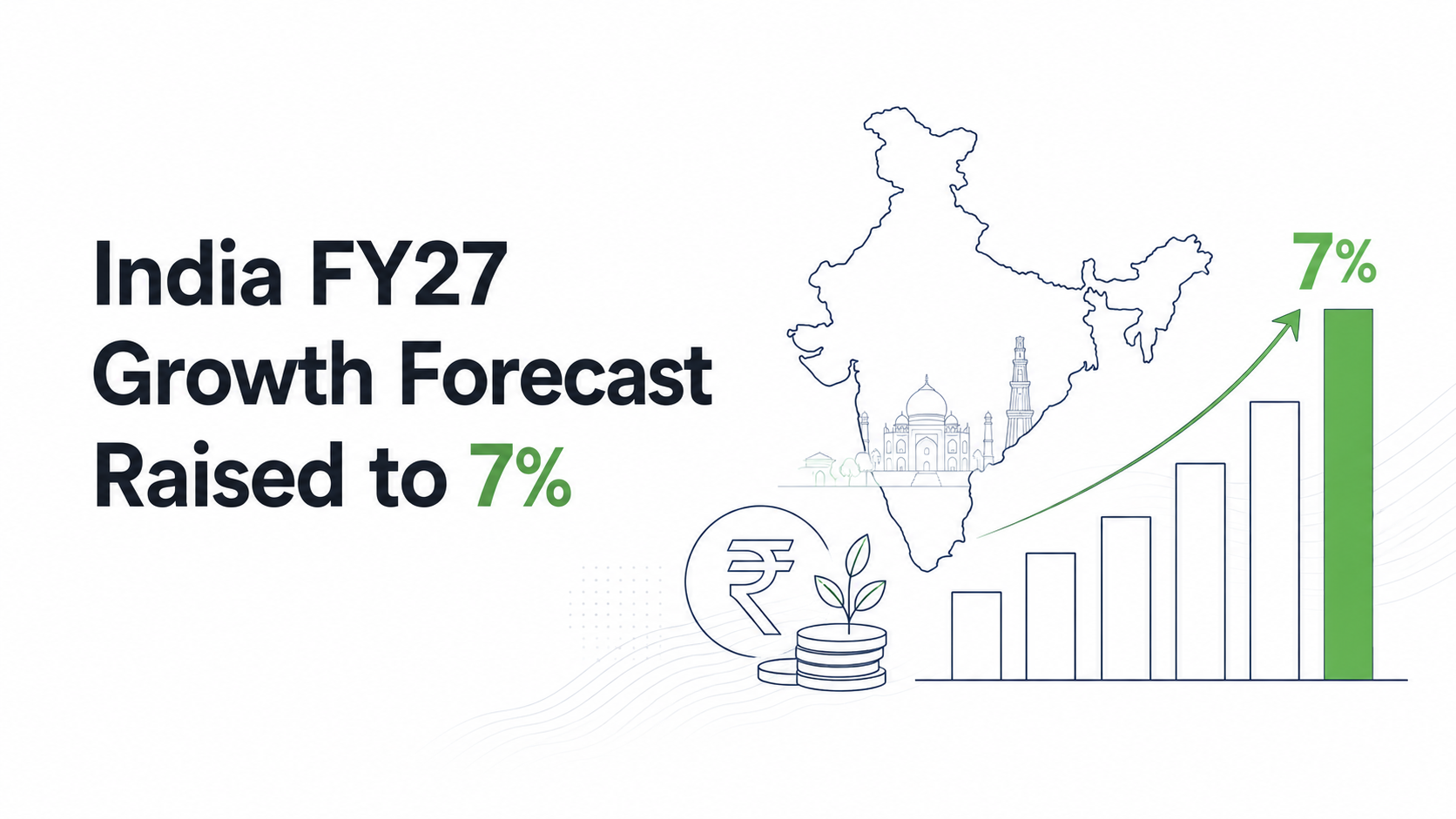
India’s economic growth outlook for FY27 has improved after real GDP expanded 7.8% in the April-June 2026 quarter, beating expectations. Economists and rating agencies have consequently raised their full-year forecasts, with estimates clustering around or above the 7% mark.
The stronger-than-expected first quarter was supported by investment, household consumption, exports, manufacturing and services. Still, inflation, crude oil prices, global demand and weather conditions remain important risks for the rest of the financial year.
India’s Q1 FY27 GDP Growth at a Glance
According to government data, India’s real GDP grew 7.8% in Q1 FY27, compared with 6.9% in the corresponding quarter of FY26. The Q1 performance also exceeded the Reserve Bank of India’s 7% projection for the quarter.
Here are some of the key numbers:
| Indicator | Q1 FY27 |
|---|---|
| Real GDP growth | 7.8% |
| Real GVA growth | 8.2% |
| Investment growth | 11.9% |
| Household consumption growth | 7.1% |
| Export growth | 12.0% |
| Nominal GDP growth | 10.3% |
Real GDP at constant prices was estimated at ₹81.36 lakh crore, while nominal GDP at current prices stood at ₹88.27 lakh crore.
The 7.8% figure was also the highest first-quarter real GDP growth recorded in the four-year period from FY24 through FY27.
Why Has India’s FY27 Growth Forecast Been Raised?
The immediate reason is straightforward. The economy entered FY27 with considerably more momentum than many economists had expected.
Before the Q1 data, the consensus forecast among a group of economists surveyed by The Indian Express was around 6.7% for FY27. Following the GDP release, that consensus moved up to about 7.2%, with individual forecasts ranging from 6.8% to 7.5%.
Several institutions have made notable revisions.
ICRA raised its FY27 GDP growth forecast to 7.1% from 6.7%, while SBI economists increased their projection to 7.3%. Morgan Stanley also raised its forecast to 7.3% from 6.7%.
India Ratings & Research and HDFC Bank have also revised their projections to around or above 7%, according to reports following the GDP release.
“Start investing with confidence! Explore
0 demat account
and grow your wealth.”
What Drove India’s 7.8% GDP Growth?
India’s Q1 performance was not dependent on a single sector. Investment, consumption, exports and activity across manufacturing and services contributed to the expansion.
1. Investment Growth Remained Strong
Investment was one of the clearest drivers.
Gross capital formation increased 11.9% year on year during the quarter. Strong investment matters because spending on factories, machinery, roads and other productive assets can support both current demand and future economic capacity.
Economists at Morgan Stanley pointed to strength in manufacturing and investment as evidence supporting expectations of a broader capital expenditure cycle.
2. Household Consumption Supported Domestic Demand
Household consumption grew 7.1% in Q1 FY27.
This is particularly significant for India because domestic consumption represents a major part of economic activity. Resilient consumer spending can provide some protection when international demand becomes uncertain.
3. Exports Recorded Double-Digit Growth
Exports grew 12% during the quarter, adding another source of momentum.
The trend extended beyond June. According to government data, cumulative merchandise and services exports during April-July were up 13.16% year on year.
That performance is notable given continued uncertainty surrounding global trade and geopolitical tensions.
4. Manufacturing and Services Stayed Resilient
Manufacturing and services were major contributors to the strong first-quarter performance.
Real gross value added, or GVA, increased 8.2%, faster than headline GDP growth. The government attributed the strong start partly to buoyant domestic demand and gains in manufacturing and services.
Industrial momentum also continued into the next quarter, with industrial production rising 6.7% in July.
Why Did GVA Grow Faster Than GDP?
India’s GVA grew 8.2% while GDP increased 7.8% in Q1 FY27.
The difference partly reflects relatively weak growth in net indirect taxes on products. ICRA estimated growth in net indirect taxes at 3.9%, its lowest level in 12 quarters.
In simple terms, GVA measures the value generated by different sectors of the economy, while GDP incorporates taxes on products after subtracting subsidies.
Looking at both indicators can therefore provide a clearer picture of underlying economic activity.
Is 7% Growth Now Guaranteed for FY27?
No. A strong first quarter improves the probability of India achieving around 7% growth, but it does not guarantee that outcome.
The RBI’s August forecast for full-year FY27 growth was 6.7%, even though it had projected 7% growth for the April-June quarter. Its quarterly projections pointed to slower growth of 6.4% in Q2, 6.5% in Q3 and 6.8% in Q4.
That means growth could moderate as the financial year progresses.
The RBI Monetary Policy Committee is scheduled to meet on October 5-7, 2026, when economists expect the central bank to reassess its growth outlook.
What Could Slow India’s Growth in FY27?
Despite the stronger outlook, several risks could affect growth during the remaining three quarters.
Inflation
Retail inflation increased to 4.45% in July from 4.38% in June, putting it above the RBI’s medium-term target of 4% for a second consecutive month.
If inflation remains elevated, the RBI may have less room to support growth through easier monetary policy.
Crude Oil Prices
India is a major importer of crude oil, making the economy sensitive to international energy prices.
Higher oil prices can increase India’s import bill, put pressure on inflation and raise input costs for businesses. Prolonged geopolitical tensions could therefore complicate the growth outlook.
Monsoon and Rural Demand
Agriculture and rural consumption remain sensitive to rainfall.
A weaker-than-expected monsoon could affect crop production and household incomes in rural areas. Conversely, supportive rainfall during the Kharif season would strengthen the case for continued rural demand.
Global Demand
Weak growth in major international markets could eventually weigh on India’s exports.
This is particularly relevant if tighter global financial conditions, trade disruptions or geopolitical tensions persist through the second half of FY27.
Base Effects
India is also comparing upcoming quarters with relatively strong growth periods from the previous year.
That statistical base can make maintaining a 7% to 8% headline growth rate increasingly difficult even if underlying economic activity remains healthy.
What Does the GDP Data Mean for RBI Policy?
The strong GDP numbers reduce immediate concerns about economic growth, potentially allowing the RBI to place greater emphasis on controlling inflation.
The policy repo rate was maintained at 5.25% in August, while the RBI projected inflation at 4.7% in Q2 FY27, followed by 5.9% in Q3 and 5.5% in Q4.
A combination of stronger growth and persistent inflation could make further monetary easing less likely.
The October MPC meeting will therefore be important not only for the RBI’s updated GDP forecast but also for signals about the future direction of interest rates.
What Does 7% Growth Mean for India’s Economy?
Growth around 7% would keep India on a relatively strong economic trajectory, particularly against a challenging global backdrop.
More importantly, the composition of growth matters.
Investment rising 11.9%, household consumption growing 7.1% and exports increasing 12% suggest that Q1 growth was supported by several parts of the economy rather than one temporary factor.
However, headline GDP growth alone does not answer every economic question. Employment creation, household income growth, private investment, inflation and productivity will remain important measures of whether rapid GDP expansion translates into broader improvements in living standards.
Will India Maintain Its Growth Momentum?
The Q1 FY27 GDP numbers have strengthened expectations that India can deliver growth of around 7% or higher for the full year.
The immediate indicators are encouraging. Manufacturing and services have remained strong, investment has recorded double-digit growth, consumer spending has held up and exports have provided additional support.
Still, maintaining that momentum will depend on inflation, energy prices, the monsoon, global demand and investment activity during the remaining quarters.
For now, the 7.8% Q1 GDP print has shifted the discussion from whether India can reach 7% growth to whether the economy can sustain enough momentum to exceed it.
FAQs
What was India’s GDP growth rate in Q1 FY27?
India’s real GDP grew 7.8% year on year in April-June 2026, compared with 6.9% in the same quarter of the previous financial year.
What is India’s GDP growth forecast for FY27?
Several economists have revised their forecasts to around or above 7% following the strong Q1 numbers. The consensus among 10 economists cited by The Indian Express rose to 7.2%, while forecasts ranged between 6.8% and 7.5%.
What is the RBI’s FY27 GDP growth forecast?
As of its August 2026 policy meeting, the RBI projected 6.7% real GDP growth for FY27. The strong Q1 GDP result has increased expectations that this forecast could be revised upward at a subsequent policy meeting.
Why did India’s GDP grow 7.8% in Q1?
Strong investment, household consumption, exports, manufacturing and services supported growth. Investment rose 11.9%, household consumption increased 7.1%, and exports grew 12% during the quarter.
What is the difference between GDP and GVA growth?
GDP measures the total value of final goods and services produced in the economy, including the effect of product taxes and subsidies. GVA measures the value created by individual economic sectors. In Q1 FY27, real GDP grew 7.8% while real GVA increased 8.2%.
What are the biggest risks to India’s FY27 growth?
Key risks include higher crude oil prices, persistent inflation, weaker global demand, adverse monsoon conditions and an unfavourable statistical base in later quarters.
Key Takeaways
- India’s real GDP grew 7.8% in Q1 FY27, beating the RBI’s 7% quarterly projection.
- Economists have raised FY27 growth forecasts, with several estimates now at or above 7%.
- Investment grew 11.9%, household consumption rose 7.1%, and exports increased 12%.
- Real GVA expanded 8.2%, indicating broad strength in underlying economic activity.
- Inflation, crude oil prices, global demand and monsoon conditions remain key risks.
- The RBI’s next growth assessment will be closely watched after its August FY27 forecast of 6.7%.
Disclaimer
The stocks mentioned in this article are not recommendations. Please conduct your own research and due diligence before investing. Investment in securities market are subject to market risks, read all the related documents carefully before investing. Please read the Risk Disclosure documents carefully before investing in Equity Shares, Derivatives, Mutual fund, and/or other instruments traded on the Stock Exchanges. As investments are subject to market risks and price fluctuation risk, there is no assurance or guarantee that the investment objectives shall be achieved. Lemonn (Formerly known as NU Investors Technologies Pvt. Ltd) do not guarantee any assured returns on any investments. Past performance of securities/instruments is not indicative of their future performance.
Related Posts
Download Lemonn
Download my app for share market trading, ipo investment, trading account, and all your investment needs.



