Understanding the Impact of GST On the Indian Economy
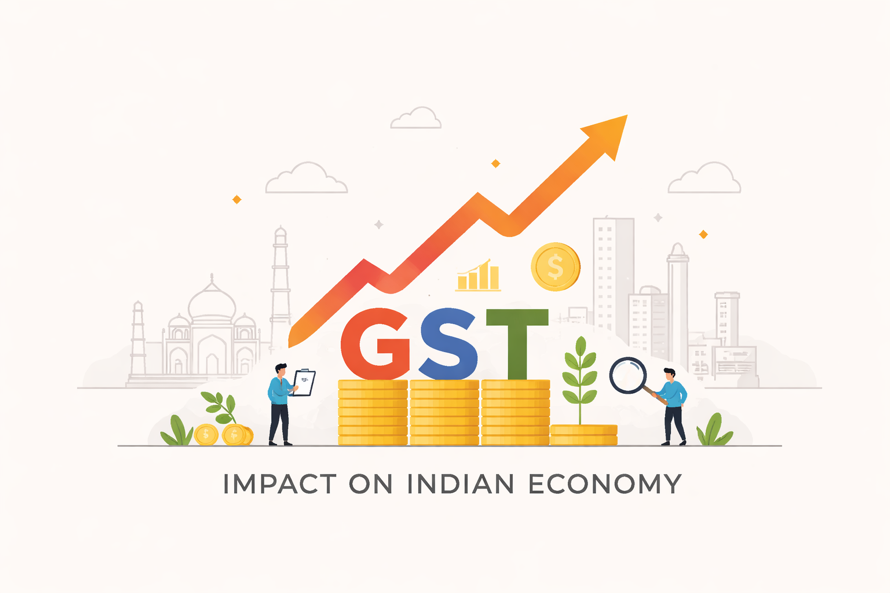
The conversation around taxation in India changed permanently the day GST stepped into the spotlight. Overnight, the country shifted from a maze of indirect taxes to a system built for transparency, uniformity, and national-scale coordination. The impact of GST on Indian economy can be felt across all walks of life—small traders filing monthly returns on smartphones, logistics networks shaving hours off interstate travel, manufacturers recalibrating sourcing strategies, and service-based firms rethinking interstate operations.
For an economy as large, diverse, and dynamic as India’s, GST shaped a new language of compliance and commerce. Understanding the impact of GST on Indian economy is not about memorizing tax slabs; it is about understanding how a single reform can touch pricing, competition, employment, digital systems, investments, and long-term economic behavior.
Understanding the Impact Of GST On Indian Economy
When we speak about the impact of GST on Indian economy, we refer to far more than a simplified tax framework. GST reorganized how goods move in India, how businesses record value, and how markets function from end to end. Earlier, every state functioned like a mini-country with its own tax identity—central excise, state VAT, octroi, entry tax, and service tax created friction, delays, and unpredictability. GST replaced this landscape with a unified, destination-based model that streamlined the movement of value across borders.
For Indian investors, the impact of GST on Indian economy influences sector performance, cost structures, and competitive strength. For businesses, the system impacts working capital cycles, supplier relationships, pricing architecture, and profitability. The emergence of e-invoicing, automated reconciliations, expanded reporting windows, and analytics-driven compliance checks further deepens the transformation.
The long-term impact of GST on Indian economy rests on how effectively companies adapt to the system and how quickly digital adoption expands across rural and urban India. With GST now entering a mature phase, the ecosystem continues to evolve: reduced return complexities, stronger invoice-matching accuracy, and data-driven audits are all part of this continuous refinement.
Key Benefits of the Impact Of GST On Indian Economy
The benefits of GST ripple across sectors, skill sets, and income groups. Each advantage contributes to a more structured economy where incentives align with long-term growth. Some of the benefits are:
- A unified national market where goods can move without state-level barriers.
- A strengthened input tax credit system that minimizes tax cascading.
- Improved digital infrastructure supporting smoother compliance.
- Reduced hidden taxes for consumers, improving price clarity.
- A transparent revenue trail that supports better government planning.
These outcomes show how deeply the impact of GST on Indian economy intertwines with national productivity. For manufacturers, GST lowers logistical redundancy. For service providers, it streamlines billing across states. For consumers, it brings stability to pricing. For governments, it improves collection efficiency and policy visibility.
The introduction of e-way bills drastically cut down transit delays. Freight movement became more predictable. Warehouses consolidated into fewer, more efficient hubs as businesses no longer needed to maintain depots in each state to avoid tax disadvantages. All these shifts highlight the macro-level impact of GST on Indian economy, especially in terms of productivity and competitiveness.
“Start investing with confidence! Explore
0 demat account
and grow your wealth.”
A Step-by-Step Guide
This section is designed to connect the practical side of GST with the broader system-wide impact of GST on Indian economy. It breaks down the core steps individuals and businesses encounter while entering and maintaining compliance within the GST ecosystem.
Step 1: Getting started
Every business begins by assessing whether it falls within GST’s mandatory registration limits. Goods-based companies with a turnover above ₹40 lakh and service-oriented firms above ₹20 lakh must register. This threshold-based inclusion strengthens the impact of GST on Indian economy because it formalizes more participants and builds a broader taxable base. Once registered, the business enters a structured, record-driven environment that encourages discipline and accountability.
Step 2: Required documents
To register, businesses upload PAN, Aadhaar, proof of business registration, photographs, address details, bank account verification, and authorization letters (if applicable). This digital-first process replaces paper-heavy, state-specific hurdles. The simplicity of this step reduced administrative friction and increased accessibility for small enterprises.
Step 3: How to execute or invest
Executing GST responsibilities means filing monthly or quarterly returns, uploading invoices, reconciling purchases with supplier filings, handling tax payments, and documenting credits. Companies use GSTR-1, GSTR-3B, and annual returns to maintain compliance. Investors review these filings when analyzing operational efficiency, particularly in sectors where margins respond directly to the accuracy of tax credits. The cleanliness of compliance processes boosts investor confidence, adding to the impact of GST on Indian economy in terms of financial transparency.
Step 4: Monitoring and exit strategy
Monitoring involves checking mismatches between your invoices and your supplier’s invoices, tracking reverse-charge mechanisms, and ensuring uninterrupted input credit flow. Businesses exiting GST—either due to closure or reduced turnover—apply for cancellation through the portal. By creating a standardized exit route, GST minimizes documentation ambiguity, reinforcing the structured impact of GST on Indian economy across all phases of business operations.
Risks and Challenges
The impact of GST on Indian economy includes hurdles that businesses must navigate. Small traders often express concerns about the frequency of filings. Digital literacy gaps still exist. Manufacturers face compliance bottlenecks if suppliers fail to upload invoices on time, impacting input credit visibility. Multi-slab GST rates also complicate classification decisions in sectors with varied product lines.
Working capital intensity remains a common challenge. Businesses wait for refunds in cases of exports or inverted duty structures. Service-based firms operating across states handle multiple place-of-supply rules. Any mismatch between uploaded data and received data could delay credit claims. These issues reflect the complex side of the impact of GST on Indian economy, highlighting areas where smoother reforms or simplification may still be required.
Expert Tips for Indians
Professionals across India share practical, experience-tested insights that improve day-to-day interaction with GST.
Adopt accounting tools that automate reconciliation
Automation reduces the likelihood of missed invoices and ensures cleaner tax credit flow.
- Treat GST filing dates as non-negotiable financial events
This discipline helps avoid cash flow shocks and late fees. - Train teams regularly
Even a basic understanding of GST among staff reduces avoidable compliance errors. - Monitor GST Council announcements
Rate changes can dramatically influence cost structures and pricing decisions. - Use e-invoicing efficiently
Real-time invoice authentication improves credit accuracy and lowers audit risks. - Build strong supplier communication
Many input-credit issues arise because suppliers delay invoice uploads. - Review GSTR-2B every cycle
This ensures you never claim credits that will be reversed later.
These expert suggestions sharpen operational judgment and help businesses experience the positive impact of GST on Indian economy.
Conclusion
The impact of GST on Indian economy is wide, far-reaching, and continually evolving. GST redefined how India trades, consumes, manufactures, ships, records, and reports. It accelerated the journey toward a more formal and digitally empowered marketplace. As e-invoicing expands, as AI-driven audits strengthen authenticity, and as businesses adapt to smoother processes, the long-term effect of GST becomes even more visible. The reform does not function in isolation—it interacts with economic cycles, government incentives, business strategies, and digital transformations.
By understanding how GST flows through systems, how invoices interact, how credits shape pricing, and how compliance influences trust, individuals and businesses build a more mature financial perspective. The impact of GST on Indian economy is becoming increasingly visible year after year, supported by technology, scale, and consistent learning.
FAQs on Impact of GST on Indian Economy
Q. What is the impact of GST on Indian economy?
It refers to the structural, financial, digital, and operational changes triggered by GST across India’s diverse markets.
Q. How is the impact of GST on Indian economy felt, practically speaking?
GST works by replacing fragmented indirect taxes with a unified system that simplifies the movement of goods, enhances compliance, and reduces tax inefficiencies.
Q. What are the benefits of GST for the Indian economy?
Key benefits include a unified national market, better input credit flow, transparent tax reporting, and stronger government revenue planning.
Q. Are there any risks involved in the implementation of GST in India?
Yes—working capital delays, invoice mismatches, classification disputes, and digital skill gaps remain noted challenges.
Q. Who should consider the impact of GST on Indian economy?
Business owners, traders, service providers, investors, and policymakers all benefit from understanding GST’s influence.
Q. How can I get started with assessing the impact of GST on Indian economy?
Begin by learning GST thresholds, tracking rate changes, using digital tools, maintaining timely filings, and monitoring credits carefully.
Disclaimer
The stocks mentioned in this article are not recommendations. Please conduct your own research and due diligence before investing. Investment in securities market are subject to market risks, read all the related documents carefully before investing. Please read the Risk Disclosure documents carefully before investing in Equity Shares, Derivatives, Mutual fund, and/or other instruments traded on the Stock Exchanges. As investments are subject to market risks and price fluctuation risk, there is no assurance or guarantee that the investment objectives shall be achieved. Lemonn (Formerly known as NU Investors Technologies Pvt. Ltd) do not guarantee any assured returns on any investments. Past performance of securities/instruments is not indicative of their future performance.
Related Posts



Download Lemonn
Download my app for share market trading, ipo investment, trading account, and all your investment needs.