
How to Start Commodity Trading in India: First Trade
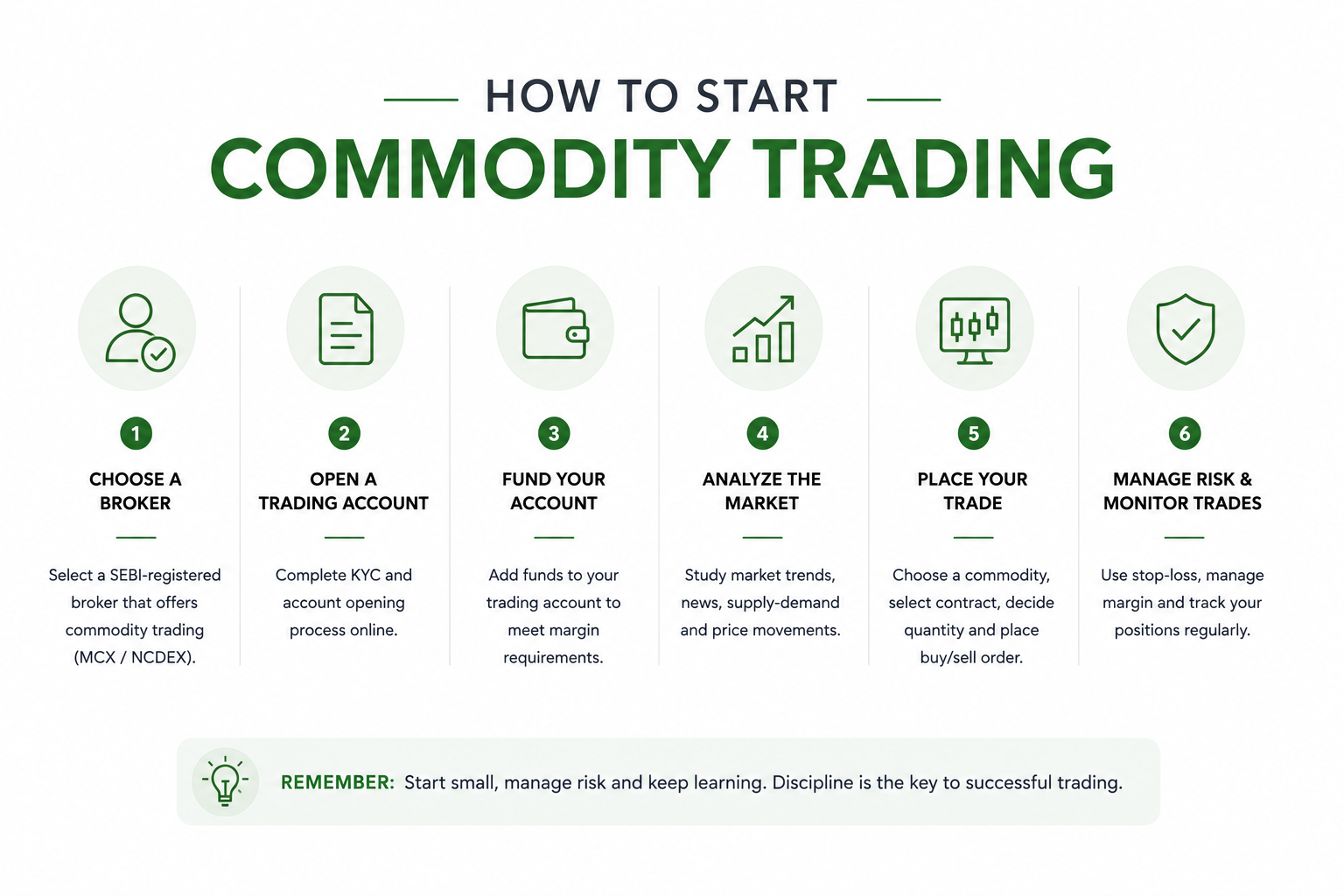
Commodity trading in India starts with opening a commodity derivatives account with a SEBI-registered stockbroker, completing KYC, activating the commodity segment, adding the required margin, and selecting an exchange-traded futures or options contract.
Before placing your first trade, understand three numbers clearly: contract value, lot size, and margin required. Commodity derivatives use leverage, so the amount you deposit can be much smaller than the actual market exposure you take.
SEBI specifically states that commodity derivatives trading must be conducted through a SEBI-registered stockbroker. Investors must complete KYC, understand the Risk Disclosure Document, receive a Unique Client Code, and deposit the required margin through banking channels.
What Is Commodity Trading?
Commodity trading means buying or selling contracts linked to physical commodities such as:
- Gold
- Silver
- Crude oil
- Natural gas
- Copper
- Aluminium
- Zinc
- Agricultural commodities
Retail traders generally participate through commodity derivatives, mainly futures and options, rather than buying physical barrels of crude oil or tonnes of metal.
For example, if you expect gold prices to rise, you could take a long position in a gold futures contract. If the price rises, the contract may gain value. If the price falls, you may incur a loss.
Because derivatives require margin rather than the full contract value upfront, both gains and losses can be magnified.
How to Start Commodity Trading in India
The basic process is:
- Choose a SEBI-registered broker.
- Complete KYC and open or activate your trading account.
- Enable the commodity derivatives segment.
- Add funds or eligible collateral.
- Select a commodity and contract.
- Check lot size, expiry, margin, and settlement terms.
- Decide your entry, stop-loss, and maximum loss.
- Place your first trade.
- Monitor margin and mark-to-market losses.
- Exit before expiry unless you understand the settlement process.
SEBI’s investor guidance follows a similar framework, including broker verification, KYC, acceptance of the Risk Disclosure Document, UCC allotment, margin deposit, and banking arrangements.
“Start investing with confidence! Explore
0 demat account
and grow your wealth.”
Step 1: Choose a SEBI-Registered Commodity Broker
The first requirement is a broker that offers access to the commodity derivatives segment.
Do not assume that every trading account automatically includes commodity trading.
Before opening or activating an account, check:
- Whether the broker is SEBI registered
- Which commodity exchanges it supports
- Brokerage and other charges
- Margin requirements
- Available order types
- Commodity contract information
- Risk controls around expiry and physical delivery
SEBI maintains an official searchable database of stock brokers registered in the commodity derivatives segment.
Why Broker Registration Matters
SEBI advises investors to trade only through registered stock brokers and avoid off-market commodity transactions.
It also recommends that investors obtain the Risk Disclosure Document, use their assigned Unique Client Code, verify contract notes, and avoid cash payments for margin or settlement obligations.
Step 2: Complete KYC and Activate Commodity Trading
If you already have an equity trading account, you may still need to activate the commodity derivatives segment separately.
The broker may ask you to complete or confirm:
- PAN
- Identity details
- Address details
- Bank account information
- KYC declarations
- Income or financial details where required for derivatives
- Risk disclosures
- Commodity segment activation
The exact onboarding process varies by broker.
Once activated, trades should be mapped to your Unique Client Code (UCC).
Do You Need a Demat Account for Commodity Trading?
For simply taking a position in a commodity futures or options contract, the key requirement is access to the commodity derivatives trading segment.
However, settlement requirements vary by contract.
SEBI’s commodity derivatives guidance notes that investors may need an account with a repository to facilitate physical delivery.
This is why you should check the settlement terms before holding any commodity contract close to expiry.
Step 3: Understand Which Commodity You Want to Trade
Do not select a contract simply because its price is moving quickly.
Different commodities react to different factors.
| Commodity | Major price drivers |
|---|---|
| Gold | Interest rates, US dollar, inflation expectations, global uncertainty |
| Silver | Gold prices, industrial demand, dollar movements |
| Crude oil | Global supply and demand, OPEC+ decisions, geopolitics |
| Natural gas | Weather, inventories, production, global energy demand |
| Copper | Industrial demand, China, manufacturing activity |
| Agricultural commodities | Weather, crop output, government policy, supply |
A beginner will usually find it easier to learn one or two markets deeply rather than constantly switching between several commodities.
Step 4: Learn How a Commodity Contract Works
You are not simply buying “gold” or “crude oil.”
You are trading a specific exchange contract.
That contract has predefined specifications, including:
- Commodity
- Expiry month
- Lot size
- Quotation unit
- Tick size
- Trading hours
- Settlement method
- Delivery terms
- Margin requirements
Always read the contract specifications before placing the trade.
What Is Lot Size?
Lot size is the standard quantity represented by one derivatives contract.
Suppose a fictional commodity futures contract represents 100 units.
If the quoted price is ₹500 per unit:
Contract value = ₹500 × 100 = ₹50,000
You usually cannot buy 17 units or 63 units using that futures contract.
You trade in standardized lots defined by the exchange.
Step 5: Calculate the Contract Value
Contract value tells you how much market exposure you are actually taking.
A simplified calculation is:
Contract value = Price × Contract quantity
Suppose:
- Commodity price = ₹1,000
- Lot size = 100 units
Then:
₹1,000 × 100 = ₹1,00,000
Your market exposure is ₹1 lakh.
This does not necessarily mean you must deposit ₹1 lakh to open the futures trade.
That is where margin comes in.
Step 6: Understand Commodity Trading Margin
Margin is the collateral required to open and maintain a commodity derivatives position.
Suppose a contract has:
- Contract value: ₹1,00,000
- Required upfront margin: ₹15,000
You may be able to take ₹1 lakh of market exposure by providing ₹15,000 in margin.
That creates leverage of roughly:
₹1,00,000 ÷ ₹15,000 = 6.67x
This is a simplified illustration. Actual exchange margin calculations are more complex and can change with market risk.
NSE Clearing, for example, uses an online position-monitoring and SPAN-based margining framework for commodity derivatives. It collects initial margin upfront, with additional margin components applicable depending on the contract and market conditions.
What Types of Margin Apply to Commodity Trading?
Commodity derivatives can involve several margin components.
Initial Margin
Initial margin is collected upfront when you take a position.
NSE states that initial margin is collected upfront for open commodity derivative positions.
Extreme Loss Margin
An additional margin may be collected to cover extreme market movements.
NSE currently states that an Extreme Loss Margin of 1% on gross open positions is levied in its commodity derivatives segment, subject to applicable rules and changes.
Mark-to-Market Margin
Futures positions are marked to market.
If the market moves against you, losses affect the funds available to maintain the position.
SEBI’s risk disclosure explains that commodity futures positions are settled daily and that adverse price movements may require traders to deposit the resulting loss.
Additional or Special Margins
Exchanges and clearing corporations may impose additional margins during periods of increased risk or volatility.
Delivery and Pre-Expiry Margins
Margin requirements may rise as physically settled contracts approach expiry.
NSE, for example, lists the tender period, pre-expiry, delivery period, final settlement, and concentration margins within its commodity derivatives risk framework.
This is one reason you should not hold a contract close to expiry without understanding its settlement terms.
How Much Money Do You Need to Start Commodity Trading?
There is no single minimum amount that applies to every commodity trade.
The capital required depends on:
- Commodity
- Contract
- Lot size
- Current price
- Exchange margin
- Broker risk policy
- Volatility
- Additional margins
- Number of lots
Suppose one futures contract requires ₹18,000 in upfront margin.
Technically, having just over ₹18,000 may allow you to enter under simplified assumptions.
That does not mean ₹18,000 is enough capital to trade it responsibly.
You also need a buffer for:
- Mark-to-market losses
- Margin changes
- Brokerage and charges
- Volatility
- Unexpected overnight moves
Using your entire trading balance as initial margin leaves very little room for adverse price movement.
A Simple Commodity Margin Example
Suppose a fictional crude oil contract has:
- Contract value: ₹2,00,000
- Initial margin: ₹30,000
- Trader’s account balance: ₹60,000
The trader opens one contract.
After entry:
- ₹30,000 supports the trade
- ₹30,000 remains as an additional cash buffer, ignoring other obligations
Now suppose the position loses ₹8,000.
The trader’s equity effectively declines to:
₹60,000 – ₹8,000 = ₹52,000
If losses continue, available margin falls further.
If required margin increases at the same time, the trader may need to provide additional funds or reduce the position.
This is why margin should be treated as a risk requirement, not as the total amount you are willing to lose.
Step 7: Check the Expiry Date
Commodity futures have expiry dates.
For example, you might see separate contracts for different months.
Two contracts linked to the same commodity can trade at different prices because of:
- Interest costs
- Storage costs
- Supply expectations
- Seasonal demand
- Global market conditions
Before selecting a contract, check:
- Expiry date
- Liquidity
- Open interest
- Bid-ask spread
- Settlement method
For a beginner, entering a thinly traded expiry simply because its quoted price looks attractive can make exiting more difficult.
Step 8: Understand Physical Delivery Before You Trade
Physical settlement is one of the biggest differences between commodity derivatives and ordinary stock trading.
Depending on the commodity and contract, holding a position toward expiry may create delivery obligations.
These can involve:
- Delivery intention
- Repository accounts
- Additional margins
- Quality standards
- Delivery locations
- Taxes and charges
- Settlement deadlines
If your goal is purely trading price movements, understand your broker’s square-off policy well before expiry.
Do not assume every open commodity position will automatically disappear without consequences on the expiry date.
Step 9: Decide How Much You Are Willing to Lose
Do this before choosing your entry.
Suppose your trading capital is ₹1,00,000.
You decide that your maximum acceptable loss on a single trade is ₹2,000.
Now suppose:
- Entry price = ₹500
- Stop-loss = ₹490
- Loss per unit = ₹10
- Contract lot size = 100 units
Potential loss:
₹10 × 100 = ₹1,000 per lot
Ignoring slippage and charges, two lots would expose you to approximately:
₹2,000
This approach begins with the amount you can afford to lose rather than the maximum margin your broker allows you to use.
Step 10: Choose Long or Short
Commodity futures allow you to trade in either direction.
Long Position
You go long when you expect the futures price to rise.
Example:
Buy at ₹500 → Sell at ₹520
Gross gain per unit:
₹20
Short Position
You go short when you expect the futures price to fall.
Example:
Sell at ₹500 → Buy back at ₹480
Gross gain per unit:
₹20
The calculation reverses when the market moves against you.
The ability to sell first does not make short trading less risky. Some commodities can experience sharp price increases after unexpected supply or geopolitical events.
Step 11: Choose Your Order Type
The main order types beginners should understand are market and limit orders.
Market Order
A market order attempts to execute immediately at the best available price.
The risk is that your actual execution price may differ from what you saw on screen, particularly in volatile or illiquid markets.
Limit Order
A limit order specifies the price at which you are willing to buy or sell.
For example:
Gold futures currently trading: ₹72,100
Your buy limit: ₹72,000
The trade executes only if sellers are available at ₹72,000 or lower, subject to market conditions.
Stop-Loss Order
A stop-loss order is designed to trigger when the market reaches a specified level.
It can help manage losses, although execution at the exact trigger price is not guaranteed during fast markets.
Step 12: Place Your First Commodity Trade
Consider a simplified example.
Suppose you want to trade a fictional metal futures contract.
Contract details:
- Futures price: ₹500
- Lot size: 100 units
- Contract value: ₹50,000
- Required margin: ₹8,000
You expect the price to rise.
You place:
Buy 1 lot at ₹500
You also decide:
- Stop-loss: ₹490
- Target: ₹520
If the Price Reaches ₹520
Price movement:
₹520 – ₹500 = ₹20
Gross profit:
₹20 × 100 = ₹2,000
If the Price Falls to ₹490
Price movement:
₹500 – ₹490 = ₹10
Gross loss:
₹10 × 100 = ₹1,000
Both calculations exclude brokerage, taxes, exchange charges, slippage, and other costs.
Notice that your profit and loss are based on the entire contract quantity, not the ₹8,000 margin you deposited.
That is the effect of leverage.
Step 13: Monitor Mark-to-Market Losses
Once a futures position is open, changes in its price create profit or loss.
SEBI warns that because commodity futures are leveraged, a relatively small margin can generate gains or losses that are large relative to the initial deposit.
Suppose your trade loses ₹3,000.
That may sound small compared with a ₹1 lakh contract value.
But if you initially posted only ₹12,000 of margin, ₹3,000 represents 25% of that amount.
Always evaluate risk relative to your actual capital, not just the contract’s percentage price movement.
Can Commodity Margin Increase After You Enter a Trade?
Yes.
Margin requirements are not necessarily fixed for the life of the position.
They can change because of:
- Increased volatility
- Exchange risk measures
- Concentrated positions
- Approaching expiry
- Delivery obligations
- Special or additional margins
NSE explicitly provides for additional, concentration, tender-period, pre-expiry, and delivery-related margins in its commodity risk-management framework.
So having exactly enough funds to meet today’s margin requirement may not be enough to maintain the position tomorrow.
What Happens If You Do Not Maintain Enough Margin?
If losses or higher requirements reduce your available funds below required levels, you may need to:
- Add funds
- Reduce the position
- Close the position
Depending on the broker’s and exchange’s risk controls, positions can also be squared off when margin requirements are not met.
Do not rely on receiving enough warning to transfer funds during a fast-moving market.
What Are Commodity Market Trading Hours in India?
Commodity trading hours depend on the commodity category and exchange calendar.
SEBI’s commodity investor guidance notes that non-agricultural commodity derivatives generally start trading at 9:00 AM and can trade into the late evening, while agricultural commodities may close earlier.
Exact timings may change due to exchange schedules, international daylight saving time adjustments, holidays, or regulatory changes.
Always check your exchange’s current trading calendar before placing a trade.
What Charges Apply to Commodity Trading?
Commodity trades can involve several costs.
These may include:
- Brokerage
- Exchange transaction charges
- Commodities Transaction Tax where applicable
- GST
- SEBI charges
- Stamp duty
- Other applicable regulatory or clearing charges
Your broker’s contract note should show the charges applied to executed trades.
For short-term strategies, transaction costs can materially reduce profitability even when individual trades appear profitable before charges.
Commodity Futures vs Commodity Options for Beginners
Both instruments provide exposure to commodity prices, but they work differently.
| Futures | Options |
|---|---|
| Profit or loss moves with futures price | Payoff depends on option structure |
| Margin usually required | Buyer generally pays premium |
| Can generate significant leveraged losses | Option buyer’s direct premium risk is typically limited to premium paid |
| Mark-to-market obligations matter | Time decay and volatility also matter |
| Relatively straightforward payoff | More variables affect pricing |
Options should not automatically be considered easier simply because the buyer pays a premium.
You still need to understand:
- Strike price
- Expiry
- Premium
- Intrinsic value
- Time value
- Implied volatility
Common Mistakes Beginners Make in Commodity Trading
Using the Maximum Available Margin
If your broker allows a position, that does not mean the position is appropriate for your account size.
Leave room for adverse movement and changing margin requirements.
Ignoring Lot Size
A ₹5 price movement looks small until you multiply it by the full contract quantity.
Always calculate:
Price movement × Lot size
before entering.
Trading Without Knowing the Expiry
Commodity expiry can involve additional margins and settlement obligations.
Check it before clicking “buy” or “sell”.
Following Tips Without Understanding the Market
SEBI specifically warns commodity investors against trading based on rumors, hot tips, alluring advertisements, or promises of assured returns.
Holding Physical-Delivery Contracts Too Close to Expiry
If you do not intend to participate in settlement, understand your broker’s cut-off and square-off policy.
Risking the Entire Account on One Trade
Margin lets you control larger positions.
It should not be treated as an invitation to maximize exposure.
A First Commodity Trade Checklist
Before placing your order, confirm:
- Is my broker SEBI registered?
- Is the commodity segment activated?
- Which exact contract am I trading?
- What is the lot size?
- What is the contract value?
- How much margin is required?
- Could that margin increase?
- What is the expiry date?
- Is the contract physically settled?
- How much will I lose if my stop is reached?
- What charges will apply?
- Am I comfortable losing that amount?
If you cannot answer all of these questions, spend more time understanding the contract before trading it.
How Much Should a Beginner Risk on the First Trade?
There is no universal percentage that suits every trader.
The useful principle is to make the potential loss small enough that one bad trade does not materially damage your capital or force you to abandon your strategy.
For example, if you have ₹1 lakh in trading capital and a particular commodity lot would expose you to a ₹15,000 loss at a reasonable stop-loss, the contract may simply be too large for your risk budget.
The right response is not necessarily to artificially tighten the stop.
It may be to choose a smaller contract, reduce position size where possible, or skip the trade.
Is Commodity Trading Suitable for Beginners?
Commodity trading is accessible to retail investors in India, but leveraged derivatives require more preparation than simply opening an account and choosing whether gold or crude oil will rise.
Before your first trade, you should understand:
- Futures
- Options
- Margin
- Leverage
- Lot size
- Mark-to-market settlement
- Stop-loss orders
- Expiry
- Physical settlement
If any of those terms are unclear, learning them first can prevent expensive mistakes later.
FAQs About Starting Commodity Trading in India
How can I start commodity trading in India?
A. Choose a SEBI-registered broker offering commodity derivatives, complete KYC, activate the commodity segment, add the required margin, select an exchange-traded contract, understand its lot size and expiry, and then place your order.
How much money is required to start commodity trading?
A. There is no fixed minimum for every trade. Required capital depends on the selected commodity, contract value, lot size, current margin requirements, volatility, and the broker’s risk policy.
Do I need a separate account for commodity trading?
A. You need access to the commodity derivatives segment through a SEBI-registered broker. If you already have a trading account, your broker may allow you to activate the commodity segment rather than open an entirely separate account.
What is margin in commodity trading?
A. Margin is the collateral required to open and maintain a commodity derivatives position. It is generally much smaller than the full contract value, which creates leverage.
Can commodity margin change after I buy a contract?
A. Yes. Exchanges and clearing corporations can impose additional or higher margins based on volatility, concentration, expiry, delivery conditions, and other risk factors.
Can beginners trade commodities in India?
A. Yes, eligible retail investors can access commodity derivatives through registered brokers. However, futures and options are leveraged instruments and can generate substantial losses, so understanding the contract and margin mechanics is essential.
Can I sell commodity futures without owning the commodity?
A. Yes. Futures allow traders to take short positions without first owning the physical commodity. You must still satisfy margin and settlement requirements.
What is lot size in commodity trading?
A. Lot size is the standard quantity represented by one commodity derivatives contract. Your profit and loss depend on the price movement multiplied by the applicable contract quantity.
What happens if I do not have enough margin?
A. You may need to add funds or reduce the position. If margin obligations are not met, your broker’s risk-management system may close positions in accordance with applicable rules and policies.
Can commodity futures lead to physical delivery?
A. Depending on the specific contract, settlement can involve physical delivery. Check the exchange specifications and broker expiry policy before holding a contract close to expiry.
Key Takeaways
- Commodity trading in India must be carried out through a SEBI-registered broker offering the commodity derivatives segment.
- Complete KYC, understand the Risk Disclosure Document, and activate the commodity segment before trading.
- Learn the contract’s lot size, value, expiry, margin, and settlement terms before placing an order.
- Margin is only a fraction of the market exposure, so commodity futures involve leverage.
- Initial, extreme loss, mark-to-market, additional, and delivery-related margins may affect the funds required.
- Margin requirements can increase after a trade is opened.
- Calculate your potential rupee loss based on the full lot size, not just the margin deposited.
- Understand physical settlement and broker expiry policies before holding contracts close to expiry.
- For a first trade, focus on managing risk rather than using the maximum available leverage.
Disclaimer
The stocks mentioned in this article are not recommendations. Please conduct your own research and due diligence before investing. Investment in securities market are subject to market risks, read all the related documents carefully before investing. Please read the Risk Disclosure documents carefully before investing in Equity Shares, Derivatives, Mutual fund, and/or other instruments traded on the Stock Exchanges. As investments are subject to market risks and price fluctuation risk, there is no assurance or guarantee that the investment objectives shall be achieved. Lemonn (Formerly known as NU Investors Technologies Pvt. Ltd) do not guarantee any assured returns on any investments. Past performance of securities/instruments is not indicative of their future performance.
Related Posts
Download Lemonn
Download my app for share market trading, ipo investment, trading account, and all your investment needs.



