How To Start A Business With Low Investment In India
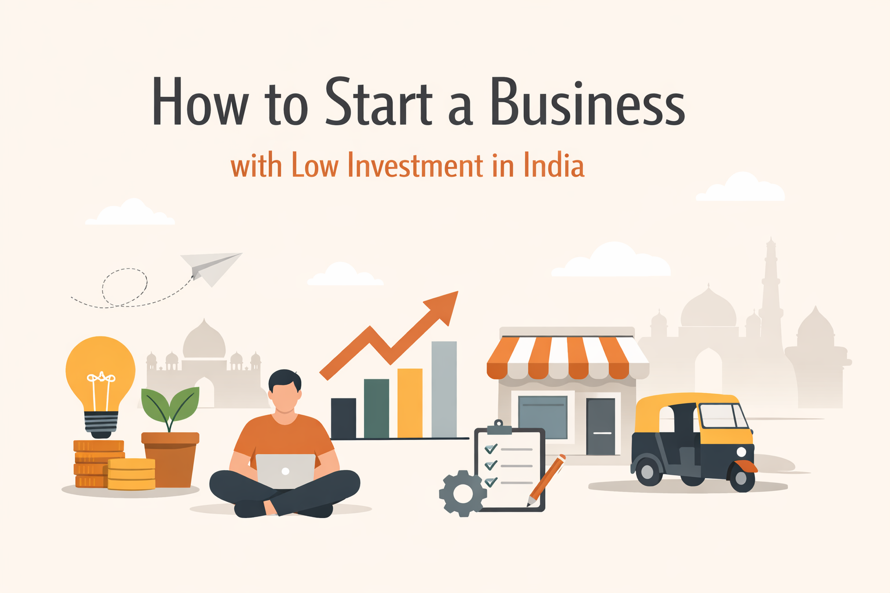
Every few months, across households, co-working cafés, and even quiet late-night conversations, the same idea surfaces: people want something of their own. Something that grows, something they can shape. That is exactly why the question how to start a business with low investment in India has become so compelling. India’s financial landscape is buzzing — digital payments everywhere, customers shopping on Instagram, and young and older adults exploring second incomes. A low-investment business fits this moment beautifully. It feels attainable, realistic, and deeply empowering. It opens doors for those who once believed entrepreneurship belonged only to people with large capital. Today, it belongs to anyone who can think, plan, test, and improve.
Understanding How To Start A Business With Low Investment In India
To understand how to start a business with low investment in India, imagine building a house where the foundation is not money but clarity. You start with a compact idea — something you can test within days, not months. You rely on digital tools that cost nothing. You focus on usefulness instead of complicated infrastructure. In India’s fast-growing, value-driven market, this approach works better than throwing money at a problem.
The phrase how to start a business with low investment in India captures more than frugality. It reflects a shift in the Indian mindset. Businesses today can run entirely online. Customers appreciate authenticity more than polished storefronts. Payments settle instantly through UPI. Logistics networks reach remote towns. And small ventures scale faster than traditional ones because they learn and adapt in real time.
For first-time entrepreneurs, the context matters: India’s consumer base is huge, price-sensitive, curious, and quick to reward good service. That makes lean businesses highly competitive — and surprisingly resilient.
Key Benefits of How To Start A Business With Low Investment In India
Anyone exploring how to start a business with low investment in India discovers advantages that feel both practical and reassuring.
Lower risk means you’re not carrying the weight of heavy loans or long-term commitments. You can pivot early, experiment freely, pause if needed, and accelerate when momentum builds. Growth feels more organic, more controlled, more sustainable.
Tax benefits also support beginners. India’s presumptive taxation schemes, MSME incentives, and relaxed compliance thresholds give breathing room. That breathing room matters — it lets new entrepreneurs focus on customers first, paperwork later.
But perhaps the most significant advantage is psychological. When you understand how to start a business with low investment in India, you shift from hesitation to participation. You realize that entrepreneurship is not a distant dream; it is a structured process, accessible to anyone willing to take patient, consistent steps. And in a digital-first India, those steps now bring faster responses, more precise feedback, and greater opportunity than ever before.
“Start investing with confidence! Explore
0 demat account
and grow your wealth.”
A Step-by-Step Guide
Let’s break down how to start a business with low investment in India into a fluid, practical journey. Each step builds momentum, creating a direction that feels manageable even for complete beginners.
Step 1: Getting Started
This is the moment where the idea takes shape. Not perfectly — just enough to test. You ask yourself: Who needs this? Why would they choose me? How fast can I create a basic version?
Everything begins with conversations, observations, and small experiments. In a country with such varied markets, the “best idea” is simply the one that solves a clear problem for a specific group. Those who truly master how to start a business with low investment in India often begin by watching their own neighborhoods, workplaces, or online communities to identify what people keep asking for.
Step 2: Required Documents
Documentation sounds intimidating until you realize how simplified the Indian system has become.
- PAN and Aadhaar for identity.
- A bank account to keep transactions transparent.
- Udyam Registration to access MSME benefits.
- GST only after turnover crosses the threshold (or earlier if your industry demands it).
- Occasional local licenses, depending on what you sell or offer.
Understanding how to start a business also means understanding compliance without fear. These documents not only protect you; they open doors to subsidies, credit, and trust-building.
Step 3: How to Execute or Invest
Execution is where energy meets practicality. You figure out what absolutely needs money today — and what can wait.
Maybe it’s raw materials. Maybe it’s a simple website. Maybe it’s a paid promotion worth ₹200 a day. Or maybe it’s nothing more than a Canva design and a WhatsApp broadcast list.
The magic of how to start a business with low investment in India lies in creative allocation. Small investments, placed thoughtfully, often outperform large capital deployed blindly. India’s digital ecosystem — UPI transactions, ONDC listings, hyperlocal delivery partners, social media reels — gives small ventures a stage once available only to larger brands.
Step 4: Monitoring and Exit Strategy
Monitoring feels boring until you see how powerful it is. Track cash flow. Study which items sell fast. Check customer feedback. Review costs monthly. These patterns reveal insights no mentor, YouTube guru, or generic startup book can offer.
Knowing how to start a business with low investment in India includes knowing when to pause, pivot, or exit. Exit is not failure. Exit is intelligent risk management — an acknowledgement that your time, energy, and money deserve a better direction.
Risks and Challenges
Every business path has rough edges. Learning how to set up a business doesn’t remove risk; it teaches you how to handle it.
Financial unpredictability, shifting customer expectations, sudden supply shortages, and algorithm changes on social platforms — India’s markets move quickly. Competition lurks in the corner. Regulations evolve. Delivery timelines stretch. Sometimes a great idea meets a slow month. Sometimes a weak competitor suddenly becomes aggressive.
And there is emotional turbulence. Doubts persist. Comparisons can be stressful. Discipline falters. But these are part and parcel of entrepreneurship — not signs of failure.
Expert Tips for Indians
Below are insights that strengthen your journey on how to start a business with low investment in India:
- Use every no-cost digital tool available before spending on paid services. India offers an astonishing ecosystem of free apps for catalogue creation, billing, communication, and analytics.
- Explore available schemes — Mudra loans, Prime Minister’s Employment Generation Programme (PMEGP), state startup missions. Not every entrepreneur needs them, but knowing they exist expands strategic options.
- Test multiple versions of your product with small groups; Indian consumers respond well to iterative improvement.
- Keep your business extremely lean for the first 180 days. Rent, staff, and inventory should remain minimal until demand stabilizes.
- Build visibility slowly but consistently. In India’s social marketplace, trust grows through repeated small interactions, not grandeur.
- Document finances clearly from day one. Future credit, investor interest, and clean taxation all depend on this.
- Focus on retention over reach. A loyal group of repeat buyers generates more stability than 50,000 one-time likes on a reel.
These suggestions become powerful when repeated regularly. They reshape thinking and guide everyday decisions on how to start a business with low investment in India.
Conclusion
The real beauty of how to start a business with low investment in India is not the low cost — it’s the possibility it opens up. With clarity, patience, and smart execution, anyone can start something meaningful. India’s digital shift has flattened the playing field. Small businesses can grow nationally. Creativity earns recognition faster than ever. And the barriers that once discouraged new entrepreneurs have faded significantly. Entrepreneurship in India is no longer linked to big capital. It is linked to thoughtful decisions, small steps, constant testing, and a willingness to adjust as the market shifts. Once you understand how to start a business with low investment in India, you carry a blueprint you can use again and again — for your next venture, and the one after that.
FAQs
What is your understanding of starting a business with low investment in India?
It refers to building a lean, cost-efficient business using minimal capital and focusing on skills, digital reach, and low operational expenses.
How does starting a business with low investment in India work in practical terms?
It works through small-scale launches, simple registration processes, digital payments, and scalable models tailored for Indian consumers.
Are there any risks involved in starting a business with low investment in India?
Yes—market competition, demand uncertainty, operational hurdles, and emotional fatigue, all of which require consistent adaptation.
Who should consider starting a business with low investment in India?
Students, professionals, homemakers, side-hustlers, retirees, and anyone seeking flexible entrepreneurship without heavy capital.
How do I start a business with low investment in India?
Begin by validating an idea, completing basic documentation, launching a minimal version, and monitoring progress over time.
Disclaimer
The stocks mentioned in this article are not recommendations. Please conduct your own research and due diligence before investing. Investment in securities market are subject to market risks, read all the related documents carefully before investing. Please read the Risk Disclosure documents carefully before investing in Equity Shares, Derivatives, Mutual fund, and/or other instruments traded on the Stock Exchanges. As investments are subject to market risks and price fluctuation risk, there is no assurance or guarantee that the investment objectives shall be achieved. Lemonn (Formerly known as NU Investors Technologies Pvt. Ltd) do not guarantee any assured returns on any investments. Past performance of securities/instruments is not indicative of their future performance.
Related Posts


Download Lemonn
Download my app for share market trading, ipo investment, trading account, and all your investment needs.