How to Read a Balance Sheet for Stock Investors in India
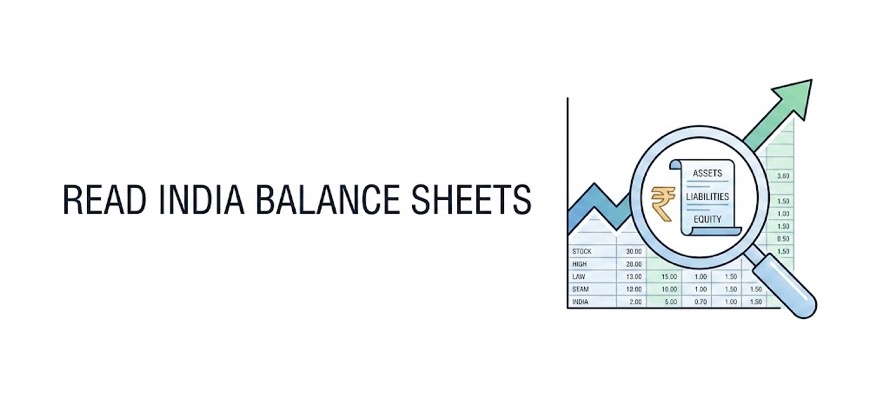
A balance sheet is a financial snapshot of a company at a specific point in time, it shows what the company owns (assets), what it owes (liabilities), and what belongs to shareholders (equity). Reading balance sheets is the first skill every stock investor must develop.
The Balance Sheet Equation
Assets = Liabilities + Shareholders’ Equity. This equation always balances. Everything a company owns was funded either by borrowing (liabilities) or by shareholder money (equity). Understanding this relationship helps you assess financial risk instantly.
Assets: What the Company Owns
| Asset Type | Examples | What It Tells You |
|---|---|---|
| Fixed Assets / PPE | Land, buildings, plant, machinery | How capital-intensive the business is |
| Intangible Assets | Brand value, patents, goodwill from acquisitions | Quality of competitive advantage and acquisition history |
| Investments | Shares in subsidiaries, mutual funds, bonds held | Capital allocation decisions by management |
| Inventories | Raw materials, work-in-progress, finished goods | Inventory management efficiency (watch for bloat) |
| Trade Receivables | Money owed by customers (debtors) | Collection efficiency; high DSO can signal problems |
| Cash and Equivalents | Bank balances, liquid investments | Liquidity buffer and financial flexibility |
“Start investing with confidence! Explore
0 demat account
and grow your wealth.”
Liabilities: What the Company Owes
| Liability Type | Examples | Red Flag If… |
|---|---|---|
| Long-term Borrowings | Bank loans, NCDs, debentures | Debt-to-equity ratio exceeds 1 for non-financial companies |
| Current Liabilities | Accounts payable, short-term loans | Current ratio falls below 1, immediate liquidity stress |
| Deferred Tax Liability | Timing differences in tax recognition | Growing faster than revenue may signal accounting issues |
| Provisions | Employee benefit obligations, warranty claims | Growing much faster than revenue or headcount |
Shareholders’ Equity: What Belongs to You
Shareholders’ equity = Assets minus Liabilities. It comprises share capital (face value of issued shares) and reserves and surplus (retained earnings accumulated over years). Book value per share = Total equity / Number of shares. Comparing book value to market price tells you whether the stock trades at a premium or discount to its net assets.
5 Key Balance Sheet Ratios
| Ratio | Formula | Healthy Range | What It Measures |
|---|---|---|---|
| Debt-to-Equity | Total Debt / Shareholders Equity | < 0.5 (non-financial) | Financial leverage: risk from borrowing |
| Current Ratio | Current Assets / Current Liabilities | > 1.5 | Short-term liquidity; can it pay near-term obligations? |
| Quick Ratio | (Current Assets minus Inventory) / Current Liabilities | > 1 | Immediate liquidity without selling inventory |
| Book Value per Share | Total Equity / Shares Outstanding | Compare to market price | Net asset value per share, floor valuation |
| Debt-to-EBITDA | Total Debt / EBITDA | < 3x | Debt serviceability: years of EBITDA to repay debt |
Red Flags to Watch For
- Receivables growing much faster than revenue: customers not paying on time
- Inventory piling up without corresponding revenue growth: demand slowdown
- Goodwill on balance sheet increasing year after year: serial acquisition history without organic growth
- Debt increasing while cash from operations is flat or declining
- Contingent liabilities (in notes) that could become real liabilities: lawsuits, guarantees
How to Find Balance Sheets for Indian Companies
Visit BSE (bseindia.com) or NSE (nseindia.com) and search for the company. Go to the Financials section to download the annual report or quarterly balance sheet. Screener.in provides a clean, formatted view of 10 years of balance sheet data for free.
FAQs
How often is a balance sheet published?
Indian listed companies publish quarterly balance sheets as part of their financial results and a detailed annual balance sheet in their annual report.
Is a high cash balance always good?
Not necessarily. If a company has large cash on the balance sheet but is not deploying it productively (low ROCE despite high cash), it signals poor capital allocation.
What is working capital?
Working capital = Current Assets minus Current Liabilities. Positive and growing working capital generally signals a healthy, expanding business.
What is the difference between gross and net fixed assets?
Gross fixed assets = total cost of assets. Net fixed assets = gross assets minus accumulated depreciation. Net fixed assets show the remaining book value.
Can balance sheets be manipulated?
Yes. Common methods include aggressive capitalisation of expenses, inflating receivables, and understating liabilities. Always read the auditor’s report and notes to accounts for qualifications.
Disclaimer
The stocks mentioned in this article are not recommendations. Please conduct your own research and due diligence before investing. Investment in securities market are subject to market risks, read all the related documents carefully before investing. Please read the Risk Disclosure documents carefully before investing in Equity Shares, Derivatives, Mutual fund, and/or other instruments traded on the Stock Exchanges. As investments are subject to market risks and price fluctuation risk, there is no assurance or guarantee that the investment objectives shall be achieved. Lemonn (Formerly known as NU Investors Technologies Pvt. Ltd) do not guarantee any assured returns on any investments. Past performance of securities/instruments is not indicative of their future performance.
Related Posts

Download Lemonn
Download my app for share market trading, ipo investment, trading account, and all your investment needs.