How To Invest In Real Estate Investment Trusts (REITs) In India
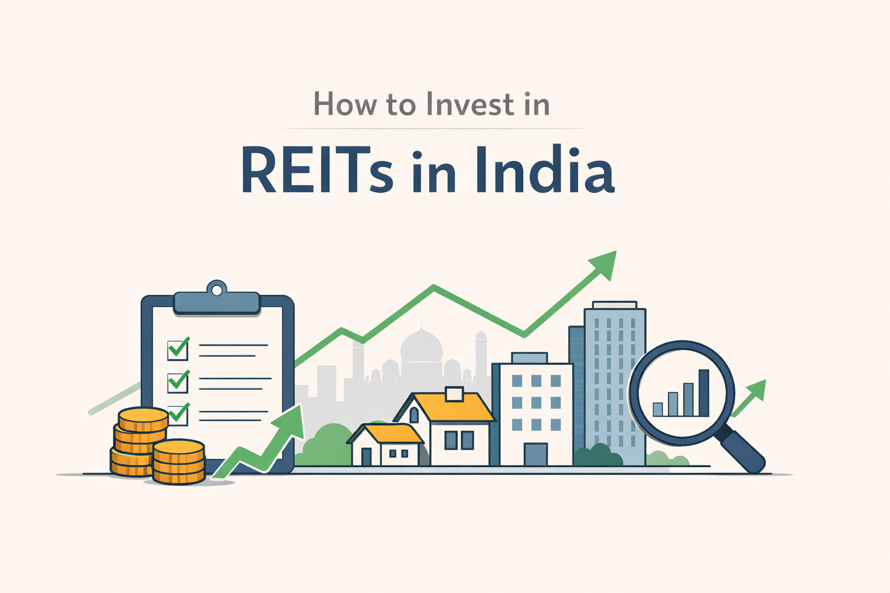
If buying a flat, finding tenants, handling brokers, and chasing rent sounds exhausting, you are not alone—and that is precisely why many Indians are suddenly Googling “how to invest in real estate investment trusts (REITs) in India.” Instead of locking up crores in a single property, REITs let you own a slice of commercial real estate—office parks, malls, warehouses—through simple stock-market units. You get rental income in the form of distributions, plus the potential upside of property prices, without doing any of the legwork yourself.
Understanding How To Invest In Real Estate Investment Trusts (REITs) In India
Before diving into how to invest in real estate investment trusts (REITs) in India, it helps to understand what a REIT actually is. A Real Estate Investment Trust is a SEBI-regulated trust that owns, operates, or finances income-generating real estate. In India, listed REITs mainly hold commercial properties like office parks and, increasingly, shopping malls and logistics assets. Investors buy “units” of the REIT on the stock exchange, just like buying shares of a company, and in return receive periodic payouts sourced from rental income and other cash flows.
When you ask how to invest in real estate investment trusts (REITs) in India, you are essentially asking how to participate in these pooled property portfolios using your regular demat account. There is no need to sign sale deeds, pay stamp duty on a flat, or scout for tenants.
Key Benefits of How To Invest In Real Estate Investment Trusts (REITs) In India
- Understanding how to invest in real estate investment trusts (REITs) in India allows you to access premium commercial real estate with relatively small ticket sizes, sometimes just a few thousand rupees per unit.
- REITs offer a combination of regular cash distributions (largely rent-linked) and potential capital appreciation as property values and rentals rise over time.
- Because REIT units are listed and traded on exchanges, they provide far better liquidity than selling a physical property, where exits can take months.
- For diversification, investing in real estate investment trusts (REITs) in India lets you reduce concentration risk. Instead of one flat in one locality, you own pieces of multiple properties across cities.
- Tax treatment can be relatively efficient: parts of the payout may be taxed differently (for example, as interest, dividend, or return of capital), which investors can plan around under current rules.
- For conservative investors, REITs can act as a semi-defensive asset class—less volatile than small-cap stocks but with more upside potential than traditional fixed deposits.
“Start investing with confidence! Explore
0 demat account
and grow your wealth.”
A Step-by-Step Guide
Step 1: Getting started
The first step in understanding how to invest in real estate investment trusts (REITs) in India is clarity on your objective. Are you looking for steady cash flow like “rent,” or are you more focused on long-term appreciation of prime office and retail assets? Typically, REITs suit investors with at least a 3–5-year horizon, because both rental cycles and property cycles play out slowly.
Step 2: Required documents
Operationally, learning how to invest in real estate investment trusts (REITs) in India is similar to buying a share:
- You need a PAN card, Aadhaar, and a bank account in your name.
- A KYC-compliant demat and trading account with a SEBI-registered broker or online platform.
- Linked bank details so that distributions (rent-like payouts) are credited directly to your bank account.
Step 3: How to execute or invest
Execution is where the real fun begins. To actually learn how to invest in real estate investment trusts (REITs) in India, follow a disciplined process rather than impulse buying on social media hype.
- Screen and shortlist
- Compare the REIT’s market capitalization and net asset value (NAV) to determine whether it trades at a premium or discount to its underlying properties.
- Check distribution yield: total distributions over the last 12 months divided by the current market price.
- Plan your entry
- Instead of investing a lump sum in a day, stagger purchases through systematic investment or multiple tranches over a few months.
- Place the order
- In your broker app or terminal, search for the REIT symbol and select “Buy.”
- Enter quantity, choose market or limit price, and confirm.
- Reinvest or withdraw payouts
- When distributions hit your bank account, you can either withdraw them as income (like rent) or reinvest them in more units.
Step 4: Monitoring and exit strategy
Even though REITs feel more stable than regular shares, monitoring is still crucial to understand how to invest in real estate investment trusts (REITs) in India. Every quarter, review:
- Occupancy trends—are they improving, stable, or declining?
- Tenant mix—are new tenants strong names, or is the REIT replacing top-tier tenants with weaker ones?
- Rental re-negotiations, escalations, and new acquisitions or disposals.
- Debt levels—rising interest costs can hit distributable cash flows.
As for exiting, set broad rules. You might choose to partially exit if a REIT trades at a very high premium to NAV and has a compressed yield, or if there is structural deterioration in occupancy or tenant quality.
Risks and Challenges
Every asset has a dark side, and investing in real estate investment trusts (REITs) in India is no exception. The most apparent risk is real estate cycle risk. If commercial leasing slows down—due to work-from-home trends, an economic slowdown, or oversupply—occupancy and rental rates can stagnate or decline. This hits both distributions and unit prices.
There is also interest-rate risk. REITs often carry debt, and their units are considered income-producing instruments. When interest rates rise sharply, fixed-income options like FDs and bonds become more attractive, which can pressure REIT valuations. At the same time, borrowing costs for the REIT go up, squeezing margins.
Expert Tips for Indians
- For truly mastering how to invest in real estate investment trusts (REITs) in India, treat REITs as a core income asset, not a get-rich-quick trade; plan to hold through cycles rather than flipping on every 5% move.
- Prefer REITs with diversified portfolios—multiple cities, multiple properties, and a healthy tenant mix across sectors—so that a slowdown in one region does not derail your entire exposure.
- Study the distribution break-up (interest, dividend, amortisation of SPV debt, etc.) and map it to your tax slab; sometimes, the after-tax yield can look very different from the headline number.
- If you are in the higher tax bracket, consider holding REITs within structures where you already manage taxes carefully—such as balancing them with long-term capital gains elsewhere—to make investing in real estate investment trusts (REITs) in India more efficient overall.
- Use systematic investing and rebalancing: add units during market dips and trim a bit if your REIT allocation balloons beyond your target due to price rallies.
- Don’t ignore macros—keep an eye on office absorption data, interest-rate expectations, and large corporate capex plans, because these factors silently shape the long-term success of investing in real estate investment trusts (REITs) in India.
Conclusion
If owning property without the pain of being a landlord sounds appealing, then learning how to invest in real estate investment trusts (REITs) in India might be what your portfolio needs. REITs compress the entire real-estate journey—buying, leasing, collecting rent, managing tenants—into a simple, exchange-traded unit you can buy and sell from your phone.
FAQs:
What do you understand by investing in real estate investment trusts (REITs) in India?
It is the process of using your regular demat and trading account to buy units of listed REITs, thereby indirectly owning income-generating properties and receiving their cash flows.
How does investing in real estate investment trusts (REITs) in India work?
You purchase REIT units on NSE or BSE through a demat account. The REIT collects rent from tenants and manages properties, and then it periodically distributes most of the cash to unit-holders, which arrives in your bank account.
What are the benefits of investing in real estate investment trusts (REITs) in India?
You gain access to premium commercial real estate with small amounts, enjoy regular income plus potential capital gains, and benefit from better liquidity and diversification than investing directly in property.
Are there any risks involved in investing in real estate investment trusts (REITs) in India?
Yes, returns can be impacted by real-estate cycles, interest-rate moves, regulatory or tax changes, leverage levels, and the health of key tenants and property markets.
Who should consider learning how to invest in real estate investment trusts (REITs) in India?
REITs are suitable for investors seeking a mix of stable income and moderate growth, especially those who like real estate exposure minus the hassle of buying property directly.
How can I get started with investing in real estate investment trusts (REITs) in India?
Open a KYC-compliant demat account, research the listed REITs, decide your allocation, buy units through your broker in staggered tranches, and then monitor distributions, occupancy and debt on an ongoing basis.
Disclaimer
The stocks mentioned in this article are not recommendations. Please conduct your own research and due diligence before investing. Investment in securities market are subject to market risks, read all the related documents carefully before investing. Please read the Risk Disclosure documents carefully before investing in Equity Shares, Derivatives, Mutual fund, and/or other instruments traded on the Stock Exchanges. As investments are subject to market risks and price fluctuation risk, there is no assurance or guarantee that the investment objectives shall be achieved. Lemonn (Formerly known as NU Investors Technologies Pvt. Ltd) do not guarantee any assured returns on any investments. Past performance of securities/instruments is not indicative of their future performance.
Related Posts


Download Lemonn
Download my app for share market trading, ipo investment, trading account, and all your investment needs.